

The content is published under Creative Commons Attribution 4.0 International license (CC BY 4.0).
Unreviewed Mixed Matters Article:
Book Review: Lime Bast Harvest, Preparation & Use by Sally Pointer and Chiz Harward
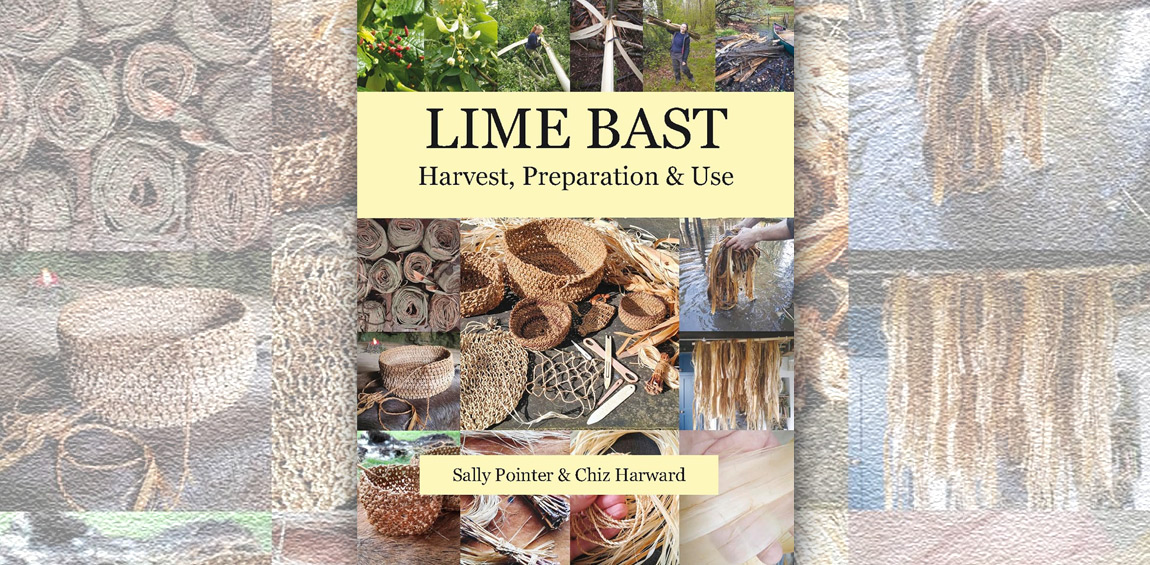
Sally Pointer; an EXARC member, heritage educator, craftswoman and archaeologist, has joined forces with Chiz Harward, woodland manager, craftsman and archaeologist, to write a book about lime bast and how to harvest and prepare it for use, with six projects to try out.
The book has eight chapters, which progress fluently from topic to topic, so that the basic information (such as what is bast and how it is different from bark) is handled first before getting any further. The book discusses shortly the archaeological use of bast, including Ötzi ’s (a natural Chalcolithic mummy found in the Ötztal Alps in 1991) gear made of bast. For a yarnie such as myself, the third chapter is the most mind-blowing part of the book. Weaving with lime bast, with examples of the Ainu textiles (who mainly used elm), and how to splice, knot and then spin lime bast into yarn fine enough to weave with it. A method of carding and then spinning lime bast with a spinning wheel is also introduced, but the authors remark that weaving with the carded yarn does require a separate warp for support. The fourth chapter introduces the care and uses of lime trees and progresses well to chapter five and the harvest of bast. There are a few recipes utilizing lime leaves, nectar and flowers, aside of the basswood and bast. The harvest chapter is rightfully very safety (for humans and the surrounding nature alike) and permission orientated, but it also has a very hands-on approach on how to harvest the lime bark for the best possible outcome. Chapter six continues directly from chapter five, by telling us what to do with your nicely harvested bundles of lime bark in order to end up with good quality lime bast you can start working with. It even gives options if retting in water is not possible. Chapter seven introduces other tree basts, such as oak, elm and willow, and how to best process them where the process is different from lime; it also explains why birch bark does not render bast.
Chapter eight covers almost half of the book and it includes the above-mentioned six projects and the techniques on how to work with your ready-to-work bast, starting from twisting or splicing some cordage. Used techniques include nalbinding, coiling, twining and netting. (If you counted five different project words, you are right; the sixth project is a thorn brush made with your just-finished cordage!) Some of the project photos are similar to Sally Pointer’s book “Nalbinding ” (Herbert Press, 2026), and the structure of the chapter follows the project chapters of the “Nalbinding ”-book, with tips and troubleshooting sections. The book finishes with a short glossary and an extensive bibliography.
Overall it is a very nice book, the paper is of good quality, the photos are well-thought-out, clear and well lighted, and there is good contrast between the cord and the background, and the hands demonstrating the work. Of course, occasionally photos taken in nature do require a second look to see what is pictured in them. Some of the technical introductions have contrasting coloured yarns to make the process clearer to understand. There is a different “furry assistant” compared to the above-mentioned “Nalbinding ”-book; equally cute but definitely missing its socks! Unfortunately, it does show in the layout, language, and all-round editorial choices, that the book has been made with a small team, but it does not bother the reading or learning experience. I find naming the core audience a little difficult: on the one hand it is very clearly a crafting book aimed at almost all periods of re-enactors and living history enthusiasts, without being too rigid about the historical significance, so it is well suited to all crafters looking to get into nature crafts. Simultaneously it shows quality research with traceable sources, which is usually not expected in crafting books, although in this age of AI-slop the traceability of information is a nice addition even for a crafter just looking to expand their skill set. With the recent trend towards nature crafts, there is a need for safe and considerate instructions on bark harvest and bast production, and Pointer’s and Harward’s book does fit well into that gap.
I, for one, cannot wait for next May to try my first bark harvest and make my own twined basket out of bast!
Book Information:
Sally Pointer & Chiz Harward. 2026. Lime Bast Harvest, Preparation & Use. 99 pages. Print on Demand by BookVAULT Publishing
ISBN 9781807389239