
The content is published under Creative Commons Attribution 4.0 International license (CC BY 4.0).
Reviewed Article:
Bog Bodies in Context
This paper presents bog bodies as storytellers contributing to the discussion based on current exhibitions in Northwest Europe. It is an attempt to do away with the reproduction of old knowledge and present the bog bodies in a wider context. By shifting the focus from the physical remains to the broader cultural and archaeological context, this didactic approach encourages visitors to engage with the past in a more immersive and reflective manner. This approach allows for a richer understanding of how Iron Age communities in the North Sea Zone interacted with their landscape, perceived life, death, and expressed their beliefs through rituals and everyday practices. The question is, therefore, whether it is time to move the narrative beyond the body, inviting the audience to explore the above.
Introduction
By scrutinising Iron Age dissemination in selected museums, authenticity and interpretation can be questioned. This paper offers a discussion on bog bodies with reference to current exhibitions in Northwest Europe. The bodies found in bogs are often presented as storytellers communicating a story of the early Iron Age and most often a sacrificial narrative of bodies given to the gods as the most valued gift. This paper questions if the present narratives is sometimes more speculative than factual and introduces alternative interpretations. The authors wish to address the existing interpretations in a critical light and introduce a hands-on exhibition form with a stronger focus on engagement and context than the actual body.
Staging the past includes didactic considerations and in the case of the bog bodies, ethical awareness. Case studies of bog bodies in Denmark, northern Germany, the Netherlands and England, show that bog bodies on display often act as protagonists telling a story of the early Iron Age. In this context, sacrifice is the narrative that governs the underlying principles. In the ongoing Ph.D. project ‘When Man becomes Material: Beliefs and practices in the Iron Age North Sea Zone’ Leila Joensson investigates violence before deposition in an interdisciplinary study incorporating history of religions, archaeology and phenomenology. Continental and insular case studies, including strangled bog bodies, indicate that the ‘Celtic’ and ‘Germanic’ communities may have shared similar belief systems. The reason for ending life may be associated with a belief system that includes death as a path to regeneration. Keeping in mind that as the bodies were buried deep down in the bog, several fastened to the bog bed or covered with stakes or stones, they were meant to stay there. A comparable site from Windover in Florida, USA, show 168 burials in a bog of presumably indigenous people of the Americas c. 6000-5000 BC (Van der Sanden, 1996, p.7). The corpses of men, women and children had been pinned to the bog bed with stakes. This do not indicate a direct resemblance to the bog bodies of the North Sea Zone of a much later date, but an interesting parallel, nevertheless.
As an alternative to the current exhibitions on bog bodies, archaeologist, Jannie Marie Christensen, includes the craftsmanship and everyday life of the Iron Age in a do-touch exhibition concept at Stenvad Mosebrug (Stenvad Peat Works, DK), where the museum visitor engages with the story of the Huldremose Woman, but without the actual body displayed in the museum. The history is brought to life in dialogue with the museum's own story about the bog as a resource through time. To get closer to the premises for including or not including bodies in the dissemination, we advocate a dissemination approach with a focus on context. First, let us present the bog body phenomenon briefly.
The Bog Body Phenomenon
The bog bodies of Northwest Europe were primarily found by accident during peat extraction in the 19th and 20th century, 1-2 m down in the bogs. The majority of the Danish bog bodies have been dated (Mannering, et al., 2010) to the La Tène and early Roman periods (500 BC – AD 200). They include females, males and children. A more recent study of the bog body phenomenon in north European mires concludes that the peak starts in the Late Bronze Age and continues into the early Middle Ages, thus confirming a long-term tradition of burying bodies in bogs (Van Beek, et al. 2023, p.136). In Denmark there is an even distribution of both sexes and a few children. In other parts of Europe, males prevail. As mentioned previously, several of the bog bodies had been secured to the bog bed with tapered branches. A most likely explanation is that the branches were used to keep the bodies down so as not to float to the surface, but why were they inhumed in bogs, when cremation is supposed to be the norm on the continent, as seen in the great urn field cemeteries –Insular archaeology shows pit burials, excarnation and inhumation practices for example on the British Isles. According to Mannering et al. (2010) and Ravn (2011), bog burials of the early Iron Age can be regarded as a burial practice supplementing the more common burial practice for this period. This argument does not support the ‘sacrifice’ theory, which has been dominant in the bog body research since the 1960s.
Archaeological data from case studies of the North Sea zone presents a range of bodies and objects that were destroyed before deposition (Aldhouse-Green, 2015; Bradley, 2017). Initial results of the Ph.D. project suggest that the mystery of the bog bodies is taking a turn towards the need for ontological fluidity to interpret the beliefs and practices of the Iron Age communities. In the present discussion, case studies involve bog bodies on display at museums acting as storytellers of the past, it is possible that the current narrative should not be trusted.
The story of the bog bodies is tied to landscapes and wetlands, primarily in northwestern Europe due to the high distribution of raised bogs (Aldhouse-Green, 2015; Bradley, 2017; Giles, 2020; Glob, 1965; Joensson, 2021, p.23; Mannering, et al., 2010; Turner and Scaife, 1995; Van der Sanden, 1996; Van Beek, et al., 2023). The chemistry of the raised bogs provides good preservation conditions in acidic water for human soft tissue, animal skin and woollen textiles. Bodies from chalk-rich low bogs primarily show preserved bones but also metal parts. This is not the case for raised bogs, as the acidic water would dissolve metal and bones. As the preservation of the bog bodies depends on the chemistry of the bogs, there is good reason in including skeletons and other remains of bodies in the bog body data as presented in the OSM1-2 database by Van Beek et al. (2023). Bog bodies are not recorded in French archaeological data (Joensson, 2021; Van Beek, et al., 2023) and seldom recorded in southern Europe. In Bavaria, southern Germany, only two bog bodies have been recorded (Eisenbeiss, 2016).
Bog Bodies in Context
Within the last 5-10 years a 'best practice approach' in bog body research has been introduced (Chapman, Van Beek and Gearey, 2019; Van Beek, Candel, et al. 2019; Van Beek, Quick, et al., 2023), which addresses the wider context of the bog bodies, but seems to underrate the principles of the ritual practice. In this light, there is fertile ground for greater reflection on the exhibition and dissemination of bog bodies in context. The ethical discussion is further enriched, when applying ontological fluidity to the idea of sacrifice. By questioning whether the Iron Age people differentiated value in man, animal and material, animate or inanimate new perspectives emerge. Perhaps the Iron Age people perceived all as infused with a potent power, an agent with its own purpose as seen in other parts of the world (Silar, 2009; Bray, 2009). To take this a step further, what if, when the ‘purpose of existence’ was over, people and material were given back to the universum, the bog, where contact with the gods was possible and a rebirth could take place (See Figure 1). An idea that was suggested in the preliminary study of the Ph.D.- project (Joensson, 2021).
Looking at a lake or bog surface, it is understandable why Iron Age people perceived it as something special, a gate to the Otherworld (Kaul, 2003). In the bog and the lake's mirror, nature is reflected 'upside down'. This understanding of another world, where everything is reversed but just like the 'known' world, is prominent in the ancient Siberian hunters' understanding of the world (Willerslev, 2007) and may well have been so with the Iron Age societies of the North Sea Zone.
The aim of this paper is to advocate for a ‘best practice’ dissemination with a strong focus on context. In the following, two cases of dissemination are presented as comparative examples. The cases show pro et contra concerning the communication on the Iron Age through bog bodies with or without the body.
Ethics and Bodies on Display
When modern museums choose to exhibit mummified corpses or skeletons, from the Iron Age and other periods, there should be no doubt that ethics and wider context are paramount. What the dead represent is a lived life. In the book Tollund Man: Gift to the Gods , Christian Fischer (2012), the former museum director of Silkeborg Museum (DK), gives an account of the preparations for the exhibition of the Tollund Man, the hanged Iron Age bog body found in Bjældskovdal near Silkeborg (DK) in 1950. The museum audience had previously only been able to admire the well-preserved head of the bog body and had inquired about the 'rest of the man', which was only partially preserved and spread out over different locations. The museum set out to collect the remains of Tollund Man from the departments of conservation at the National Museum of Denmark, the Normal-Anatomical Institute (DK) and Moesgaard Museum (DK) (Fischer, 2012). After “many sleepless nights” as Fischer (2012, p.105) explains, with thoughts on how the museum could set up the exhibition, it was decided to reconstruct the body in wax and include the well-preserved authentic head. The reconstruction was performed by the Natural History Museum of Denmark to preserve the dried body parts for future research. However, a preserved foot, a big toe and a thumb can be seen at Silkeborg Museum (DK) today.
It was the reception of the audience that was to define the future of the Tollund Man as the ancient materiality on display with such a success that museum visitors still flock to the experience. In addition, it must be said that Denmark has several mummified bog bodies on display, including the Haraldskær Woman Vejle Kulturmuseet (The Cultural Museum of Vejle, DK) the Elling Woman (Silkeborg Museum, DK), the Huldremose Woman (The National Museum of Denmark) and the Grauballe Man (Moesgaard Museum, DK). The first and second bodies are attested as strangled, the third body has a string around the neck, and the fourth body had their throat cut.
False Narratives
Compared to other museums' exhibitions of bog bodies, for example: Yde Girl (Drents Museum, NL), Lindow Man (British Museum, UK), Old Croghan Man (National Museum of Ireland) and Windeby I (Schloss Gottorf, D), the exhibition of the Tollund Man is a special case. The room in which the Tollund Man is exhibited has walls decorated with large photos of sphagnum indicating the bog environment. In the middle of the room the reconstructed body of the Tollund Man is displayed in a transparent perspex box. Though his, and other bog bodies’ eyes are closed, reconstructions of the bog bodies' faces (Tollund Man, Yde Girl, Windeby I, Lindow Man) have been reconstructed with open blue eyes, without knowing if this is accurate. By making a reconstruction with blue eyes, the narrative takes a very Scandinavian approach (Fig.1). Mendel’s genetic studies of the 19th century confirm that brown eyes are the phenotypical expression of a gene that dominates the recessive blue allele and usually stems from the southern populations. DNA studies (Allentoft, et al., 2015; McColl, et al., 2025) support the theory of steppe ancestry in western Eurasia. If any of the bog bodies presented had ancestors from further south (‘Celtic’ areas’) they most probably would have had brown eyes, although attested by the Romans and Greeks as having blue eyes (Waldhauser, 2001, p.20). DNA tests of the Tollund Man were performed in 2013 but failed, and strontium analyses so far has only shown that the Tollund Man had probably stayed in Jutland, Denmark for the last 10 years prior to his death and in Silkeborg area for only the last four months of his life (Silkeborg Museum, 2026b) yet the reconstruction of his face show bright blue eyes. (See Figure 2)
Bog Bodies as Storytellers
When museums curate bodies as storytellers in the historical and archaeological dissemination, a position on ethical and aesthetic principles is necessary. One matter is the material, in this case the body on display. Context is likewise important. It is the story of the body, its lived life and its (disturbed) resting place in the bog.
Since Glob's book about The Bog People (1965), interpretations have revolved around sacrifice to the gods in the Otherworld. The fact that the Iron Age people believed in a parallel world is not difficult to reconcile with, when considering the grave goods that most often accompany burial rituals, including cremation graves (Foss and Møller, 2015). Grave goods are rarely discussed in connection with bog bodies, however, there are several examples of personal equipment, for example woollen textiles, shoes, beads, combs etcetera. found in the company of bog bodies (Mannering, et al,. 2010; Mannering, 2017; 2024) and with the remains of bog bodies for example the Huldremose Woman, which we shall elaborate on below.
Progress in natural sciences has led to further knowledge and insights concerning the bog bodies within the last 20 years (Chapman, Van Beek and Gearey, 2019; Fischer, 2012; Frei, et al,. 2015; Frei, 2018; Giles, 2020; Gill-Robinson, 2005; Nielsen, 2018; Van Beek, Candel, et al., 2019; Van Beek, Quick, et al.,2023; Van der Plicht, et al,. 2004) including more reliable dating methods than typological chronologies (Glob, 1965). Strontium isotope analysis of textiles, hair and teeth can tell where the person grew up and where they have lived, yet not all bog bodies have been subject to scientific studies beyond the anthropologist's or forensic pathologist's examination of the body. The ‘Dutch’ bog body (Yde Girl) has not had DNA or strontium isotope tests performed, even though she was found with long hair that could reveal information on the Woman's lived life, which was relatively short. According to studies, the Yde Girl was 17 years old when she died. However, it is worth stressing that a detailed contextual approach, a 'best practice approach' (Chapman, Van Beek and Gearey, 2019; Van Beek, et al., 2019) through interdisciplinary collaboration has contributed to a greater understanding of the Yde Girl's life and cultural environment. The question is if the narrative linked to the Yde Girl is correct, when scientific methods are missing in the context. The story of the Yde Girl and her time can still reveal new details as for why, she was inhumed in an old peat cutting and if she was local.
Thus, it is the extent of scientific methods, including anthropological studies and an in-depth analysis of the wider context of the given bog body, that can tell us about the person once placed in the bog. Marks on skin and bones and a noose around the neck can contribute to the story of the dead person. The bodies can be treated as material because they are material (Sofaer, 2006) - an object that once was alive. Yet some kind of agency seems to follow the bodies of the bogs regardless of time and space. As has been the case especially in the last few years, the debate concerning exhibition of skeletons and mummified bodies (Alberti, et al., 2009) comes to mind. In Denmark, a recent public survey from Silkeborg Museum (Silkeborg Museum, 2026a) clearly supports the exhibition of human remains.
Huldremose Woman (DK) – Storytelling without a Body
A body was found during peat digging at Huldremose near Stenvad (Denmark) in 1879 first believed to be the body of a person missing from a few years earlier (See Figure 3). The well-preserved and well-dressed woman was quickly reburied and her clothes washed while searching for her relatives. Due to the style of her clothes the National Museum of Denmark was contacted, and they collected the body and clothes, which is exhibited at the National Museum of Denmark today. Textile with the body (sample AAR-11675) is dated to 350-41 cal. BC (Mannering, Gleba, et al. 2009; Mannering, Possnert, et al.,2010; Mannering, 2017, p.119). Even though the body being absent at Stenvad Peat Works ( Stenvad Mosebrug, DK) the knowledge of the Huldremose Woman is alive and is an integral part of the local heritage and identity of the community. Therefore, a new exhibition on the Huldremose Woman, her clothing and her story was created but without the body was developed by archaeologist, Jannie Christensen, for the Stenvad Peat Works in 2025. The exhibition is in an open and light environment divided into eight interconnected areas. These areas all displayed different pictures taken of the body and facts about her life, death, and discovery, the bog and the natural preservation, but also facts about her clothes and reconstructions made by local volunteers. Moreover, the exhibition has a floor display case built into the floor (See Figure 4, left) presenting a reconstruction of the Huldremose Woman and how she was found. The reconstructed body is made from wire, newspaper, a wig, and dressed in reconstructed clothes made by the volunteers. In addition to this, the exhibition presents hands-on reconstructions of her clothes that visitors can try on and a floor outline illustrating how the Huldremose Woman was found. The visitors can lie down in the outline wearing the reconstructed clothing (See Figure 4, right). Moreover, there are looms and spinning tools available for hands-on use, and microscopes for examining materials from the bog.
The Haraldskaer Woman (DK) – Storytelling with a Body
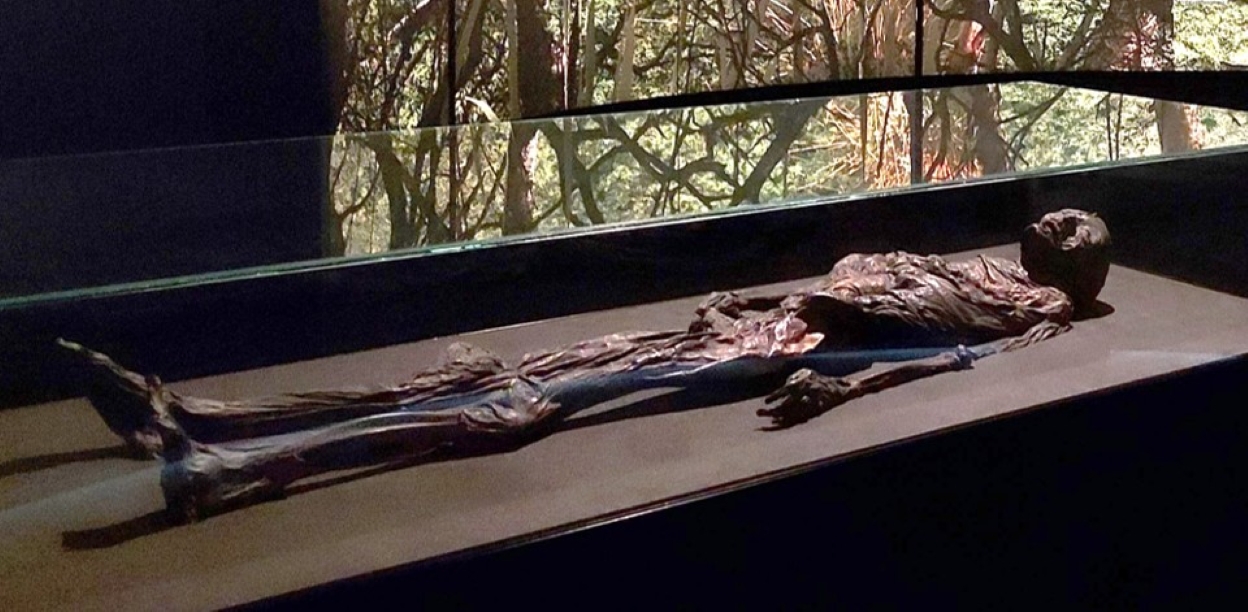
The body of a woman was found in 1835 in a bog on the Haraldskær estate in Vejle area and named the Haraldskaer Woman (See Figure 5). At first it was interpretated as the remains of ‘Queen Gunhild’ of the Viking Age, believed to be the wife of Eric Bloodaxe. The most recent radiocarbon result dates the body to late pre-Roman Iron Age approx. 247-17 cal. BC (Ravn, 2023). The Haraldskaer Woman was previously exhibited in St. Nicolai’s Church ( Vejle, DK) and is now on loan to the Cultural Museum of Vejle ( Vejle Kulturmuseet, DK). The bog body is displayed in a solitary room, but first the visitor must walk through a child-friendly exhibition on the Viking Age, retold in modern comic book form. The audience is led in a spiral-like corridor to the body of the woman, who is lying naked on her back in a glass case. Information texts on a background of bog landscape follow the visitor through the corridor to the solitary room. Artefacts found next to the body are on display. The experience is optional as it is not part of the general exhibition on finds from the Iron Age (the context). Although Lone Hvass, former archaeologist at the Cultural Museum of Vejle ( Vejle Kulturmuseeet, DK), advocated against separating bog bodies from their context in the interpretation (Hvass, 1998), the exhibition lacks coherence. This may be because, unlike the exhibition at Silkeborg Museum, the visitor at the Cultural Museum of Vejle ( Vejle Kulturmuseet, DK) does not encounter the collection of pre-Roman Iron Age artefacts until after seeing the bog body of the Haraldskaer Woman. Instead, the visitor is informed about the much later wars in the 17 th century ’War Chaos and Survival’, ‘Nightlife’ in the 90’s and an exhibition on the Second World War ‘During the War’ prior to meeting the bog body of the pre-Roman Iron Age. The space used for temporary exhibitions prior to meeting the Haraldskaer Woman makes the body appear separated from its context and the communication on the archaeological chronology seems confusing. If the exhibition’s chronology is from modern (start) to prehistory (end), this should be further stressed at the entrance.
The Haraldskaer Woman has a face without teeth (taken or fallen out) and hair (cut or fallen off). Despite being dried up and somewhat smaller than she would have been in the Iron Age, the body is intact. The body shows clear furrows on the neck indicating the cause of death was strangulation and marks from tight hooks on knees and elbows from securing the body to the bog bed (See Figure 6)
The museum's learning programme for primary school offers dissemination as a ‘Role-play game based on the knowledge we have about the Haraldskær Woman’ ( Vejle Museerne, 2025). In the role play, the woman is interpreted to have been a 'Völva' (Old Norse term for a North Germanic seeress) sacrificed to the gods as the greatest sacrifice. There is no scientific or archaeological evidence for this interpretation, other than the fact that the Haraldskaer Woman was killed and secured to the bog bed, like several other bog bodies in Northwest Europe. If it had been a sacrifice, was it the greatest sacrifice to offer a human being? Our errand is to question this kind of communication that easily can lead to misinformation and be a factoid.
Concluding Remarks
The museums that have chosen to exhibit bog bodies (Silkeborg Museum, DK, Drents Museum, NL, The British Museum, UK, Schloss Gottorf, D, The National Museum of Ireland, IRE) all present their bog bodies differently (Giles, 2020), but the purpose is the same; they act as storytellers. The bog bodies chosen from the archive for exhibition all have a face, some better preserved than others and are relatively intact, even the Grauballe Man (exhibited at Moesgaard Museum, DK) with a severe cut to the throat. In 2026, it can be discussed whether reconstructed faces with open eyes (but whose correctness and eye colour may not be reliable) are outdated. The question of whether we need to exhibit human remains to understand the Iron Age people and their wider context is an ongoing discussion (Alberti, et al., 2009). In our technological age there are multiple methods to engage museum visitors, for example augmented reality with interactive options and digital solutions or hands-on performance. The example of the reconstructed Tollund Man indicates that the audience is not fixed on authenticity alone. What the audience seems to be most concerned about is to understand the past – being a part of the narrative as exemplified in the exhibition of the Huldremose Woman at the Stenvad Peat Works.
The example of the Huldremose Woman exhibition shows that it is possible to tell the story of the Iron Age bog body with a strong focus on the context and visitor engagement - without the body. The example of the Haraldskaer Woman exhibition shows the fascinating bog body with marks that can reveal a story, but also how dissemination can get muddled up in current research and old ideas of ‘Queen Gunhild’ of the Viking Age, as the Haraldskaer Woman was believed to be.
Acknowledgements
We would like to thank the following for interesting discussions and constructive feedback: Christian Fischer (†), Charlotta Lindblom and Louise Felding (The Cultural Museum of Vejle, DK), Andrew Lamb (The University of Edinburgh, UK), Irini Biezeveld (Drents Museum, NL) and Stenvad Peat Works.
Keywords
Country
- Denmark
- the Netherlands
- United Kingdom
Bibliography
Alberti, S. J. M. M., Bienkowski, P., Chapman, M. J. and Drew, R., 2009. Should we display the dead?, Museum and Society, 7(3), pp.133-149.
Aldhouse-Green, M., 2015. Bog Bodies Uncovered: solving Europe´s ancient mystery. London: Thames & Hudson.
Allentoft, M., Sikora, M, Sjögren, K.G, Rasmussen S., Rasmussen, M, Stenderup, J., Damgaard, P.B., Schroeder, H., Ahlström, T., Vinner, L., Malaspinas, A.S., Margaryan A., Higham, T., Chivall, D., Lynnerup, N., Harvig, L., Baron, J. Della Casa, P., Dąbrowski, P., Duffy, P.R., Ebel, A.V., Epimakhov, A., Frei, K.M., Furmanek, M., Gralak, T., Gromov, A., Gronkiewicz S., Grupe, G. Hajdu, T., Jarysz R., Khartanovich, V., Khokhlov, A., Kiss, V., Kolář, J., Kriiska, A. Lasak, I., Longhi, C., McGlynn, G., Merkevicius, A., Merkyte, I., Metspalu, M., Mkrtchyan, R.,Moiseyev, V., Paja, L., Pálfi, G., Pokutta, D., Pospieszny, L., Price, D.T., Saag, L., Sablin, M., Shishlina, N., Smrčka, V., Soenov, V.I., Szeverényi, V., Tóth, G., Trifanova, S.V., Varul, L., Vicze, M., Yepiskoposyan, L., Zhitenev V., Orlando, L., Sicheritz-Pontén, T., Brunak, S. Nielsen, R. Kristiansen, K., Willerslev, E. 2015. ’Population genomics of Bronze Age Eurasia’. Nature, Vol. 522, pp.167-171
Bradley, R., 2017. A Geography of Offerings: Deposits of Valuables in the Landscapes of Ancient Europe. Oxford: Oxbow Books.
Bray, T., 2009. An Archaeological Perspective on the Andean Concept of Camaquen: Thinking Through Late Pre-Columbian Ofrendas and Huacas, Animating Archaeology: of Subjects, Objects and Alternative Ontologies. Cambridge Archaeological Journal, 19(3), pp.357–366.
Chapman, H. P., Van Beek, R., Gearey, B., 2019. Bog Bodies in Context: Developing a Best Practice Approach. European Journal of Archaeology, Cambridge.
Eisenbeiss, S., 2016.Preserved in Peat: Decoding Bog Bodies from Lower Saxony, Germany, Expedition, 58(2), pp.19-23.
Fischer, C., 2012. Tollund Man: Gift to the Gods. Translated from Danish by D.E. Robinson and A B. Jørgensen. Gloucestershire: History Press.
Foss, P. and Algreen Møller, N., eds., 2015. The Landscape of the Dead: Burial and practices in the early Iron Age in Denmark. Archaeological Writings 13. Report from a colloquium in Ribe 2013. Society for Archaeological Studies, Saxo Institute, University of Copenhagen.
Frei, K. M., Mannering, U., Douglas Price, T., and Birch Iversen, R., 2015. Strontium isotope investigations of the Haraldskær Woman – a complex record of various tissues, ArcheoSciences, 39, pp.93-101.
Frei, K.M., 2018. Egtvedpigens rejse. Lindhardt og Ringhof: København
Giles, M., 2020. Bog bodies: face to face with your past. Manchester: Manchester University Press.
Gill-Robinson, H. C., 2005. The Iron Age Bog Bodies of the Archaeologisches Landesmuseum, Schloss Gottorf, Schleswig, Germany. Ph.D. dissertation, Department of Anthropology, University of Manitoba.
Glob, P.V., 1965. Mosefolket: jernalderens mennesker bevaret i 2000 år. København: Gyldendals.
Hvass, L., 1998. Dronning Gunhild - et moselig fra jernalderen. København: Sesam.
Joensson, L. 2021. The strangled bog bodies: Interpretation of religious beliefs and practices in Iron Age north-west Europe. MA dissertation, Bangor University < https://univie.academia.edu/LeilaJoensson >
Kaul, F., 2003. Mosen: Porten til den anden verden, in L. Jørgensen, B. Storgaard and L. Thomsen Gebauer, eds. Sejrens Triumf: Norden i skyggen af det romerske imperie. København: Nationalmuseet, pp.18-43.
Mannering, U., Gleba, M, Possnert, G. and Heinemeier, J., 2009. Om datering af mosefundne lig og beklædningsdele, KUML, pp.103-125.
Mannering, U., Possnert G., Heinemeier J. and Gleba, M., 2010. Dating Danish textiles and skins from bog finds by means of 14C AMS, Journal of Archaeological Science, 37, pp.261–268.
Mannering, U., ed., 2017. Arkæologisk Tekstilforskning: Baggrund og ny viden. København: National Museum of Denmark.
Mannering, U., 2024. Tøj og tekstil i Danmarks oldtid. Aarhus: Turbine.
McColl, H., Kroonen, G., Moreno-Mayar, J.V., Seersholm, F.V., Scorrano, G. Pinotti, T, Vimala, T., Sindbæk, S.M., Ethelberg, P., Fyfe, F., Gaillard, M.J., Larsen, H.M.E., Mortensen, M.F., Demeter, F., Jørkov, M.L.S., Bergerbrant, S., Damgaard, P.D.B., Allentoft, M.E., Vinner, L., Gaunitz, C., Ramsøe, A., Altinkaya, I., Henriksen, R.A., Irving-Pease, E.K., Sabatini, S., Fischer, A., Barrie, W., Ingason, A., Rosengren, A.,Vaughn, A., Cao, J., Staring, J., Stenderup, J. Yediay, F.E., Ahlström, T., Albris, S.L., Atabiev, B., Bangsgaard, P., Belcastro, M.G., Card, N., Charlier, P., Chernykh, E., Christiansen, T.T., Coppa, A., Coster, M.D., Denham, S.D., Desenne, S., Downes, J., Frei, K.M., Gábor, O., Gårdsvoll, J.Z., Glørstad, Z.T., Hansen, J., Heeren, S., Henriksen, M., Heyd, V., Høj, M., Holst, M.K., Jankauskas, R., Janson, H., Jessen, M.D., Johannsen, J.W., Johansen, T., Kastholm, O. T., Kern, A., Khaskhanov, R., Kjær, K., Kolosov, V., Kootker, L.M., Larsen, A.C., Lejars, T., Løvschal, M., Lynnerup, N., Magnusson, Y., Mannermaa, C., Masyakin, V., Melheim, A.L., Merkyte, I., Moiseyev, V., Møller, S.T., Molnár, E., Mortensen, N., Murphy, E., Nielsen, B.H., Pany-Kucera, D., Paulsson, B.S., Ponce de León, M.S., Reiersen, H., Reinhard, W., Sajantila, A., Skar, B., Slavchev, V., Smrčka, V., Sørensen, L., Tiefengraber, G., Uldum, O.C., Vega, J., Vitali, D., Voloshinov, A., Wåhlin, S., Wendling, H., Wessman, A., Wilhelmson, H., Wiltschke, K., Zilhao, J., Zollikofer, C.P.E., Korneliussen, T.S., Chaume, B., Demoule, J.P., Werge, T., Olsen, L., Nielsen, R., Hedeager, L., Kristiansen, K., Sikora, M., Willerslev, E. 2024. ‘Steppe Ancestry in Western Eurasia and the Spread of the Germanic Languages’ Pre-print in BioRxiv. doi: https://doi.org/10.1101/2024.03.13.584607
Nielsen, H. N., 2018. Diet and Radiocarbon Dating of Tollund Man: New Analyses of an Iron Age Bog Body from Denmark. Radiocarbon, 60(5), pp.1533–1545.
Ravn, M. 2011. ‘Bog bodies – a burial practice during the Early Iron Age?’ in L. Boye (ed), The Iron Age on Zealand. Status and Perspectives. Det Kongelige Nordiske Oldskriftselskab, København, Nordiske Fortidsminder, serie C, vol. 8, pp. 221-227.
Ravn, M., 2023. Haraldskær Woman under a new light: Bog bodies, martial rituals and value, in M. J. Walsh, S. O’Neill and L. Sørensen, eds., In the Darkest of Days: Exploring Human Sacrifice and Value in Southern Scandinavian Prehistory. Oxford: Oxbow Books.
Sillar, B., 2009. The Social Agency of Things? Animism and Materiality in the Andes, Animating Archaeology: of Subjects, Objects and Alternative Ontologies. Cambridge Archaeological Journal, 19(3).
Silkeborg Museum, 2026a. [online] Available at: < https://www.museumsilkeborg.dk/nyheder-visningsside?Action=1&NewsId=1399&M=NewsV2&PID=148 > [Accessed 11 July 2026]
Silkeborg Museum, 2026b. [online] Available at: < https://www.museumsilkeborg.dk/nyheder-visningsside?M=NewsV2&PID=148&NewsID=605 > [Accessed 11 July 2026]
Sofaer, J., 2006. The Body as Material Culture. A Theoretical Osteoarchaeology. Cambridge: Cambridge University Press
Turner, R. C. and Scaife, R. G., eds., 1995. Bog Bodies: New Discoveries and New Perspectives. London: British Museum Press
Van Beek, R., Candel, J. H. J., Quick, C., Bos, J. A. A., Gouw-Bouman M. T. I. J., Makaske, B. and Maas G. J., 2019. The landscape setting of bog bodies: Interdisciplinary research into the site location of Yde Girl, The Netherlands. The Holocene, 29(7), pp.1206 –1222.
Van Beek, R., Quick, C., Bergerbrants, S., Huisman, F. and Kamas, P., 2023. Bogs, bones and bodies: the deposition of human remains in northern European mires (9000 BC–AD 1900). Antiquity, 97, pp.120–140.
Van der Plicht, J., Van der Sanden, W.A.B., Aerts, A.T. and Streurman, H. J., 2004. Dating bog bodies by means of 14C-AMS. Journal of Archaeological Science, 31, pp.471–491.
Van der Sanden, W.A.B. 1996. Through nature to eternity: The bog bodies of northwest Europe. Amsterdam: Batavian Lion International.
Vejle Museums, 2025. [online] Available at: < https://www.vejlemuseerne.dk/undervisning/vingsted-jernalder/skoleforloeb-i-vingsted/voelven-varga-ofringen/ > [Accessed 11 July 2026]
Waldhauser, J. 2001. Encyklopedie Keltů v Čechách, Praha: Libri.
Willerslev, R., 2007. Soul Hunters. California: University of California Press