
The content is published under Creative Commons Attribution 4.0 International license (CC BY 4.0).
Reviewed Article:
Shooting Mice. The Solenarion and its use in the Armies of Byzantium
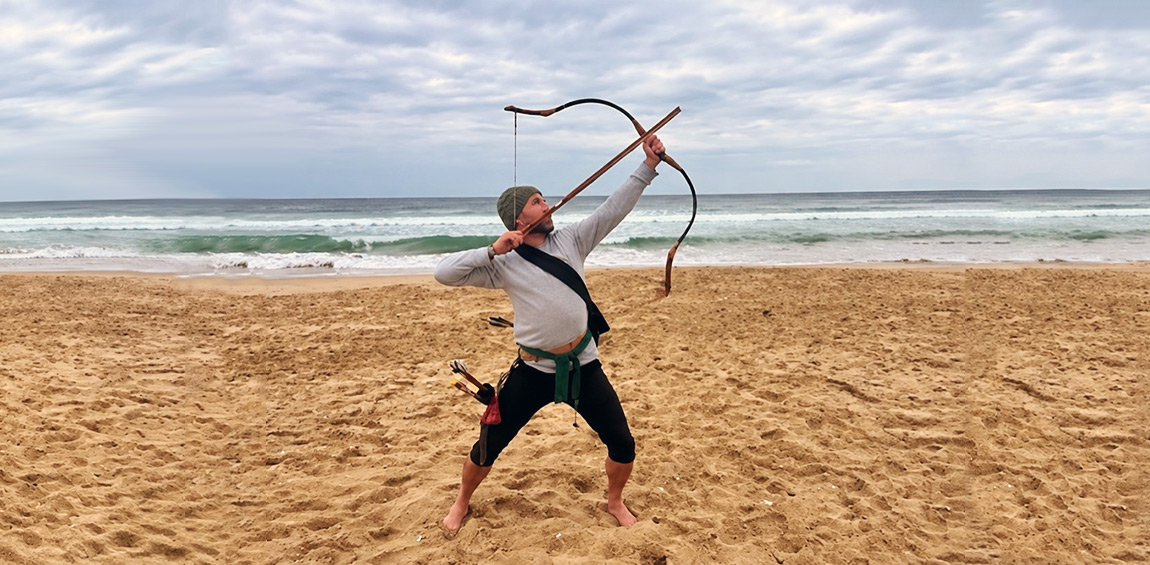
Byzantine literary sources from the sixth to the tenth century mention the effectiveness of the solenarion, and arrow-guide used by Byzantine archers. This paper presents of the effectiveness of the solenarion on the battlefield by comparing the literary accounts with the results of experimental archaeology. The study examines the range capabilities and the velocity of period heavy war arrows to that of the ‘mouse’ arrows shot from the solenarion arrow guide. The study allows for a better understanding of the solenarion and its use in Byzantine warfare.
Introduction
The term solenarion (σωληνάριον) appears in several Byzantine literary sources from the sixth to tenth centuries AD (Maurice. Strategikon ., 12.2.5; Leo. Tactica, 6.22 ; Anon., Sylloge Tacticorum, 38.8-10). It is a piece of military equipment associated with archers. It was previously thought to denote a crossbow, but has since been identified as an arrow-guide (Haldon, 1970, pp.155-157; Dennis, 1981, pp.1-5). It is a simply an archery tool that served as an overdraw device allowing archers to shoot much shorter arrows than their bows would normally allow. According to literary sources, discussed in greater detail below, these shorter arrows or darts could be shot at greater distances and at higher velocities than the standard arrows (Maurice, Strat. 12.2.5; Leo. Tact. 6.22; Anon. Syll. Tact. 38.8-10; Faris and Elmer, 1945, s. XLIII pp.124-131).
These arrow-guides were by no means exclusive to Byzantium, but saw popular use throughout North Africa, the Middle East, India, and as far east as Korea and China. In Arabia the arrow-guide was called majrā, and in Iran the nāvak, while in Korea it was known as the tong-ah and in Imperial China as the tong jian (Nishimura, 1988, p.425; Harmon, 2017, pp.5-6; Dwyer 2023, pp.205-220). Its earliest mention dates to the sixth century AD and its use survived well into the 19th century AD (Maurice. Strat. 12.2.5; Dwyer 2023, pp.211). The fact that it was attested in Byzantine military manuals from the sixth to the tenth centuries AD (its use likely stretched beyond the tenth century) testifies to the arrow-guides effectiveness and abilities. Its widespread use by a variety of different cultures across a broad geographical area further speaks volumes for its effectiveness in warfare.
Despite of this, no study, to my knowledge, has examined the battle effectiveness of the solenarion. This research study is to examine, though the use of experimental archaeology, the effectiveness of the arrow-guide in Byzantine warfare and comparing the results to the literary text.
- First, the research will examine at what velocity the shorter arrows could be shot compared to the standard war arrows.
- Secondly, the research paper will examine how far the solenarion could shoot these shorter arrows compared to standard war arrows.
The Byzantine Sources
The earliest mention of an arrow-guide comes from the sixth century Byzantine military manual, the Strategikon (Στρατηγικόν), attributed to the soldier-emperor Maurice (582–602 AD). Book 12 of the manual dedicates a small section to the arms and armour of the light infantry:
They (the light infantry) should carry bows on their shoulders with large quivers holding about thirty or forty arrows. They should have small shields, as well as a wooden solenaria with short arrows in small quivers. These can be fired a great distance with the bows and cause harm to the enemy (Maurice, Strat. 12.2.5).
The solenarion next appears somewhat later in the early tenth century Taktika (Τακτικά), the Byzantine military manual of the emperor Leo VI the Wise (886-912 AD). Drawing very closely from the Strategikon, a section is dedicated to the arms of the light infantry:
They (the light infantry) should carry bows on their shoulders with large quivers holding up to thirty or forty arrows. Also grooved wooden tubes (solenaria) with short arrows in small quivers, that can be fired a great distance with the bows, and which cannot be used by the enemy (Leo. Tact. 6.22).
There is also a reference to the solenarion from the mid-tenth century anonymous Sylloge Tacticorum, yet another Byzantine military manual. Out of the three manuals, the Sylloge’s description is the most detailed:
The manner in which the equipment of the so-called light [infantry] should be made is the following: they should hang bows and quiver cases, which can each fit thirty or forty arrows, from their shoulders. They should also each have two bow-strings and small wooden tubes (solenaria) with small arrows and bows. Some call these kinds of small arrows menas (μένας). These missiles [are] useful during the battle, since they are discharged from the bows at a great distance and, because they are invisible to the enemy due to their small size, they thus kill very suddenly. Besides, these missiles [are] also useful because they are unusable by the enemy due to ignorance (Anon. Syll. Tact. 38.8-10).
Lastly, there is the Ambrosiana paraphrase of the Strategikon compiled in around 959 AD:
pieces of wood hollowed out to the same size as the arrows, fashioned like a reed cut in two down the middle. They (the light infantry) are to use these to fire arrows of the type called ‘mice’, which can be shot from the bows to a great distance (Basilio Parakimomenos, Dagli anni di Basilio Parakimomenos, Codex Ambrosianus. B 119 sup.)
The Arrow-Guide & Its Arrows
The Solenarion
While the Byzantine sources do not go into much detail about the solenarion, we do however have later Islamic archery manuals that provide more detailed descriptions such as the 14th century Saracen Archery (trans. Latham and Paterson, 1970) and the 15th century Arab Archery (trans. Faris and Elmer, 1945). The arrow-guide or solenarion mentioned in the sources above was essentially a wooden stave with a channel cut into it or a piece of bamboo split down the middle to act as the channel for an arrow. They were roughly the same length as the standard arrow of the archer (See Figure 1). It is used in conjunction with the bow by placing the guide horizontally on the bow shaft (See Figure 2). The smaller arrow would be placed in the groove of the hollowed-out shaft and then nocked onto the bowstring (See Figure 3). The arrow-guide was attached to the drawing hand with a loop and when the archer draws the bow and releases the string, the string runs along the arrow-guide, pushing the small arrow along the groove until is shoots out of the guide at a high velocity.
In Eastern Asia, the arrow-guide tended to be made from bamboo while those in the middle east and the Mediterranean tended to be made of wood as noted in the above-mentioned Byzantine sources. Arab Archery (Faris and Elmer, 1945, p.125) advocates for “hard, seasoned wood, free from moisture in order to avoid warping and contortion”. While no solenarion from a Byzantine context survived the ravages of time, we have surviving examples from areas of Pakistan and Indian dating back to the 18th century that fit the description of both the Byzantine and Islamic literary descriptions (Dwyer, 2023, p.211). Despite its long history of use across diverse martial cultures, its form and function remained largely the same, with the main difference being the materials used, such as hardwood in the West and bamboo in East Asia.
Mice Arrows
The small arrows or darts shot from the arrow-guide were called husbān (hailstone) in the Saracen Archery and in Arab Archery manuals while the Persian sources refer to them as the tīr-e nāvak (Dwyer, 2023, p.206). As noted above, the Sylloge Tacticorum refer to the small arrows as menas (μένας). Dennis (1981, p.4) argues that this was a scribal error, and that the copier was meant to copy down μύας or μύιας, meaning ‘mice’ or ‘flies’, instead of μένας (menas) which is a nonsensical word. The tenth century Ambrosian (Basilio Parakimomenos, Dagli anni, cod. Ambros. B 119 sup.) paraphrase above supports this theory by stating that the light infantry “are to use these to fire arrows of the type called ‘mice’, which can be shot from the bows to a great distance”. Furthermore, the seventh century physician, Paul of Aegina (Heiberg, 1924, p.129), in his section on treatment of arrow wounds refer to small arrows called ‘mice’ (μυωτά) that were used by the Egyptians. There is also a reference in Constantine VII’s Book on Ceremonies (Moffatt and Tall, 2012, pp.670, 676) that mentions ‘mice’ arrows as part of the supplies for the Cretan expedition of 949 AD.
The Byzantine sources do not elaborate on the ‘mice’ arrows but Arab Archery (Faris and Elmer, 1945, s.XLIII, p.129) states that the husbān arrow used in context of war ranged between 34 – 46 cm in length: “Those suitable for warfare should not exceed two spans (just under 46 cm) in length including the arrowhead and should not be shorter than one and a half spans (just over 34 cm)” (see also Latham and Paterson, 1970 p.149). It is interesting to note that the Korean pyeonjeon dart shot from the tong-ah arrow-guide is 45 cm long (Elmy, 1979, pp.9-10). Based on these facts we can assume that the Byzantine ‘mice’ were of a similar length.
The bow used by the Byzantines was the composite type comprised of three different materials: horn, sinew, and wood. These bows are creative and complex in design, where the various materials were shaped and glued together in a process which took a long time to complete. The wood, which would be non-resinous to allow for the glue to take well, formed the core of the bow. The sinew was glued onto the back of the bow (the part facing away from the archer when drawing the bow) while the horn was glued onto the belly (the part facing towards the archer when drawing the bow) (See Figure 4). The glue which held everything together was usually made from boiled fish parts or boiled hide. The combination allowed for a balance of tensile and compressive strength. When the bow is drawn, the sinew stretches while the horn compresses, allowing the bow limbs to store an immense amount of energy. This energy is then transferred to the arrow upon release, allowing the arrow to be shot with great force and speed.
A very important part of shooting these traditional recurve bows is that the arrow weight and spine of the arrow shaft (how much flex is in the shaft) is adapted to the strength or draw-weight of the bow (in the world of archery, this is measured in pounds avoirdupois with 1 kg equating to 2.2 lb). In Arab Archery (Faris and Elmer, 1945, s.XL pp.113-117), bow draw-weights are expressed in rotls. According to Faris and Elmer (1945, Appendix 7 p.164), the rotl used in the manuscript is equivalent to one troy pound (0.823 lb avoirdupois / 0.373 kg) (see Table 1). Arab Archery (Faris and Elmer, 1945, s.XL p.113) states that a bow of 20 rotls (16.5 lb / 7.46 kg) strength would use arrows of three dirhams (135 grains / 8.7 g), and for a bow of 30 rotls (24.68 lb / 11.19 kg) the arrow should weigh four dirhams (180 grains / 11.6 grams) and “for every increase of ten rotls in the weight of the bow a corresponding increase of one dirham should be introduced into the weight of the arrow”1. A bow of 80 rotls (65.8 lb / 29.85 kg) should shoot arrows of ten dirhams (450 grains / 29.1 g). Bows of over a 100 rotls (82.28 lb / 37.32 kg) should shoot arrows between 16 - 20 dirhams (720 - 900 grains / 46.65 – 58.32 g). It is interesting to note that the manuscript (Faris and Elmer, 1945, s.XL p.113) states that “war arrows… should weigh from fifteen to twenty dirhams”. From this we may deduce that bows used in war had a minimum draw weight of 74 pounds (90 rotls ), since the arrow weight for these bows, 15 dirhams (675 grains), were the minimum weight of war arrows.
| Ancient Arabic rotl | Pounds troy (lb t) | Pounds avoirdupois (lb) | Kilograms (kg) |
| 1 | 1 | 0.823 | 0.373 |
| 5 | 5 | 4.114 | 1.866 |
| 10 | 10 | 8.229 | 3.732 |
| 20 | 20 | 16.457 | 7.465 |
| 30 | 30 | 24.686 | 11.197 |
| 40 | 40 | 32.914 | 14.930 |
| 50 | 50 | 41.143 | 18.662 |
| 60 | 60 | 49.372 | 22.394 |
| 70 | 70 | 57.600 | 26.127 |
| 80 | 80 | 65.829 | 29.859 |
| 90 | 90 | 74.057 | 33.592 |
| 100 | 100 | 82.286 | 37.324 |
| 125 | 125 | 102.857 | 46.655 |
| 150 | 150 | 123.429 | 55.986 |
| 175 | 175 | 144.000 | 65.317 |
| 200 | 200 | 164.571 | 74.648 |
| Dirhams | Troy ounces (oz t) | Grains | Grams (g) |
| 1 | 0.09375 | 45 | 2.916 |
| 2 | 0.18750 | 90 | 5.832 |
| 3 | 0.28125 | 135 | 8.748 |
| 4 | 0.37500 | 180 | 11.664 |
| 5 | 0.46875 | 225 | 14.580 |
| 7 | 0.65625 | 315 | 20.412 |
| 10 | 0.93750 | 450 | 29.160 |
| 12 | 1.12500 | 540 | 34.992 |
| 16 | 1.50000 | 720 | 46.656 |
| 20 | 1.87500 | 900 | 58.320 |
Table 1. Conversion of Ancient Arabic rotls (top table) and dirhams (practical conversion used in Arab Archery; bottom table). Notes: The rotl conversion follows the Ancient Arabic rotl proposed in Faris and Elmer's Appendix 7:1rotl = 1 troy pound = 5,760 troy grains (approximately 0.37324 kg or 0.82286 avoirdupois pounds). For the dirham, the table uses the practical 45-grain value adopted in Arab Archery's calculations; 1grain = 0.06479891g, and 480 grains = 1troy ounce. Faris and Elmer also discuss a theoretical value of 43.2 grains per dirham. The manuscript's description of 50.4 medium barley grains is a separate historical measure and should not be treated as 50.4 modern English grains.
Shooting arrows that are under spined or underweight will damage the limbs of the bow. Therefore, the shorter ‘mice’ arrows could not be much lighter than the standard long arrow used without the solenarion. To achieve this the shorter arrow would be capped with a heavier arrowhead, and the shaft would have to be made of thicker and / or of a heavier wood. This is raised in Arab Archery (Faris and Elmer, 1945, s.XLIII, p.129):
The kind of wood suitable for these arrows (husbān) is heavy, hard, and strong. Likewise, the arrowheads should be heavy as light ones are worthless for these arrows.
According to the Arab Archery (Faris and Elmer, 1945, s.XL, p.113; s.XLIII, p.129) manual these arrows should weigh between ten and 12 dirhams or 450-540 grains (roughly 29 – 35 grams). The heavier version of 12 dirhams is only 135 grains (8.7 g) less than the 15 dirham war arrows and 360 grains (23.3 g) less than the heaviest war arrow of 20 dirhams.
The Solenarion in War
The use of the solenarion according to the sources had several advantages. The Strategikon (12.2.5) emphasises that the arrows shot with the solenarion can be shot “a great distance with the bows and cause harm to the enemy”. This is agreed upon by all the Byzantine sources. Because the arrows were smaller, they were lighter (despite being constructed of heavier material) and more aerodynamic and thus were able to travel further than the standard ‘long’ arrow, because there was a reduction of surface drag resulting from the shorter shaft of the arrow. Outside of the Byzantine sources, the 14th century Saracen Archery manual also confirms the longer range of these smaller ‘mice’ arrows. The Sylloge Tacticorum further builds upon this by saying that these small arrows “are invisible to the enemy due to their small size, they thus kill very suddenly”. This is supported by Saracen Archery (Latham and Paterson, 1970, p.145) that states that “an enemy, if attacked with darts, will not see them and dodge in the same way as he might if long arrows were used”. The size and speed of these ‘mice’ thus made it difficult for them to be spotted by the enemy.
Leo’s Taktika and the Sylloge Tacticorum provide us with additional information by asserting that the arrows shot from the solenarion cannot be shot back by the enemy. The Taktika (6.22) says that these arrows “cannot be used by the enemy” while the Sylloge Tacticorum (38.8-10) states that “these missiles [are] also useful because they are unusable by the enemy due to ignorance”. Because the Byzantine enemies were unfamiliar with this type of weapon and therefore did not have solenaria of their own, they could not reuse them and shoot them back at the Byzantines. According to Arab Archery (Faris and Elmer, 1945, s.XLIII, p.124), this was the main reason for the invention of the arrow-guide:
The Moslems, in their raids against the Turks, were wont to use the long arrow. But, whenever they missed, the Turks would pick up the arrow and shoot it back, inflicting serious injury upon the Moslems. In desperation, therefore, they held a council of war and vowed they would discover a method of shooting which would make it impossible for the Turks to return their arrows. After long study they evolved shooting with the ḥusbān arrow through the hollow of a guide. The Turks, having seen nothing like these small arrows, were unable to return them against the Moslems, who achieved several victories through the use of this new device.
Saracen Archery (Latham and Paterson, 1970, p.145) echoes this by saying that “the enemy cannot shoot them back as he might well do to great effect if long arrows are used”.
Another advantage of the use of the arrow-guide is given in Saracen Archery (Latham and Paterson, 1970, p.145) which states that since the arrows were small in size, it allowed for archers to carry a larger number of arrows “twice as many indeed – than he would be capable of carrying if he were using ordinary long arrows”.
It is also possible that these smaller arrows had more hitting power than longer arrows due to the higher velocity that they were shot at. This is also referred to in Arab Archery (Faris and Elmer, 1945, s.XLIII, pp.124-125) who gives an alternate version of the invention of the solenarion, crediting the invention to the Persians (Sassanids) during their wars against the Turks. Arab Archery (Faris and Elmer, 1945, s.XLIII, pp.124-125) states that the Turks invented strong shields that could not be penetrated by the Persian archers. The Persians then started to use the oblique method of shooting, which is a stance that allowed for a longer draw length, and in turn the use of a longer arrow. Because the bow was drawn further back in the oblique method, it allowed for the arrow to be shot with greater force. According to Arab Archery (Faris and Elmer, 1945, s.XLIII, p.125), the greater force was able to penetrate the Turkish shields. Arab Archery then continues by saying that the arrow-guide was invented to be used by the youth and the elderly who could not shoot with the oblique method. Shooting with the arrow-guide allowed for the “old men and youngsters” to shoot their arrows with equal force of the “strong men” :
The Persians, accordingly, for the use of old men and youngsters who were unable to effect the long and hard draws resulting from the very long arrows, evolved shooting with the husban and dawdan arrows; thereby bringing up the driving force of their shots to a par with the shots of the strong men who could draw a long arrow to its full limit. If this story is true-that the Persians developed the device for use against shields-then it might be said that shooting the husban and dawdan arrows through the hollow of a guide gives greater strength and driving force than shooting the long arrow (Faris and Elmer, 1945, s.XLIII, p.125).
The author continues by saying that “the husban and dawdan arrows are not used in stunts nor in any type of shooting except against shields and strong armour”, further supporting the idea that these shorter arrows had more hitting power (Faris and Elmer, 1945, s.XLIII p.125).
While there are several advantages to using the solenarion, there is the disadvantage that it dramatically slows down the shooting process. The ability to shoot one’s arrows quickly was an important factor in archery and highlighted in literature dealing with military archery. Both Saracen Archery and Arab Archery emphasises that the ability to shoot with speed is one of the pillars of military bowmanship. Saracen Archery (Latham and Paterson, 1970, p.5) for instance, states that if an archer shoots slowly “the archer’s adversary will very likely flight and elude him because of his slowness of shooting” while Arab Archery (Faris and Elmer, 1945, s.XLIII, p.17) says that “if he lacks speed and is slow in shooting, his adversary will destroy him before he can do anything”. The need to be able to shoot rapidly is also emphasised in the Byzantine sources. The 9th century Syrianus Magister (Syrianos Magistros. Peri Strategias, 44.), formerly the Sixth-Century Byzantine Anonymous or Anonymus Byzantinus, states: “in archery we have three goals: to shoot accurately, to shoot powerfully, and to shoot rapidly”. The Strategikon (Maurice, Strat. 1.1.5) echoes Syrianus’ statement:
He should be trained to shoot rapidly on foot, either in the Roman or the Persian manner. Speed is important in shaking the arrow loose and discharging it with force… in fact, even when the arrow is well aimed, firing slowly is useless. He should practice shooting rapidly on foot from a certain distance at a spear or some other target.
This is again emphasised in Leo’s Taktika (Leo. Tact. 7.3) paraphrase of the Strategikon stating that “you shall train the so-called light-armed troops as follows: In rapid shooting with a bow, using a lance set up a good distance away as a target”. Both the Strategikon and Taktika highlight the need to shoot rapidly but also accurately at the same time by stating that the archer needs to practice by shooting at a lance or spear. This is not a very large target and it takes skill to hit such a narrow object.
From this we may deduce that the solenarion was primarily used as a long-range archery weapon. The arrows shot from the solenarion was thus in all likelihood shot at an elevated angle in a parabolic arch to maximise range. It could be used at close range at a horizontal trajectory but at short ranges there was precious little time to set-up the solenarion to shoot at the enemy, before they closed the distance between them and the archer. However, if shooting at slow-moving or pinned down heavy infantry formations where the threat of closing the distance was not as great, shooting at a flat trajectory was possible.
Another disadvantage would be the limitation of arrowhead types that could be fitted to the ‘mouse’ arrow. Because the ‘mouse’ arrow had to fit and slide though the narrow grove of the solenarion, the arrowhead could not be much wider or broader than the shaft itself. The arrowhead thus had to be narrow and could not be of the broadhead type or barbed to make large wide wounds.
As an anecdote, it seems that the arrow-guide was also particularly useful in siege warfare. The 13th century Persian poet, Fakhr-i Mudabbir, mentions in his Adab al-harb wa-l-shaja'a (The etiquette of war and valour), that:
on the gates of castles and forts and places of war this weapon (arrow-guide) may be of use, and the guide dart (tīr-i nāvak), the ‘sneak’ (?) (ghadrak), the ‘faller’ (?) (uftak), the ‘little locust’ (malakhak), … are all suitable for sieges and may be of use in these places (McEwen, 1974, p. 81).
He also relates the tale of Bilgetegin, the Turkish ruler of Ghazna (966-975 AD), who lost his life during the siege of Gardez to an archer using an arrow-guide: “They came near to taking the fortress, but a sharpshooter loosed a dart from a nāwak (arrow-guide). He was martyred on the spot, and the army retired from there without attaining its goal” (McEwen 1974, pp.85-86).
Using the arrow-guide in siege warfare made sense since the imminent danger from closing enemies was not a factor. The defending archers, protected by the battlements, had time to reload his arrow-guide and take full advantage of the range the arrow-guide and small arrows provided. This would also be the case for the attacking army who could make use of the superior range of the short arrows to clear the battlements of defenders. Arrow-guides and ‘mice’ arrows were definitely used by the Byzantines during sieges as is confirmed by Constantine VII (Moffatt and Tall 2012, p.676) account of 4 000 ‘mice’ arrows which were included among the supplies for the siege of Chandax during the Cretan expedition of 949 AD.
There were thus several advantages to carrying the solenarion into battle. Carrying the solenarion in addition to one’s standard archery equipment did not hamper the archer in any serious way. The arrow-guide was light and narrow and able to slide into the quiver with ease or could be slid through the archer’s belt. The archer could thus use his standard arrows and bow during battle and when the opportunity arose to use the solenarion he could simply draw it from the quiver and switch to his shorter mouse arrows. Essentially, it allowed for the bowmen to be multi-purpose archers.
As mentioned, the solenarion slowed down the archery process and archers often required a defensive position to shoot the arrows from. Tenth century Byzantine infantry warfare supported this type of combat. Infantry formed up in a hollow square during this period with each side consisting of files of seven soldiers. Two ranks of pikemen then forming the outside of the square, followed by three ranks of archers, which are again followed by three ranks of pikemen behind them (See Figure 5). It was essentially a moving fortress protected on all sides by pikemen. Archers could thus shoot with their solenaria at a slower pace, if necessary, from behind the protection of the heavy infantry pikemen (for a detailed account of tenth century Byzantine infantry deployment and tactics see McGeer, 2008, pp.257-272).
Invention of the Arrow-guide
Arab Archery (Faris and Elmer, 1945, s.XLIII p.125) attributed the invention of the arrow-guide to the Muslims or possibly the Sassanian Persians. The Muslim invention can be discarded as the early Arab conquests took place in the seventh century while the earliest mention of the solenarion is in the sixth century Strategikon, long before the Arabs made contact with the Turks and Islam was still in its infancy. Furthermore, the ninth century Sylloge’s comment that the solenarion’s arrows “are unusable by the enemy due to ignorance” also suggests that the Muslims, who were by this time the common enemy of the Byzantines, did not make use of arrow-guides, and that the guides were introduced to the Arabs by the Byzantines. The Sassanian origin is plausible, but there is very little evidence for the use of arrow-guides among the Sassanians. Dwyer (2023, p.210) mentions that it is possible that the Göktürks (Blue Turks) introduced the arrow-guide to the Sassanians when they attacked the eastern border of the Sassanid Empire in 588 AD. However, the Byzantine armies were already making use of the solenarion by this time. Whatever the case may be, the Strategikon is the earliest mention of the use of the arrow-guide and the possibility of it being a Byzantine invention should not be ruled out. Nishimura (1988, p.425) highlights that there is compelling evidence that Byzantium, and not the Sassanians, served as the dominant force of innovation in sixth and seventh century Mediterranean archery.
Experimental Archaeology
The author acted as the one to conduct the experimental archaeology. The author has more than a decade of experience shooting a variety of bows in different styles and competed at national level in traditional archery. He is also a war-bow archer, shooting bows in the excess of 90 lb draw weight. For example, modern target recurve bows are between 20-50 lb. War bows are in the excess of 70 lb.
Materials
Solenarion
In order to examine the effectiveness of the solenarion and ‘mice’ arrows, an arrow-guide was constructed. The most detailed Byzantine account of the arrow-guide is the Ambrosiana (Basilio Parakimomenos, Dagli anni, cod. Ambros. gr. B 119 sup.) paraphrase stating the solenaria are “pieces of wood hollowed out to the same size as the arrows, fashioned like a reed cut in two down the middle”. From this, it is clear that the solenarion was roughly the same length of the arrow. Arrow length depends on the draw-length of the archer as well as the shooting style of the archer. According to Syrianus Magister’s (Syrianos Magistros, Peri Strat.,44) ninth century treaties on archery, the Byzantine archers used three different draw lengths: “We bend the bow to the ear, sometimes to the neck, and sometimes we draw the bowstring to the breast”. The longest draw-length was thus to the ear. Since the author conducted the experiment, the length of the solenarion was based on his own draw-length when drawing to the ear, a 30 in draw-length (76.2 cm). The author did however borrow from the description of the length of the arrow-guide in Arab Archery (Faris and Elmer, 1945, s.XLIII p.126) which suggests that the arrow-guide should be the “width of three fingers” (about 8 cm) longer than the arrow. The arrows used by the author are 32 in (85 cm).
The solenarion was cut from Meranti wood, a hardwood as recommended by Arab Archery. A grove was cut 2.5 x 2.5 cm allowing for the arrows to comfortably move through the channel (See Figure 1, 2 and 3).
The back end of the solenarion, which points towards the bowstring, is worked down at an angle to be “slightly thinner” and “pointed like a pen” as recommended by Arab Archery and surviving replicas from the 18th century shows (See Figure 1, 2 and 3). At this end a hole was drilled, through which a thong was woven with a loop that could fit around the wrist.
Mice Arrows
Several reproductions of the short arrows or darts were made from heavy, hard wood as recommended by Arab Archery. Based on the length of the Korean pyeonjeon dart and the description of the husbān in Arab Archery, the replica ‘mouse’ arrows were made to be 45 cm in length. A heavy tanged metal arrowhead, as recommended by Arab Archery (Faris and Elmer, 1945, s.XL pp.113-115), was attached to the arrow shaft to compensate for the smaller size. The weight of the ‘mouse’ arrow was based on the heaviest husbān war dart of 12 dirhams (540 grains / 35 g) according to Arab Archery (See Figure 6; See Table 1).
Standard Heavy Arrows
The standard arrows used in the experiment were 900 grains (58 g) which are the same weight as the heaviest war arrows recommended by Arab Archery (See Figure 6).
Bow
For the experimental archaeology a tenth century reproduction of a Hungarian / Magyar styled bow was used (See Figure 7). The bow has a draw weight 90 lb (40.8 kg) at a 30 in draw length. Warbows are considered to have a draw weight in the excess of 70 lb, so the bow used for the experiment falls well into that category.
Arab Archery (Faris and Elmer, 1945, s.XL p.115), states that “war arrows… should weigh between fifteen to twenty dirhams (675 – 900 grains)” and a bow that shoots arrows of this weight, ranged from 90 rotals (74 lb) and up (See Table 1). Official records from 18th century China state that the majority of bannermen shot bows between 80–130 lb, but some managed only 60 lb (Loades, 2019 p.71). English war bows ranged between 90–120 lb at the beginning of the Hundred Years War (1337 – 1453 AD) but increased to 100–140 lb in later years (Loades, 2013 p.16; Arnstad and Parkes, 2021 p.52).
Methods
Velocity of the ‘Mouse’ Arrow Compared to the Standard War Arrow
For the first part of the experimental archaeology, an optical chronograph was used to measure arrow velocity. The chronograph was positioned in front of the shooting position, with its sensor frames aligned along the arrow’s flight path. The ‘mouse’ arrow of 540 grains was shot through the sensor frames several times, allowing the device to detect its passage and record its velocity. The experiment was conducted under calm, windless conditions to minimise potential environmental influences on the measurements. The same procedure was followed with the standard heaviest ‘war arrow’ of 900 grains. The results are show in the Table 2:
| Velocity of 900 Grain War Arrow | Velocity of 540 Grain 'MouseI' Arrow |
| 40.53 metres per second | 51.2 metres per second |
| 40.53 metres per second | 51.51metres per second |
| 41.14 metres per second | 51.2 metres per second |
| 40.23 metres per second | 51.2 metres per second |
| 40.84 metres per second | 50.9 metres per second |
| Mean Average | Mean Average |
| 40.5 metres per second | 51.2 metres per second |
Table 2. Arrow Velocity of Heavy War Arrow and 'mouse' Arrowheads
From the results in Table 2 above we can see that the ‘mouse’ arrow, due to its size, weight and the reduction of surface drag, travelled at a much higher velocity than the standard heavy war arrow. The ‘mouse’ arrow, compared to the heavy war arrow, travelled on average 26.42 % faster than the heavy war arrow:
26.42% = (51.2-40.5) / 40.53 x 100
Range Test
To test the range capabilities of the ‘mouse’ arrow against the standard heavy war arrow, the arrows were shot with the 90 lb (40.8 kg) bow on a wide, open secluded beach under calm windless conditions. Both types of arrows were shot at the same elevation in a parabolic arch to maximise the range (See Figure 8). The distance was measured with a sport measuring tape. Several shots were shot with each arrow to get the average distance of both types. The distance of each shot is shown in Table 3 below.
| Range of 900 GrainWar Arrow | Range of 540 Grain 'mouse' Arrow |
| 165 metres | 220 metres |
| 171metres | 218 metres |
| 170 metres | 220 metres |
| 164 metres | 217 metres |
| 168 metres | 218 metres |
| Mean Average | Mean Average |
| 168 metres | 219 metres |
Table 3. Arrow Range of Heavy War Arrow and 'mouse' Arrowheads
From Table 3 above we can see the ‘mouse’ arrow had on average longer range of 51 metres than the standard heavy war arrow.
Difference = 219 m – 168 m = 51m
30.36 % = 51/168 x 100
The ‘mouse’ arrow thus had a 30.36 % increase in distance over the heavy war arrow.
While these distances might not seem like much, it must be remembered that flight arrows used for distance shooting weighs between 140 – 280 grains (9 –18 g) and are specifically designed for long distance flight and shot with bows designed for long distance shot as opposed for warfare. Comparing these light weights to the 540 grains (35 g) weight of the ‘mouse’ arrow and the 900 grains (58 g) weight of the heavy war arrow puts these distances in perspective.
The experimental archaeology also supported the statement in the Sylloge Tacticorum (38.8-10) that these small arrows “are invisible to the enemy due to their small size, they thus kill very suddenly”, and the statement Saracen Archery (Latham and Paterson, 1970, p. 145) that “an enemy, if attacked with darts, will not see them and dodge in the same way as he might if long arrows were used”. Doing the long distance shooting it was possible to follow the heavy war arrow in flight, but it was impossible to follow the smaller ‘mouse’ arrow due to its size.
Conclusion
From the research it is clear why period literature advocated for Byzantine archers to carry the solenarion : archers could carry large quantities of ammunition because of the size of the smaller arrows. They could shoot these smaller arrows at longer distances, and shoot them at a higher velocity, making it difficult for the enemy to avoid them because of their speed and small size. More importantly, the enemy could not shoot them back as these shorter ‘mouse’ arrows could not be used without the solenarion arrow-guide. It allowed archers to become multi-purpose by switching between the solenarion and standard arrows as the need arose.
The experimental archaeology has supported the literary accounts and demonstrated that the ‘mouse’ arrow had on average a 26.42 % increase in velocity over the heavy war arrow. It also showed that the ‘mouse’ arrow had a 30.36 % increase in distance over the heavy war arrows. Finally, is confirmed how difficult it was to follow the ‘mouse’ arrow in flight compared to the heavy war arrow.
- 1
Faris and Elmer (1945, Appenix 13) gave an approximate 45 grains for a dirham. In the field of archery, arrow weight is measured in grains. One gram equals 15.43 grains.
Keywords
Bibliography
Primary Sources
Anonymous. Sylloge Tacticorum [Compilation of military tactics]. G. Chatzelis and J. Harris, eds. 2017. Translated by G. Chatzelis and J. Harris. London: Routledge.
Basilio Parakimomenos. Dagli anni di Basilio Parakimomenos [Codex Ambrosianus B 119 sup.]. Translated by C. Mazzuchi. 1978. Aevum, 52(2), pp.267–318.
Leo VI. Tactica. G.T. Dennis, ed. 2014. Translated by G.T. Dennis. CFHB 49. 2nd ed. Washington, DC: Dumbarton Oaks.
Maurice. Strategikon. Translated by G.T. Dennis, 1984. Philadelphia, PA: University of Pennsylvania Press.
Syrianos Magistros. Peri Strategias. Translated by G.T. Dennis. In: G.T. Dennis, ed. 1985.
Three Byzantine Military Treatises. CFHB 25. Washington, DC: Dumbarton Oaks. pp.11-135.
Secondary Sources
Arnstad, H., and Parkes, A. C., 2021. Maritime military archery: Bowmen on European warships, 1000-1600. In: S. Ekstrom and L Muller, ed. 2021. Facing the Sea . Falun: Nordic Academic Press. pp.41-47
Dennis, G. T., 1981. Flies, Mice, and the Byzantine Crossbow. Byzantine and Modern Greek Studies, 7 (1), pp.1–5.
Dwyer, B., 2023. Arrow Guides in Iran : History, Construction, and Techniques. Parseh Journal of Archaeological Studies, 7, pp.205–220.
Elmy, D., 1979. Korean Archery Accessories. Society of Archer-Antiquaries Journal, 22, pp.9–10.
Faris, N. A., and Elmer, R. P., 1945. Arab Archery, An Arabic Manuscript Of About A.D. 1500: A Book On The Excellence Of The Bow And Arrow And The Description Thereof . Whitefish: Kessinger Publishing.
Haldon, J. F., 1970. Solenarion - the Byzantine Crossbow? University of Birmingham Historical Journal, XII, pp.155–157.
Harmon, B., 2017. Kook Sool Goong: Korean Martial Art Archery . Indianapolis: Dog Ear Publishers.
Heiberg, J.L., 1924. Paulus Aegineta. Pars altera: Libri V–VII . Corpus Medicorum Graecorum IX.2. Leipzig and Berlin: B.G. Teubner.
Latham, J., and Paterson, W., 1970. Saracen Archery: An English Version and Exposition of a Mameluke Work on Archery . London: The Holland Press.
Loades, M., 2013. The Longbow . Oxford: Osprey Publishing.
Loades, M., 2019. War Bows. Oxford: Osprey Publishing.
McEwen, E., 1974. Persian Archery texts: Chapter Eleven of Fakhr-I Mudabbir's “Adab Al-Harb.” Islamic Quaterly, Vol. 18 (3), pp.76–99.
McGeer, E., 2008. Sowing the Dragon’s Teeth: Byzantine Warfare in the Tenth Century . Washington: Dumbarton Oaks.
Moffatt, A., and Tall, M., 2012. Constantine Porphyrogennetos: The Book of Ceremonies. Boston. Brill Publishing
Nishimura, D., 1988. Crossbows, Arrow-guides, and the “Solenarion.” Byzantion, Vol. 58 (2), pp.422–435.