
Australia
Investigation of the Practical Functions of Fluting on Throwing Sticks and on Other Ethnological Wooden Artefacts
Publication Date
Why are the surfaces of some Australian throwing sticks fluted? According to a previous research, this feature could positively influence their flight, but this effect does not explain the function of fluting on other wooden artefacts (shields, clubs, containers) which are not used as projectiles. The former function of flutes is probably to be found among others type of wooden implements from which it has been transferred to throwing sticks...
A Scheme of Evolution for Throwing Sticks
Publication Date
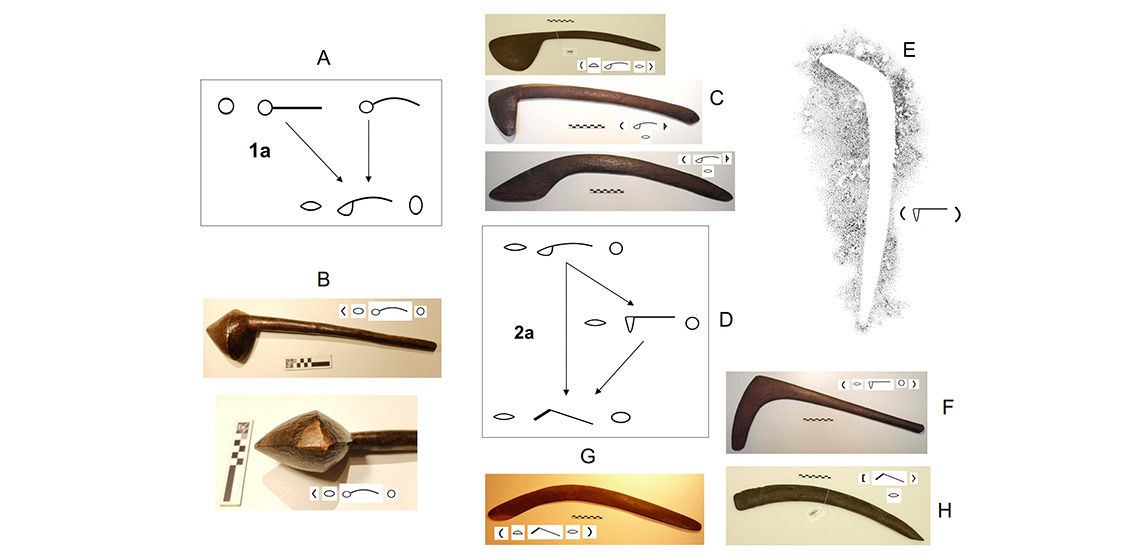
Prehistoric wooden projectiles likely have a complex evolutionary story in a similar way to stone tools, depending on their functions, and the cognitive and physical capabilities of hominins who used them. The technologies of some ancient projectiles (e.g., spears, arrows) can be studied more directly because they were equipped with...
Can Experimental Archaeology Confirm Ethnographic Evidence? The Case of Aboriginal Boomerangs Used as Retouchers

Publication Date
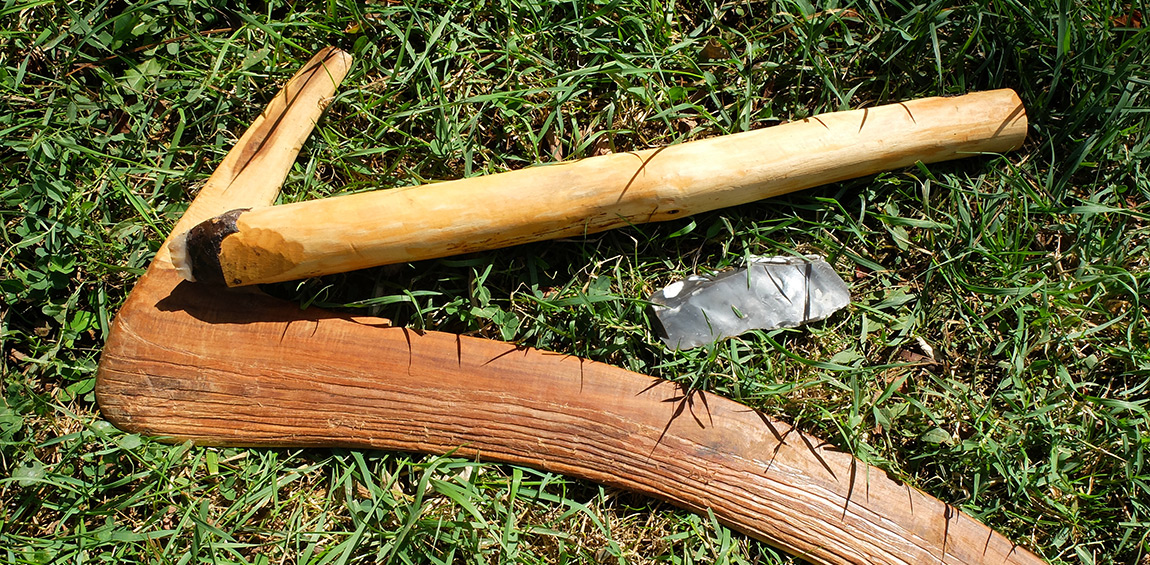
In this article, an experimental programme is used to examine how boomerangs may be used to retouch stone tools. The programme's findings confirm ethnographic data pertaining to the employment of hardwood boomerangs in retouching activities and investigate their technological similarities to Palaeolithic bone retouchers...
Traces of Manufacture, Use, Repair and Modification Observed on Ethnographic Throwing Sticks and Boomerangs
Publication Date
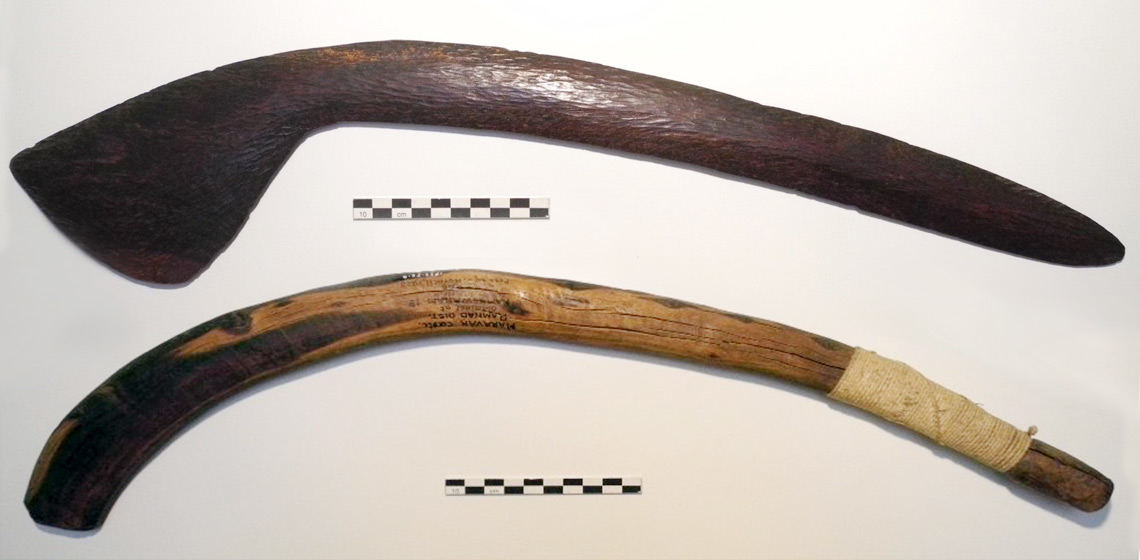
Throwing sticks and boomerangs are present in the collections of many French and international museums. Collected mainly in the 19th and 20th centuries by travelers, they were mainly analyzed from a stylistic point of view, to relate them to their region of origin. Some of these objects were made by the indigenous populations especially to be exchanged with Europeans and only bear macro-traces of manufacture...
Throwing Stick to Spear Thrower - Study of Ethnographic Artefacts and Experimentation
Publication Date
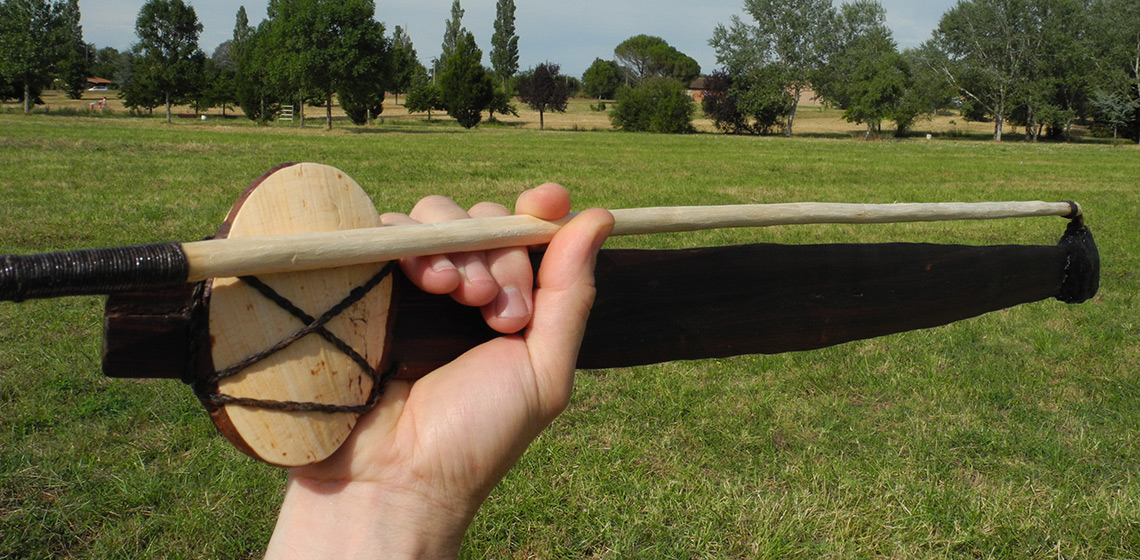
Little is known about the process of the invention of the prehistoric spear thrower which appeared around 25,000 years ago in Europe, although it may have emerged earlier on other continents. This innovative weapon had a late arrival in Australia from Papua New Guinea at the end of the late glacial maximum, and probably induced an adaptation in hand throwing spear technology used by local people. But could the spear thrower have also originated independently from older prehistoric technology on this continent?
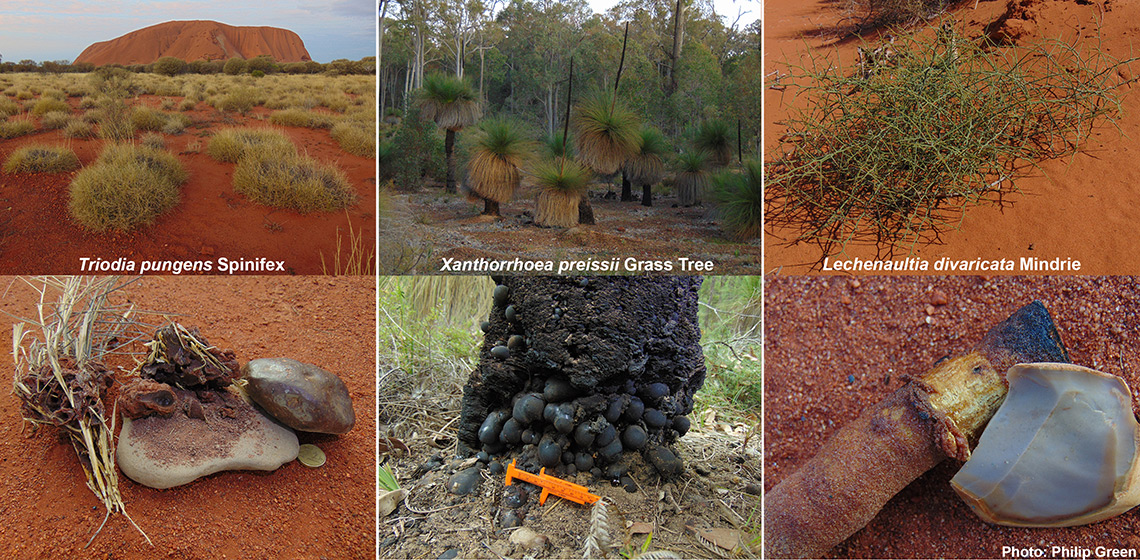
Hafted Tool-use Experiments with Australian Aboriginal Plant Adhesives: Triodia Spinifex, Xanthorrhoea Grass Tree and Lechenaultia divaricata Mindrie
Publication Date
Hafted stone tools commonly figure in Australian archaeology but hafting traces and manufacture processes are infrequently studied. The Aboriginal processing of resin from Xanthorrhoea (Sol. Ex Sm.) grass tree, Triodia (R.Br.) spinifex and Lechenaultia divaricata (F.Muell.)...
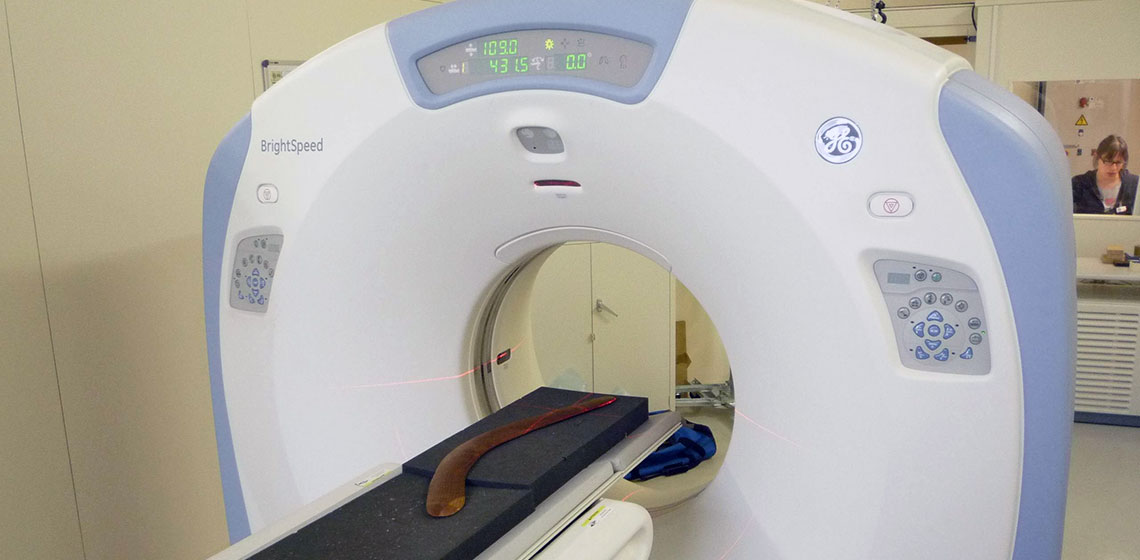
X-Ray Tomography and Infrared Spectrometry for the Analysis of Throwing Sticks & Boomerangs
Publication Date
In 2009, confronted to the study of throwing sticks collections from several museums and private collections (including more than three hundreds artefacts) and the need to evaluate their aerodynamic and functions, I developed a throwing stick classification and a methodology to measure their characteristics (Bordes, 2014). This approach is complementary to the gathering of ethnographic or archaeological contextual data to confirm or invalidate hypotheses about theirs functions.
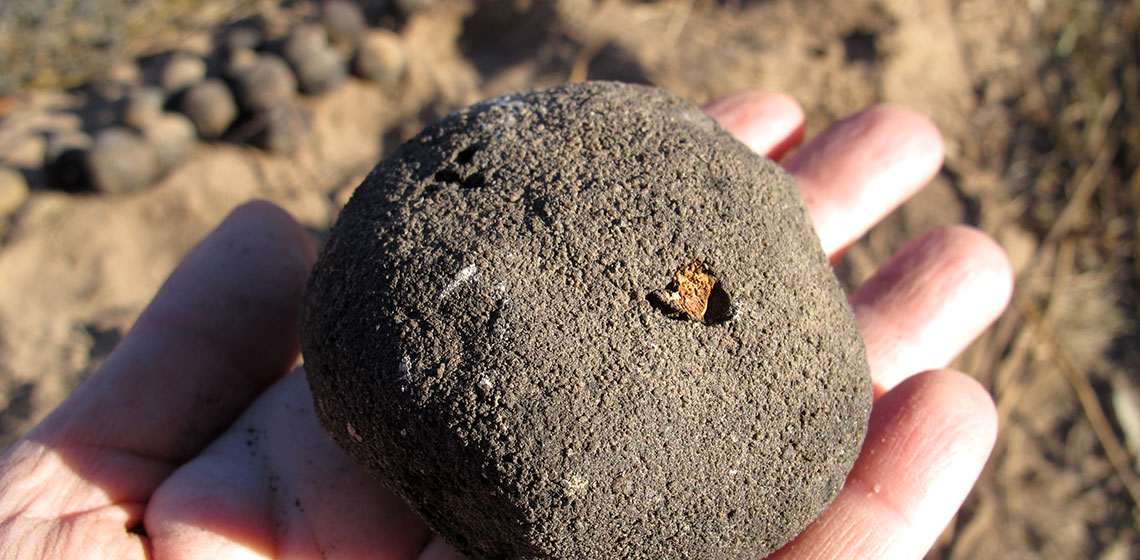
Re-Creating an Aboriginal Earth Oven with Clayey Heating Elements: Experimental Archaeology and Paleodietary Implications
Publication Date
Earth ovens may relate to different ancestral cooking techniques, serving specific needs and functions. In eastern and south-eastern Australia, they were a significant element of a thriving pre-colonial Aboriginal culture. However, today it is extremely rare to find such structures well preserved. Based on archaeological and historical records...
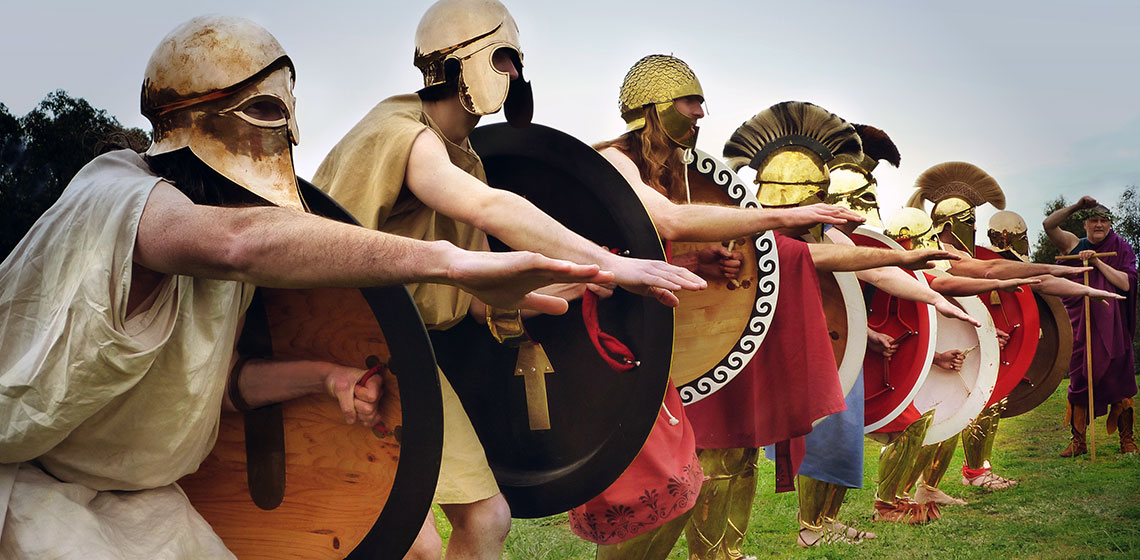
Interview: Ancient Hoplitikon, "Poorer Cousin" to History Academia or alternative XXI Century Interpretation of History?
Publication Date
I liaise with a number of living history groups globally, which all share the same aims and objectives of researching and actively pursuing experimental archaeology related to Ancient Greece and Rome. By networking, we create a foundation of knowledge that meets our framework for understanding the past, whether it be military martial arts, polytheism...
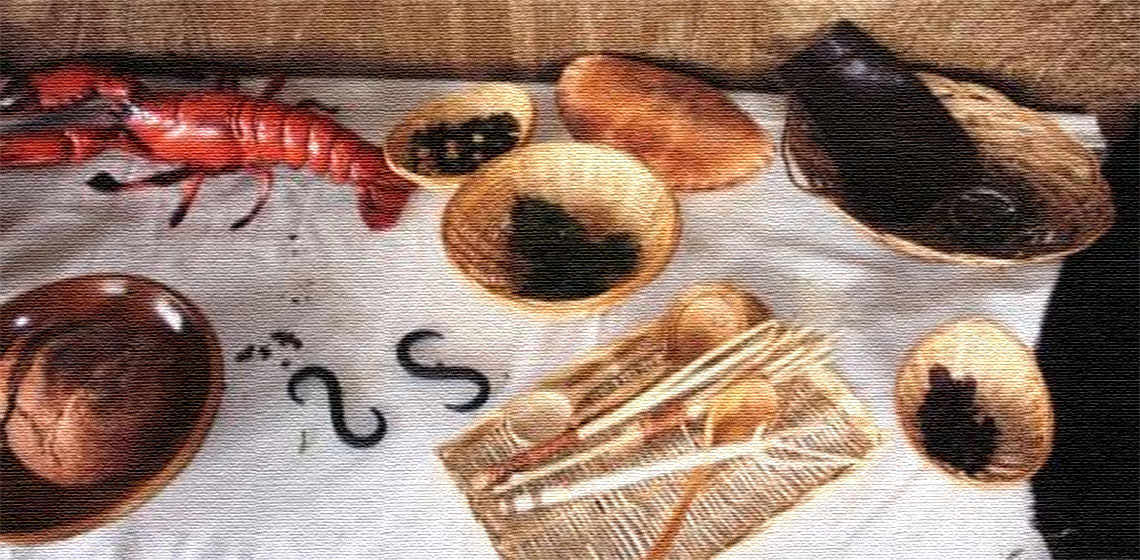
Discussion: Food - Reconstruction and the Public
Publication Date
For a BBC program in 1954, Sir Mortimer Wheeler tasted a reconstruction of the Tollund Man’s last supper, which turned out to be a tasteless mush. This led him to announce: "I believe that the poor chap of Tollund committed suicide because he could stand his...