

The content is published under Creative Commons Attribution 4.0 International license (CC BY 4.0).
Unreviewed Mixed Matters Article:
Book Review: Bog Fashion. Recreating Bronze and Iron Age Clothes by Nicole DeRushie
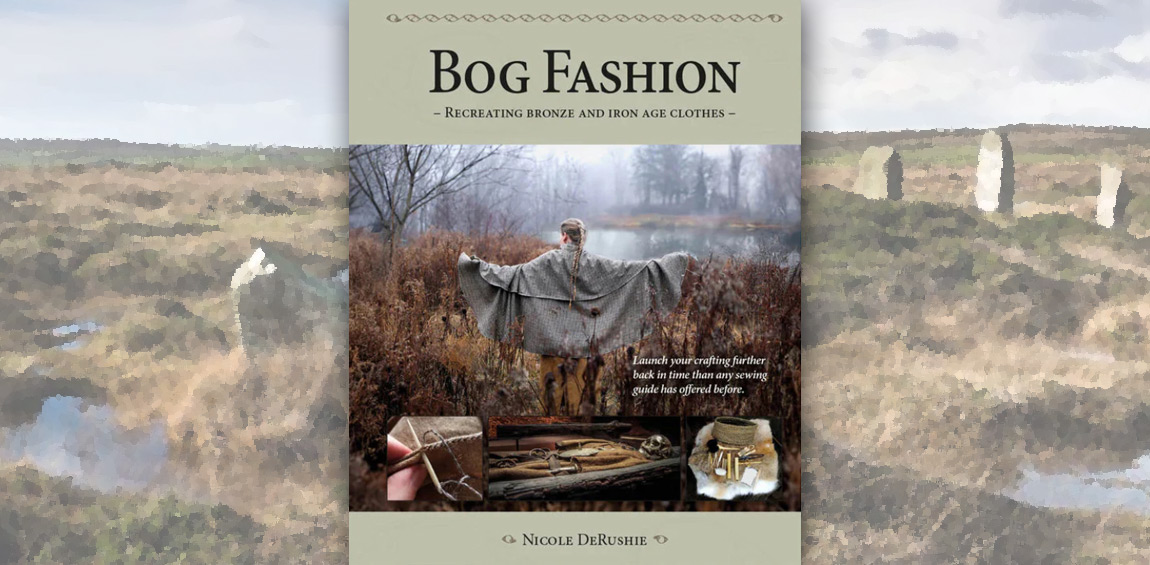
In an age dominated by mass-produced garments made from polyester or low-grade cotton, people are increasingly turning towards high-quality, traditional materials such as wool and linen. These natural fibres not only offer superior practical qualities, keeping one warm in the cold and cool in the heat, but also tend to look far better (though that, of course, remains subjective) and are vastly more durable. Could it then also be time to revisit the classic cuts of prehistory? Is fashion “from the bog” ready to step into the spotlight? With the publication of works such as Bog Fashion. Recreating Bronze and Iron Age Clothes by Nicole DeRushie, this possibility seems ever more plausible.
DeRushie’s 192-page hardback volume, published by ChronoCopia Publishing AB, presents patterns and detailed instructions for creating thirteen garments and accessories inspired by archaeological finds from the Bronze and Iron Ages. Yet it offers much more than practical guidance. The book provides a rich discussion on the broader context of prehistoric dress and explores the fascinating phenomenon of reconstructing Bronze and Iron Age fashion today, made possible largely by the survival of organic materials preserved in bogs and other waterlogged environments.
The publication is organised into three structured sections, leading the reader from theory to practice.
The opening chapters serve as an introduction to the study of prehistoric clothing. DeRushie discusses the role of bogs in preserving archaeological evidence, recalls historical written sources, and reflects on the most famous finds, all while considering the question of authenticity in reconstruction.
The next part of the book is a handy compendium of ancient textile techniques. DeRushie explores the properties of wool, linen, and other plant fibres, and describes the processes of spinning, weaving, dyeing, and sewing. Readers will find a wealth of practical tips and fascinating details here, from dyeing fabric with walnut husks to making thorns into pins or crafting needles from bone. This section, however, is not only a technical manual, but also a reflection on human creative spirit and our age-old ability to craft from what nature provides.
The most extensive section of the book is devoted to specific reconstructions – from simple cloaks and tunics to more complex pieces such as trousers or footwear. Each project includes a description of the archaeological original and DeRushie’s own interpretation, complete with instructions that can be followed at home. What particularly stands out here are the numerous insights shared by an experienced researcher and craftsperson, all conveyed with remarkable warmth that invite readers to experiment for themselves.
The final section of the book comprises appendices containing selected excerpts from ancient written sources, a glossary of terms, a bibliography, and useful reference materials such as measurements and weights.
Bog Fashion is thus a unique combination of research, practice and personal reflection that reminds more of a cookbook, with instructions functioning as experiential “recipes” to be followed, modified, and tasted in practice, thanks to numerous photographs and drawings.
The book also benefits from the fact that it does not need to be read linearly. Instead, one can dip in and out of sections according to personal interests, moving freely between theory and practice, between scholarly narrative and practical reconstruction. DeRushie’s approach here is notably inclusive and encouraging, as she invites readers to learn through their own trials and errors, an attitude that is especially refreshing for beginners, who may encounter some challenges while attempting to recreate a quality, historically accurate garment.
Bog Fashion therefore offers a warm invitation to explore how (extra-) ordinary people dressed in the Bronze and Iron Ages, an approach clearly rooted in the author’s long-standing experiential practice.
If anything could enhance this work, it would be the inclusion of a concise synthesis, a dedicated section describing and illustrating the main findings of the research on Bronze Age and Iron Age clothing. While this information is present throughout the text, gathering it into one place as a summary would offer a clearer understanding of prehistoric fashion as a whole, and would certainly benefit a general readership.
Nevertheless, Bog Fashion stands as an exceptional contribution for anyone interested in the history of dress – invaluable to living-history practitioners and essential reading for newcomers to the craft.
Book information:
Bog Fashion. Recreating Bronze and Iron Age Clothes, Nicole DeRushie, Chronocopia Publishing AB, SE, 192 pages
ISBN: 978-9198105698
Country
- Sweden