

The content is published under Creative Commons Attribution 4.0 International license (CC BY 4.0).
Unreviewed Mixed Matters Article:
100 Bloomery Iron Smelts: Presenting the Data Web Linked Tables
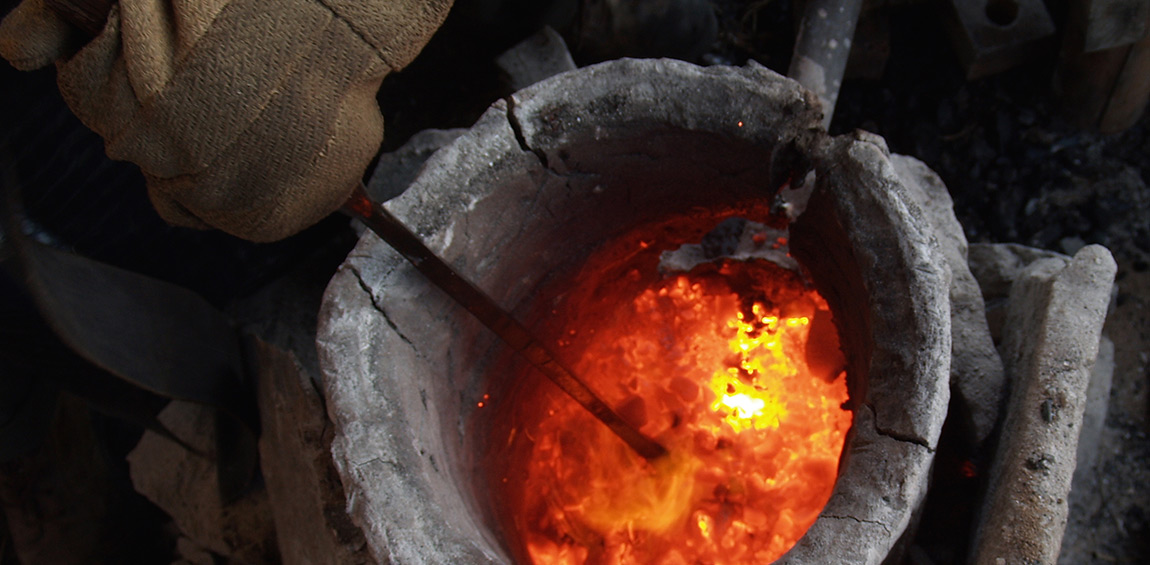
From 2001 to 2026, a total of 101 individual bloomery iron smelts have been carried out either directly or with significant participation by Darrell Markewitz. The bulk of this work was undertaken at Wareham in Central Ontario, Canada1. The total includes project work in the USA, Scotland, Denmark, Ireland and Poland. The primary supporting team was made up of members of the Dark ages Re-Creation Company2 who undertook an additional two smelts included here. Overall, this experimental research is unique in Canada.
- 1
Wareham is located roughly 120 km northwest of Toronto, a rural location in lower Grey County. The site is the location of the Wareham Forge, which has provided financial and logistical support for this work.
- 2
The Dark Ages Re-Creation Company is a group of serious amateur living history re-enactors who focus specifically on both daily life and craft work from the Viking Age. Members are drawn from over Central Ontario, the group was founded in 2000 by Markewitz and Peterson. Since inception they have had a close relationship with Parks Canada at L'Anse aux Meadows NHSC (the only authenticated Norse archaeological site in Canada). See www.darkcompany.ca
The majority of these tests would use some variation of what has come to be called a 'short shaft' furnace1. Typically, these are constructed primarily of clay with added sand and some organic component (cobb2). Size is relatively standard, 25 – 30 cm internal diameter, overall height 50 – 70 cm. Initial tests were focused on determining the working dynamics of small bloomery furnaces, in terms of functional layout, effective method, the impact of ores and air volumes. Tests have included the use of both fire brick and stone builds, and later Icelandic based turf construction. The bulk of these furnaces employed air delivery from electric blowers, as there has also been investigation of Norse type twin bellows. There have been a number of longer series investigations based on specific archaeological prototypes: Vinland, Icelandic, Pictish. Almost all of these smelts have resulted in the production of iron blooms, although aspects of historic modelling was the overall objective, not effective iron production of itself. Ore quantities have been intentionally limited to the range of 20 – 30 kg, with blooms typically in the 3 – 5 kg size.
It is worth noting that at the date these tests started, there was little understanding of an 'ideal method' for the effective functioning of small bloomery furnaces. Early work included multiple firings, testing single variations of elements like tuyere position, air volume, stack height, or slag control. Important to an assessment of this compiled data is that all of this considerable work has been undertaken without any kind of institutional support, and well outside of the regular academic framework. At the point where these investigations began, there was no standard of record keeping, a framework that would evolve over time3. Lacking University support, access to academic publications has proved difficult, and so at best has been spotty; mostly this work proceeded independently. All the costs were born personally (expended materials for an individual smelt are about $300 CDN) and this situation has greatly impacted access to instrumentation.
The purpose of this article is to present to the wider academic community the collected raw data from all of these tests. With descriptions on date / location, defining prototypes, and experiment intentions / result, there are potentially 55 data points for any given test made available here. The individual experiments are listed in their date sequence. Beyond the main table that shows all the collected data, there are further breakdowns into specific research topic areas.
The data is intentionally being presented in its simple, collected form. The descriptions of individual smelts, importantly with specific action sequences, has been available on the open internet starting in 20064. There is no attempt here to draw conclusions. These are provided in '20 Years Before the Blast – Experimental Bloomery Iron Smelting 2001 – 2025'5. These tables were prepared over 2024 – 25 in preparation of that volume. They were first made available over the internet later in 20256, imported from the initial spreadsheets into html format. Because of the raw size of the collected data tables, the direct weblinks to the individual tables are given below:
| Overall Data: All 55 data points for each smelt. | https://www.warehamforge.ca/ironsmelting/Iron-Smelt-Data/Display_All.html |
| Furnace Types: Description & measurement of each | https://www.warehamforge.ca/ironsmelting/Iron-Smelt-Data/Display_FurnaceType.html |
| Air Systems: Details of tuyere, source, volumes, effects | www.warehamforge.ca/ironsmelting/Iron-Smelt-Data/Display_AirSystems.html |
| Burn Rates: Charting of source, volume, burn rate, yield | www.warehamforge.ca/ironsmelting/Iron-Smelt-Data/Display_BurnRate.html |
| Ore Type: Source or type, elemental iron, times used | www.warehamforge.ca/ironsmelting/Iron-Smelt-Data/Display_OreTypes.html |
| Ore Details: Specific elemental content of each | www.warehamforge.ca/ironsmelting/Iron-Smelt-Data/Numbers.html |
| Calculations: As used for determining data | www.warehamforge.ca/ironsmelting/Iron-Smelt-Data/Calcs.html |
| Overall Totals: Summing up how many and how much | www.warehamforge.ca/ironsmelting/Iron-Smelt-Data/Fun.html |
This collection of data is being made available in the hopes that it will assist other researchers in this field. In the last 15 years especially there has been an explosion of interest in bloomery iron smelting. Unfortunately, those with extensive practical experience in successfully building and operating bloomeries have rarely documented that work. At least in North America, there has been a shift to concentration with effective production; high yields and alloy contents. This has overshadowed the work of those interested in investigating historic prototypes via experimental archaeology. On the academic side, too often the simple functional aspects of successful iron smelting are missing. As fellow experimenter Lee Sauder famously said: ' If you don't get any iron – you can't be doing what they did. '
Acknowledgments
Data tables are prepared with Neil Peterson.
- 1
Markewitz, D., 2012, 'But If You Don't Get Any IRON...' Towards an Effective Method for Small Iron Smelting Furnaces', in The EXARC Journal, issue 2012/1, online (web journal): https://exarc.net/ark:/88735/10041
- 2
The spelling 'cobb' is used intentionally, as the USA word 'cob' has an alternate, racist, meaning.
- 3
Markewitz, D., 2021, ‘Standardized Reporting of Experimental Iron Smelting - A modest (?) Proposal’ in The EXARC Journal, issue 2021/1, online (web journal): https://exarc.net/ark:/88735/10559
- 4
Markewitz, D., 2006 – present, 'Experimental Iron Smelting 2001 – present', website: www.warehamforge.ca/ironsmelting The older version of this site still available: www.warehamforge.ca/ironsmelting/indexA.html Peterson, N., 2006 – 2016, 'Dark Ages Re-Creation Company – IRON', website: www.darkcompany.ca/iron/
- 5
Markewitz, D., with Peterson, N., 2025, '20 Years Before the Blast – Experimental Bloomery Iron Smelting 2001 – 2025', Kindle / Amazon (self-published), ISBN: 978-1-0691597-5-5
- 6
Markewitz, D., with Peterson, N., 2025, 'Experimental Bloomery Iron Smelting DATA', website: www.warehamforge.ca/ironsmelting/Iron-Smelt-Data/index.html
Keywords
Country
- Canada