

The content is published under Creative Commons Attribution 4.0 International license (CC BY 4.0).
Unreviewed Mixed Matters Article:
The Rolling Flange Hypothesis: A Mechanical Reinterpretation of Trilithon Block Movement at Baalbek
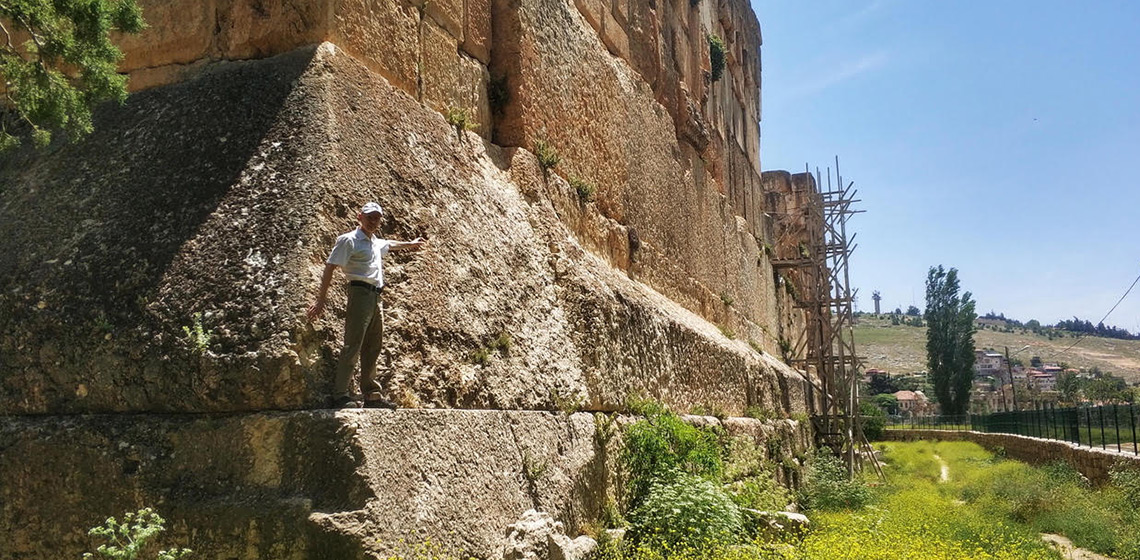
The transport of the c. 800-tonne trilithon blocks at Baalbek remains an unresolved challenge within Near Eastern archaeology. Existing hypotheses - including sledges, rollers, earth ramps, and large-scale manpower organisation - struggle to reconcile the extreme mass of the stones with practical mechanical limits (Adam, 1984; Oleson, 2008). This article introduces the Rolling Flange Hypothesis, a new model grounded in the material properties of Baalbek’s Cretaceous limestone, traditional quarrying practices, and engineering analysis. The hypothesis proposes that each trilithon block was undercut in the quarry to create a pair of sacrificial rolling flanges. These temporary structural features, shaped to run along prepared trackways, transform the block from a high-friction sliding mass into a low-friction rolling body capable of controlled movement using capstans, ropes, and human or animal power (Landels, 1978). Limestone’s high compressive strength and moderate hardness make such a configuration mechanically plausible (Oleson, 2008). The model further explains why no explicit flange remnants survive: they were removed during final dressing. A programme of experimental testing is proposed to evaluate the feasibility and falsifiability of the model.
Introduction
The transport and placement of the trilithon blocks at Baalbek—each weighing approximately 800 tonnes—represent one of the most demanding engineering challenges of antiquity. Numerous explanations have been proposed, including sledges, rollers, and earthen ramps, yet these approaches encounter significant mechanical and logistical limitations when scaled to extreme masses (Adam, 1984; Oleson, 2008).
This article presents the Rolling Flange Hypothesis, a new interpretive model proposing that the trilithon blocks were quarried with integral sacrificial flanges and transported as controlled rolling bodies. This configuration reduces friction, improves mechanical control, and aligns with known ancient engineering practices (Oleson, 2008).
Background
The trilithon stones forming part of the Jupiter podium at Baalbek measure approximately 19.6 m in length and originate from the nearby Quarry of the South. Larger unfinished stones remain in the quarry, indicating attempts at even greater scales that were ultimately abandoned. This sequence suggests iterative engineering decision-making consistent with known patterns of ancient construction (Adam, 1984).
Material Properties of Limestone
The trilithon blocks consist of Cretaceous limestone, a material characterised by high compressive strength and moderate tensile strength. Limestone performs well under compressive loading but is vulnerable to tensile stress and fracture (Oleson, 2008). Any viable transport method must therefore minimise tensile loading while maintaining structural integrity (Oleson, 2008).
Mechanical Constraints on Movement
Sliding transport methods generate significant frictional resistance. Even under favourable conditions, coefficients of friction for stone-on-stone or wood systems remain high, requiring substantial force inputs (Adam, 1984). Wooden rollers introduce additional challenges, including crushing under concentrated loads and instability during movement (Adam, 1984).
These constraints motivate the exploration of transport systems that prioritise rolling rather than sliding, thereby reducing resistance and improving control (Oleson, 2008).
The Rolling Flange Hypothesis
The Rolling Flange Hypothesis proposes that trilithon blocks were quarried with temporary flanges projecting from their underside. These flanges interfaced with shaped trackways, enabling controlled rolling motion.
The configuration offers several mechanical advantages:
- Reduced friction compared to sliding systems (Adam, 1984)
- Predominantly compressive stress distribution (Oleson, 2008)
- Improved control through rotational movement (Landels, 1978)
- Compatibility with rope and capstan systems (Landels, 1978)
As sacrificial elements, the flanges would have been removed during final dressing, explaining their absence in the finished structure (Adam, 1984).
Controlled Movement and Torque
Ancient engineering systems frequently employed capstans and rope mechanisms to generate controlled force. Capstans allow coordinated teams to apply sustained torque, which can be used to rotate large bodies (Landels, 1978).
By applying force over the upper surface of a rolling block, the system converts linear pulling into rotational motion, increasing mechanical efficiency (Landels, 1978). This approach allows incremental, controllable advancement rather than continuous high-force dragging.
Transport and Placement
Once freed from the quarry, the block could be advanced along prepared pathways toward the construction site. Rolling systems provide advantages in alignment and positioning, as differential rope tension can be used to guide movement (Landels, 1978).
Final placement would involve incremental adjustment rather than large-scale lifting, consistent with known ancient construction techniques (Oleson, 2008).
Comparison with Existing Theories
Existing transport models encounter limitations at extreme scale:
- Sledges : high friction and large force requirements (Adam, 1984)
- Rollers : structural failure under concentrated loads (Adam, 1984)
- Ramps : extensive material and labour requirements (Oleson, 2008)
- Lever systems : poor scalability (Oleson, 2008)
The Rolling Flange model reduces frictional demands and maintains the stone in compression, offering a mechanically favourable alternative (Oleson, 2008).
Archaeological Implications
The absence of direct physical evidence for rolling flanges is consistent with the hypothesis. Temporary features such as quarry trackways and sacrificial stone elements are unlikely to survive due to later modification, erosion, and final dressing processes.
This aligns with broader patterns in ancient construction, where temporary working features were routinely removed (Adam, 1984).
Limitations and Testability
This hypothesis remains speculative but testable. Key uncertainties include:
- Exact flange geometry
- Load distribution under rolling conditions
- Quarry trackway construction
Experimental archaeology offers a means of evaluating these variables through controlled reconstruction and testing (Oleson, 2008).
Proposed Experimental Programme
Testing the Rolling Flange Hypothesis would involve:
- Scaled physical models of flanged blocks
- Measurement of rolling resistance and force requirements
- Comparative testing against drag-based systems
- Archaeological survey for potential quarry trackway remains
Such work would provide empirical data to support or refute the model.
Conclusion
The Rolling Flange Hypothesis presents a mechanically plausible and archaeologically coherent explanation for the movement of the Baalbek trilithon blocks. By transforming the blocks into rolling bodies supported by sacrificial flanges, the system reduces friction, improves control, and aligns with known ancient engineering practices (Oleson, 2008).
While not definitive, the model provides a testable framework that contributes to ongoing discussion and invites further interdisciplinary investigation.
Acknowledgement
I dedicate this article to my mother, who believed in me and this work long before it reached publication.
Keywords
Country
- Lebanon
Bibliography
Adam, J.-P., 1984. Greek and Roman Construction: Materials and Techniques . London: Routledge.
Landels, J.G., 1978. Engineering in the Ancient World . London: Chatto & Windus.
Oleson, J.P., ed., 2008. The Oxford Handbook of Engineering and Technology in the Classical World . Oxford: Oxford University Press.