

The content is published under Creative Commons Attribution 4.0 International license (CC BY 4.0).
Reviewed Article:
A New Tablet Weaving Technique from Bronze Age Hallstatt
The salt mines of Hallstatt, Upper Austria, bear some of the most significant evidence for our understanding of textile culture in the Late Bronze and Early Iron Age in Central Europe due to the exceptional preservation of these finds. Following recent excavations, a new textile, HallTex 390, from the Late Bronze Age “Tuschwerk” mine has revealed multiple previously unknown features, techniques, and a peculiar design: two typical Bronze Age fabrics connected with an unusual ribbon with a ribbed structure, combining twisted and tabby-structured threads of different diameters. While comparisons for similar techniques from Denmark are discussed, this technique is quite unique for Bronze Age Central Europe. Only through experiments were we able to fully understand the textile, which seems to have consisted of tablet weaving with tablets threaded with either two or four threads while simultaneously using the weft as a sewing thread to connect the ribbon to the other textiles. This produced results comparable to the original while also revealing how efficient these Bronze Age craftspeople’s design choices were.
Introduction
The annual excavations in the Bronze and Iron Age sections of the Hallstatt salt mines in Upper Austria (Brandner et al ., 2022) consistently bring to light organic artifacts, including textiles, which enhance our knowledge of technological advancements in textile production, especially during the latter half of the 2nd millennium BC and the first half of the 1st millennium BC. The preservation state of the textiles (Grömer et al. , 2013), but also of skin, fur, leather (Ruß-Popa, 2021), and bast items (Brandner, Oberndorfer, Grömer, 2025; Cheng, 2025), is exceptional – still exhibiting colours and flexibility – due to the excellent conditions in the salt mine: primarily due to the salt, which is toxic to microorganisms, but also the constant low temperature and high humidity.
The earliest mining activities in Hallstatt (Brandner et al., 2022) date back to the end of the Middle Bronze Age – dendrochronologically dated to around 1500 BC. There are three different areas of mining: the so-called “Northern Group” dates back to the Bronze Age, the so-called “Eastern Group”, corresponding with the famous Hallstatt cemetery of the Early Iron Age (Kern, 2018), covers approximately 900-300 BC, and the “Western Group” dates back to the La Tène period according to calibrated radiocarbon dating data – this zone is no longer accessible for excavations today with only few finds known from this area. The excavations and research currently underway are focusing primarily on the Bronze Age areas of the so-called “Christian-von-Tuschwerk” (Late Bronze Age) and on the Iron Age mines – numerous textile remains have been discovered in both.
Since the first textiles were discovered in the Hallstatt salt mine in the mid-19th century by mining master Johann Georg Ramsauer, a significant surge of activity ensued. To date (year of discovery up to 2025), more than 420 textile complexes from the salt mines are known, consisting of more than 800 individual textile finds. Work is currently underway to expand the systematic cataloguing of Hallstatt textiles, the first part of which was published over 10 years ago (Grömer et al., 2013). The developments in analytical methodologies in the early 2000s resulted in many research initiatives and projects that included the Hallstatt textiles as subjects of research. Textile archaeology employs many methodologies to provide fundamental data (Ulanowska et al. , 2022; Gillis and Nosch, 2007; Walton Eastwood, 1988): the study of textiles encompasses textile analysis, including thread and fabric quality, weave, pattern, seams, and numerous scientific methodologies for assessing raw materials and colour.
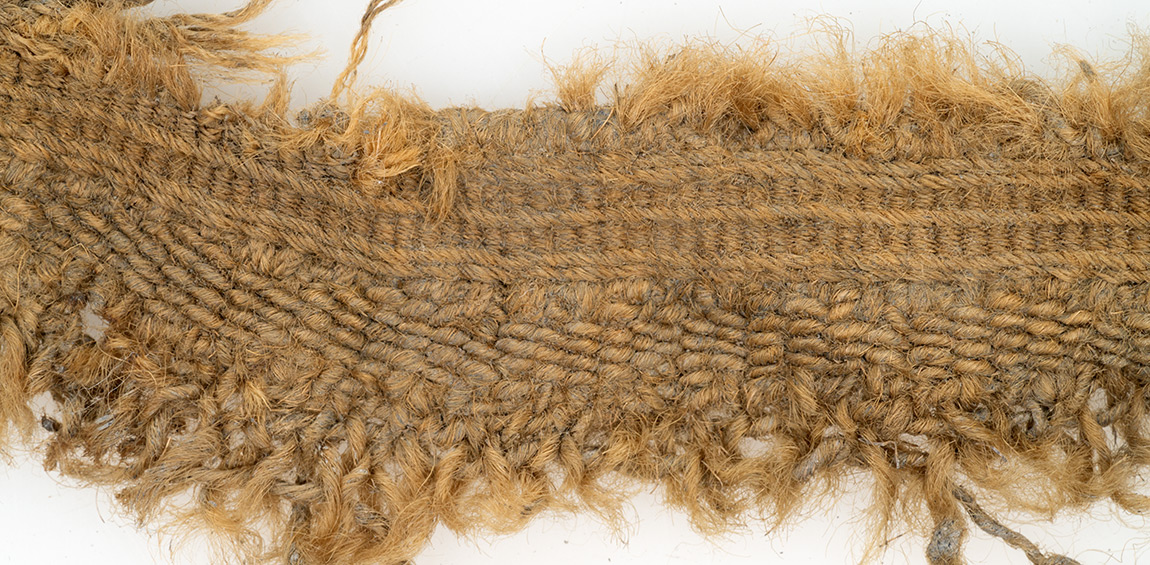
This article focuses on a newly found textile from the Bronze Age parts of the salt mine Hallstatt, which was found in the 2021 excavation season at the “Christian-von Tuschwerk” findspot, dating from the earlier phase of the mining chamber, deposited around 1150 BC. This article will present the textile find HallTex390 (See Figure 1; Inv. Nr. 127.654, Find Nr. 21.154), discuss comparison finds, and explore the techniques of manufacture using the methods of experimental archaeology.
The Bronze Age textile HallTex 390
The Hallstatt Textile 390 (subsequently referred to as HallTex 390) consists of three textiles, all of them made from wool in a now light olive colour, possibly the naturally light-coloured wool. Two coarser, tabby-woven fabrics with repp borders are connected by a densely woven ribbon with a peculiar structure pattern. The entire fragment measures approximately 16.4 x 3.8 cm.
The ribbon (HallTex390 B) is merely 0.8 cm wide and made of very fine, two-ply yarn twisted in sZ-direction (two s-yarns plied together) (See Figure 2). It shows an interesting weaving pattern: a very fine warp-faced tabby-woven structure combined with strings of threads twisted together in S-direction with a cord-like appearance that is characteristic for tablet weaving. The pattern has a mirror symmetry: one thicker, twisted string in the middle, a ten-thread-wide repp section on each side, and then two thicker, twisted strings on the edges. The twisted strings consist of four threads, each with a diameter of 0.4 mm. The threads used for the tabby-structured section are much thinner, only 0.2 mm. The weft thread, on the other hand, is very thick and measures between 0.7 and 1.0 mm, which accentuates the ribbed structure of the ribbon (See Figure 2).
The ribbon is torn in one section, exposing some of the warp and weft. One of the weft threads in this area can be seen making a loop on the edge of the fabric (See Figure 3). In the repp sections, a weaving mistake is visible: two parallel warp threads floating over three wefts (See Figure 4).
The tabby woven textiles (HallTex 390 A and C) are technologically practically identical. They are both made from coarse, single-ply yarn with a thread diameter between 0.5 and 0.8 mm and woven with a density of around 10 threads per centimetre. A 10- to 9-mm-wide repp border is preserved on both textiles, along the edge connected to the ribbon. The border of the textiles HallTex 390 A and C has paired yarn in the repp that splits into single yarn in the main fabric. This technique is suitable for creating starting borders, which are used on the warp-weighted loom to mount the warp before beginning to weave the main fabric. However, side borders can be worked in a similar way, and it is therefore not possible to determine the use of the border with certainty.
Where the ribbon connects to the tabby woven textiles, a pronounced bulge is visible on one side of the fabric (See Figure 5). On the other side, the connection is flat (See Figure 6). The bulge is crossed in regular intervals by a thick, two-ply thread, looking, at first glance, like a seam worked with an overcast stich. However, the thread is, in fact, the weft of the ribbon that was used like a sewing thread to gather the edges of the tabby woven fabrics and connect them to the ribbon while it was woven.
Comparison finds
Due to the exceptional conditions of the Hallstatt salt mines, many hundreds of different textiles are known from the site. Textiles from the Bronze Age sections of the mines are typically coarser than fabrics from the later Iron Age. They are mainly made from undyed wool woven in tabby, although some dyed fabrics and twill or tablet-woven textiles were found as well. Many of the fragments also preserve parts of starting, side, or finishing borders (Grömer, 2013). The coarser fabrics are generally interpreted as textiles made specifically for salt mining, for example, as carrying sacks used to transport salt out of the mine. Some of the finer fabrics might have been part of clothing as well (Grömer, Rösel-Mautendorf, Reschreiter, 2013, 121-126).
The connection technique and the structure pattern seen on HallTex 390 are so far unique for prehistory in Central Europe. Most of the individual techniques that were used to create it are known from other finds of the period, however. The coarse tabby woven fabrics with the borders (HallTex 390 A and C) are, by themselves, typical Bronze Age textiles, woven in the most basic technique, known in Europe since the Neolithic period (Rast-Eicher and Dietrich, 2015). While twining techniques were still more widespread during the Neolithic and Chalcolithic, weaving – especially with wool – only became much more common beginning with the Bronze Age (Grömer, 2016, 352), though threads were still rather coarse compared to later periods. These features are not limited to Hallstatt: the characteristics of Nordic Bronze Age textiles are quite similar (Hald 1980), and repp starting or side borders are, for example, known from Bronze Age graves in Schwarza, Germany (Schlabow, 1958).
The hem between the ribbon and the tabby woven textiles on HallTex 390 is, in part, worked in a similar way as a basic overcast stich which can be found on many of the Hallstatt textiles and is very common in Bronze Age textiles from Hallstatt (Rösel-Mautendorfer, 2013, 100-101).
However, the ribbon fabric HallTex 390 B, which connects the coarser tabby woven textiles HallTex 390 A and C, is exceptional for the Bronze Age, both in its fineness and in its structure, with its warp threads being very fine in comparison (See Graph 1). Wool fineness measurements were also conducted on HallTex 390 B (See Graph 2). The results show that the wool must have been carefully selected and sorted to spin both the thicker and the thinner warp threads, as it is exceptionally fine and lacks more strongly pigmented fibres as well as coarse kemp hairs, which are otherwise typically observed in Bronze Age textiles (Rast-Eicher and Bender Jørgensen, 2013).
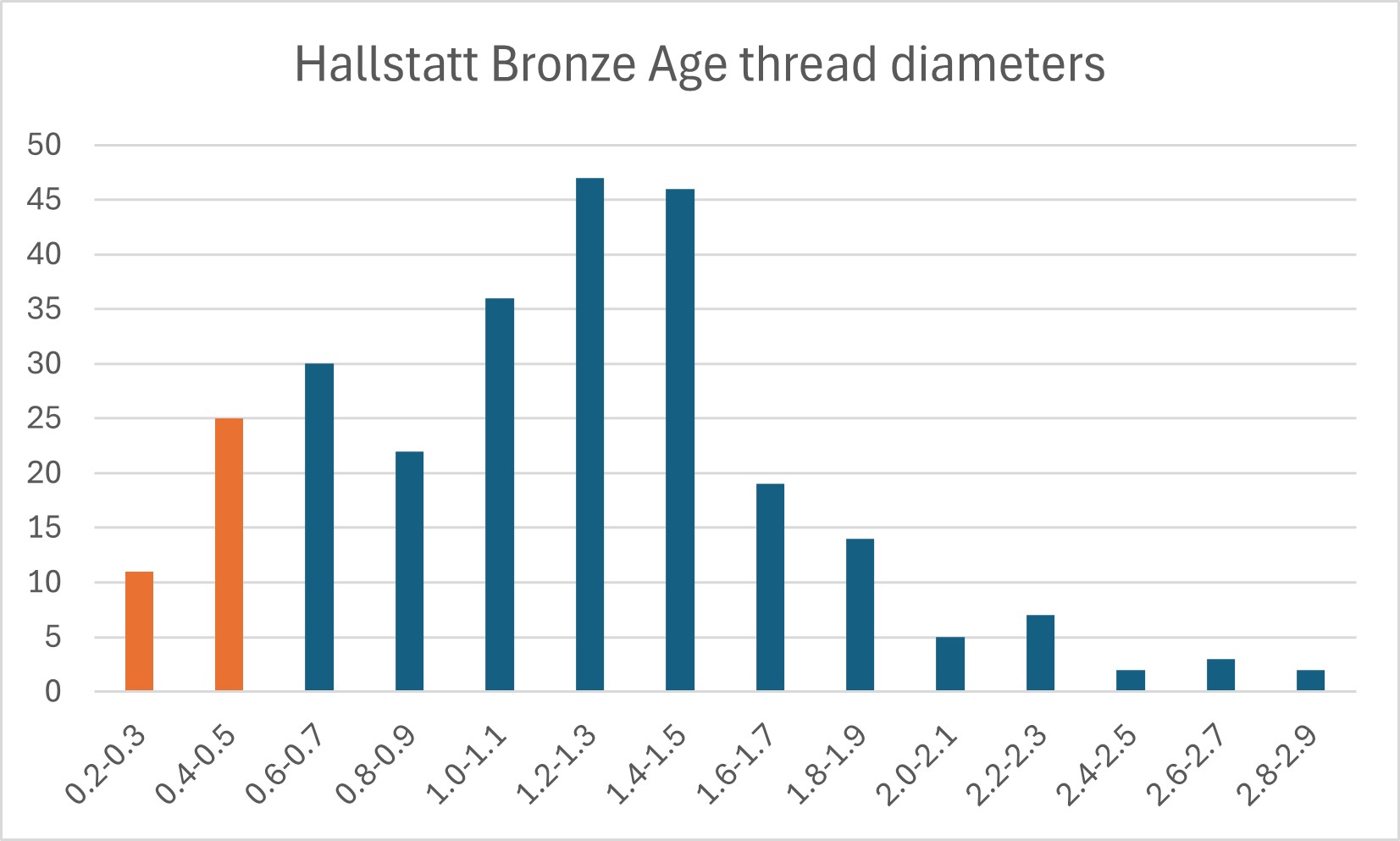
Graph 1. Thread diameters (averages) from Bronze Age Hallstatt. The ranges of HallTex 390B’s warp threads are marked in orange (n = 269). Image by Kayleigh Saunderson
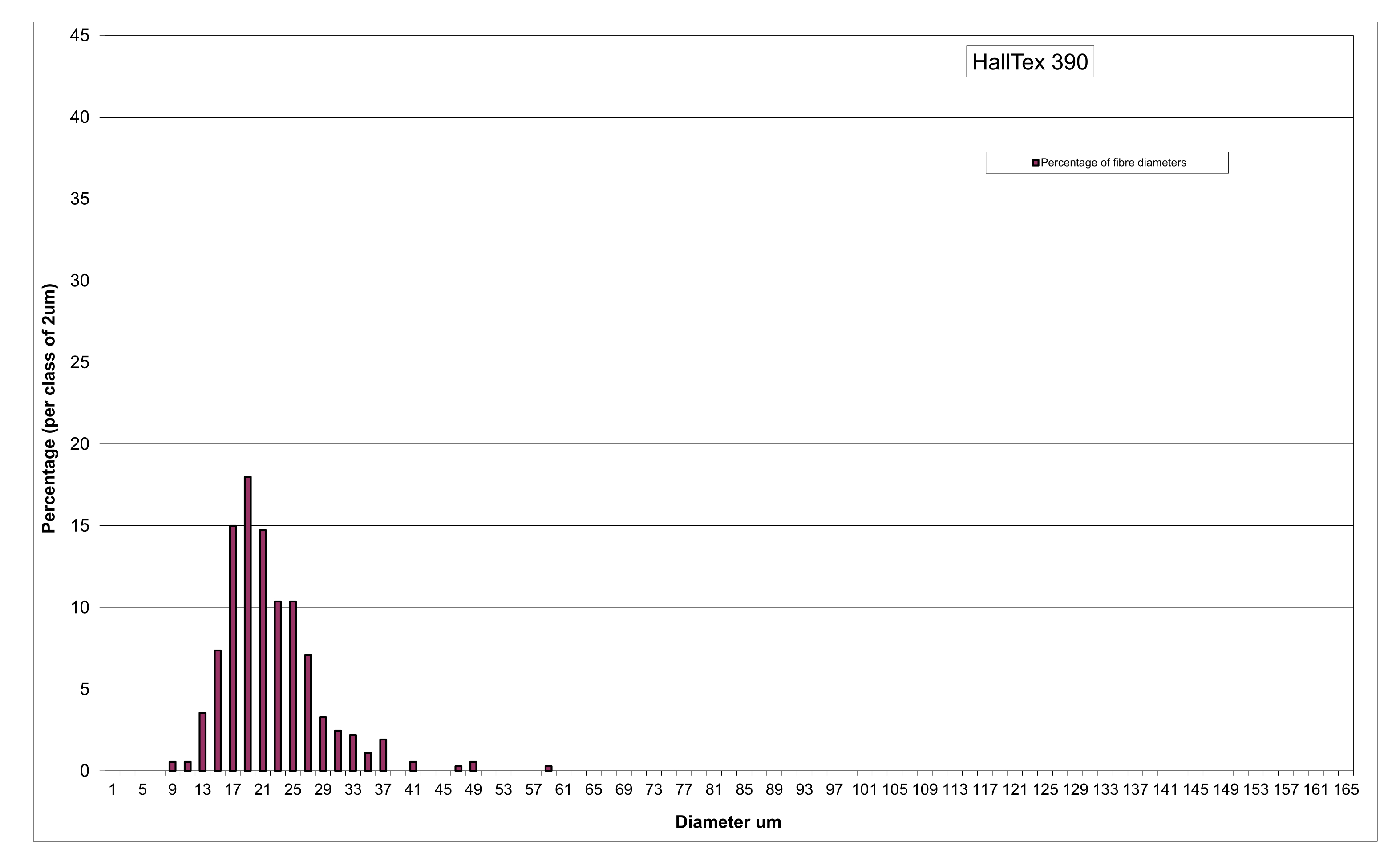
Graph 2. Histogramme displaying measurements of 367 fibres from HallTex 390 B in μm. Image by Kayleigh Saunderson
Only one other probable tablet weave has been found in Bronze Age Hallstatt up to now: HallTex 288 (Grömer et al., 2013, 310-311), which differs in many ways from the new HallTex 390. HallTex 288 has a design of simple stripes through different-coloured warp threads. The twisting of the threads is clearly visible – all in S direction, just as in the twisted part in HallTex 390 – using only two threads per tablet, as with the “tabby”-woven part of HallTex 390. In contrast, the “pattern” design of HallTex 390 is not based on colour, but on structure variations and a 3-dimensional appearance, with “ribs” in both systems through the thick weft and the different number and thickness of warp threads.
HallTex 288 was produced separately and sewn onto another fabric on one side, perhaps as a decorative border. It was presumably reused before being deposited in the salt mine, as it was found tied into a knot.
Tablet weaves attached to other fabrics during weaving are also known from Nordic Iron Age Donbæk, Thorsberg, Vehnemoor, and Vrangstrup (Möller-Wiering and Ræder Knudsen, 2013, 164–165), though the technique differs from HallTex 390, as loops on the main fabric are used for connecting the border, and the connection does not result in a “hem-like structure” seen with HallTex 390. The structure pattern and the weft that is simultaneously used as a sewing thread remains a unique and very interesting feature of HallTex 390.
The closest comparison find comes from a burial ground in Lønne Hede, Denmark, that dates to the Early Roman Iron Age (Demant et al., 2021, 272-275). A textile was preserved in Grave 1 that consisted of an orange-brown, twill-woven fabric with white and reddish-brown stripes in the weft and a tablet-woven border that was attached to the main fabric with a decorative seam. The fabric has been interpreted as part of a garment probably worn in a peplos-style. The tablet-woven border was connected to the main fabric by another thin border in repp structure. Just like on the textile HallTex390, the weaving thread of the repp was used as a sewing thread to connect the tablet-woven border to the main fabric. The tablet-woven border itself is also interesting, since it shows a similar repp structure combined with a cord-like string at the outer edge and thus a structure pattern quite similar to the one seen on HallTex 390. However, in Lønne Hede, the cord-like string was used in a different way, to create a small hollow section in the border.
An experimental reconstruction of the find from Lønne Hede was made as well. It concluded that the twill and the tablet-woven border from the Lønne Hede find were created separately. The structure pattern of the border was made by combining a two-hole tablet weaving technique to create the repp and a four-hole tablet weaving technique to create the hollow corded string at the edge. The border was then sewn onto the twill very loosely, leaving a gap between the fabrics with the sewing thread creating a “ladder” that was then filled by hand with a repp structure by inserting threads one by one, going under and over the loose sewing threads (Demant et al ., 2021, 230, 236).
Decoding the manufacturing technique: Diagnostic characteristics, textile chaîne opératoire and experimental archaeology
In order to fully understand how HallTex 390 was made, a thorough analysis combined with experiments on the production technique were imperative. The analysis of the textile under a digital microscope shows the technological characteristics of the textile, such as the thread diameter, weave density, but also damaged areas and weaving errors, which can reveal technological features that are diagnostic for certain techniques. Based on these observations, archaeological experiments can be conducted to test if the suspected methods can be used to produce comparable results. One must keep in mind that there are often multiple possibilities and tools that produce the same results; many tools in question would have been made of wood, thus there is a lack of finds due to preservation conditions in Central Europe. Furthermore, band weaving does not necessarily require many tools.
The way in which the ribbon connected the tabby-woven textiles was not immediately apparent, since the sewing in the bulge looks like a regular hem at first glance. However, in a torn section of the ribbon, a single loop of the weft was preserved, and matching the number of stitches in the hem with the number of ribs in the repp section of the ribbon confirmed that every second weft passed over the edge of the tabby woven textiles, looped around, and was then inserted back into the new shed of the ribbon (See Figure 7).
The weave structure of the ribbon was also visible in the torn section. The cord-like strings are made up of four individual, twisted threads, while no twisting is visible in the yarn in the repp-structured section, and they appear to run parallel. The twisted strings can be achieved using weaving tablets (Collingwood, 1982 in general on tablet weaving), simply passing warp threads through a tablet’s holes and turning them continuously in one direction. For the sections with a repp structure, a band-weaving tool (Grömer, 2016, figs. 44-47), such as a simple heddle bar, could have been used. Alternatively, a rigid heddle might have come into use, though there is no evidence of this tool before the Roman period (Foulkes, 2011, 41). Tablets can also be used to achieve a repp-like structure if the tablets are threaded with only two threads and then alternately turned forward and backward. Thus, two variations came to mind: a combination of weaving with tablets and a heddle or solely tablet weaving.
A third option would be to sew the tabby-woven fabrics together first, while leaving a gap, and then insert the threads of the ribbon one by one by hand, similar to the way the seam from Lønne Hede was reconstructed (Demant et al., 2021, 230). However, in the case of HallTex 390, the observation of a weaving mistake makes this variant unlikely: In the repp sections, two yarns running parallel can be seen floating over the same three threads. Such a mistake can happen when a shed in the warp – in this case, the visible threads of the ribbon that run parallel to the seam – is not opened correctly. When the weft – in this case, the thick yarn also used as a sewing thread – is inserted, it can miss some of the warp threads, as can be seen in Figure 4. Conversely, if the sewing thread would have been placed first, and the other threads inserted later, a similar mistake happening in the same spot with two different threads is very unlikely.
For the experiments, the tension of the warp was produced horizontally by fastening the warp to two fixed points (See Figure 8). In the Bronze Age, a vertical setup with weights was also a possibility.
Combining tablets and heddles within the same weave proved to be very impractical, particularly due to the four-time variation of techniques, whereby the weft was difficult to pass through the shed without mistakes, requiring the threads to be picked apart manually to open the shed correctly. This made the technique very time-consuming – within 10 minutes, only 3 cm were woven. However, further experiments with different setups, such as a warp-weighted loom, could overcome these challenges. Nevertheless, the structure resulting from this technique corresponded with the original find (See Figure 9).
The other experiment, using only tablets, was set up with four thick (1.5 mm) threads per tablet for the twisted parts, which were turned continuously in one direction, and two finer (0.5 mm) threads per tablet for the repp part (See Figure 8). For the latter, in order to create a repp structure without a twist, the tablets’ turn direction alternated after each pick (forward – backward – forward – backward) (See Figure 9). This technique was much more manageable and far quicker: the shed had a consistent dimension, and for every second pick, all tablets could be turned together. Thus, the authors are quite certain that this was the technique used. Furthermore, mistakes in the original band – two warp threads in the tabby-woven part floating over two weft threads – could be another indication of the technique using two-threaded tablets, as these are much less stable as opposed to four-threaded tablets and tend to turn unintentionally, easily leading to this type of mistake. However, such a mistake is of course also possible using heddles, especially since wool threads can “stick” together.
After receiving satisfying results from the experiments on the weaving technique (See Figure 10), the experiments on the connection technique were taken on. Two pieces of wool fabric, similar to HallTex 390 A and C, hand-woven with selvedges with a warp-faced starting border (using only small squares to demonstrate the technique), were placed beside the warp of the tablet weave.
The steps can be described as follows, starting from the left:
- During the same step the weft is passed through the shed, one of the selvedges is folded, and the needle with the weft/sewing thread is passed through the reverse side of the fabric from left to right (See Figure 11).
- The tablets are turned (the thick threads always in the same direction, the thin threads alternating 90° forwards and backwards with each pick). Thus, every second pick, all tablets can be turned in the same direction.
- The needle with the weft/sewing thread is passed through the fabric underneath the fold on the right, so that it is rolled into a hem, and the thread is pulled tight. During the same step, the needle with the weft/sewing thread is again passed through the shed from right to left and through the fabric on the left side (See Figures 12 and 13).
The steps are then repeated from step 1.
Thus, sewing the band on while weaving is relatively straightforward and barely requires more time. With the material used in the experiment, 8 cm were woven in 10 minutes for the separate band. When the band was sewn onto the fabrics while weaving, 7 cm were woven within ten minutes, though the threads used were thicker than with the original find. It must be assumed, however, that the Bronze Age weavers would have been much faster and more accustomed to these techniques. The result is very comparable to the original, though the sewing is more visible in the experiment due to the whiter colour and greater thickness of the thread.
The reason why the technique of sewing the band while weaving was used instead of weaving the band separately is apparent: in this way, the crafter saves two working steps. Instead of weaving, sewing one side, sewing the other side, all these steps are combined, demonstrating the ideas of time-saving efficiency of Bronze Age craftspeople.
Function of HallTex 390
However, the question of why this ribbon was attached remains. Was it for decorative purposes? Or perhaps the craftspeople intended to make this part sturdier?
As HallTex 390 A and C have the same properties, it appears likely that they are from the same – or even one single piece – of fabric with repp side or starting borders. If the fabric is indeed from one uncut piece of textile, the ribbon might have connected the borders of the left and right edge, which would create a tubular shape; joined the starting and the side border, which would result in a conical shape; or the fabric was folded and closed at the side to create either a wide conical shape or a bag.
Multiple possible functions for this textile come to mind – the two most plausible are:
- Since the design of the band can be considered a decorative component, maybe it was part of clothing, perhaps a sleeve that was joined together, or the torso part of a tunic, or a woman’s tubular peplos. Many fragmented items have been found that have been identified as parts of clothing in the Bronze and Iron Age salt mine areas in Hallstatt (Hundt, 1987, 284-286; Rösel-Mautendorfer, 2013). The find of a very similar textile from grave 1, Lønne Hede, Denmark, was probably worn as a tubular dress in a peplos-style (Demant et al., 2021, 272).
- It also might have been a sack for carrying salt (Grömer et al., 2013, 121-125, fig. 40), based on the context from this very findspot “Christian-von-Tuschwerk” (a so-called “filing spot”, where also ropes and other items have been found for transporting salt towards above-ground), as well as the specific characteristic properties of the textile: These salt sack fragments are very thick and dense fabrics with mostly felted surfaces and reinforced edges. In the case of HallTex 390, the sack may have been folded and fastened together along the sides – if these were merely sewn together, these areas would tear more easily when carrying heavy loads (such as rock salt) in the mines, whereas the dense border, along with the hems, would have been much stronger.
Discussion: Textile production in Bronze and Iron Age Central Europe
Textiles seem to be rare materials within the archaeological record. Initiatives of local researchers (Gleba and Mannering, 2012; Saunderson and Grömer, 2024), recent research projects on Bronze Age textiles in specific (Creativity in Bronze Age – CinBA, 2010-2013: Bender Jørgensen et al., 2018) and European textile culture in general (COST Action EuroWeb 2020-2024: Ulanowska et al. , 2024) showed that the number of textiles known from Central Europe is increasing significantly. Also, studies on textile tools (e.g. Andersson Strand, 2010; Fileš Kramberger et al ., 2025; Schierer and Grömer, 2019) are enhanced – as complementary material to the textiles. Based on this research, some overall developments of textile production can be stated. The focus region for this study is Central Europe, the timeframe is about 1500 to 500 BC, roughly the transition from the Middle to Late Bronze Age to the advanced Hallstatt period. During this time period, significant changes in the textile production in Central Europe can be observed (Grömer, 2016, fig. 140) – from a more or less simple textile production with first and rare attempts in dyeing, pattern weaving, and twill in the Bronze Age, to a textile culture of the Hallstatt period that fully embraces complex weaving, dyeing, and patterning techniques in a great variety of qualities. The Bronze Age textile HallTex 390 shows the combination of quite simple techniques that were in use in Central Europe for thousands of years, as well as advanced technologies, which maybe were invented at that time.
HallTex 390 is one of the oldest specimens of tablet weaving, with only two other textiles from the Bronze Age identified as such being known to the authors: HallTex 288 from Late Bronze Age Hallstatt and Middle Bronze Age fabric no. 13c from Tumulus C1 from Schwarza, Germany (Farke, 1993). Evidence of tools for tablet weaving are rare, likely because they were commonly made from perishable wood. The oldest known tablet derives from Abri Mühltal I in Germany, found together with other textile production tools (Grote, 1994, pl. 101−103; Grömer, 2021).
The design of the tablet-woven part from HallTex 390 is quite unusual and differs greatly from most other Iron Age examples. Thus, it could be seen as evidence of an experimental phase of tablet weaving. During the Early Iron Age, there was clearly a great rise in the popularity of decorative tablet weaving. This is visible by the patterned bands in Hallstatt (Grömer et al., 2013), Eberdingen-Hochdorf in Germany (Banck-Burgess, 1999) or Verucchio in Italy (Stauffer, 2012), for example. Apart from finds of tablet-woven bands themselves, Verucchio also bears evidence of tablet-weaving tools and possibly also an iconographic scene of tablet weavers in tomb 89 (Ræder Knudsen, 2012).
The ribbon patterns in Central Europe are mostly based on colour variations (Grömer, 2016, fig. 100-108). However, as is evident with the multi-period salt mines of Hallstatt, dyeing technology (Hofmann-de Keijzer, 2016) was not yet as advanced in the Late Bronze Age – many of the textiles are undyed, but very much so in the Iron Age. Perhaps this is one of the reasons that HallTex 390 was designed with a purely structural, three-dimensional pattern rather than a colour pattern.
Conclusion
HallTex 390 found in the Bronze Age parts of the salt mines in Hallstatt represents an exceptional and unusual textile for multiple reasons. The design is unique and displays Late Bronze Age design ideas using a three-dimensional structure and texture instead of colours through the varying threads and techniques, producing an interesting ribbed structure. Furthermore, the technique of sewing a band onto two fabric selvedges is previously unknown, and it shows how efficiently Bronze Age people were able to work on textiles. Its use might have been more functional – this very dense band along with the hems, would have been very sturdy – or perhaps it also had a more decorative use in clothing. Thus, this single new textile find once again expands our knowledge of prehistoric textiles but also provides insights into how Bronze Age people thought the work process through.
Acknowledgements
Research of the prehistoric salt mines of Hallstatt is based on cooperation between the Natural History Museum Vienna, Salinen Austria, and Salzwelten. HallTex 390 was photographed by Benedict Seidl as part of the Digital Cultural Heritage project at the Natural History Museum Vienna (2023-2024). We would also like to thank the Citizen Science community on Instagram for their active participation and lively discussions, especially the Danish textile archaeologist Ida Demant, who suggested the find from grave 1, Lønne Hede, Denmark, for comparison.
Keywords
Country
- Austria
- Denmark
Bibliography
Andersson Strand, E., 2010. The Basics of Textile Tools and Textile Technology: From fibre to fabric, in C. Michel and M.-L. Nosch, eds. Textile Terminologies in the ancient Near East and Mediterranean from the third to the first millennia BC . Ancient Textiles Series 8. Oxford: Oxbow Books, pp. 10–22.
Banck-Burgess, J., 1999. Hochdorf IV. Die Textilfunde aus dem späthallstattzeitlichen Fürstengrab von Eberdingen-Hochdorf (Kreis Ludwigburg) und weitere Grabtextilien aus hallstatt- und latènezeitlichen Kulturgruppen . Forsch. und Ber. zur Vor- und Frühgeschichte in Baden-Württemberg 70. Stuttgart: Theiss Verlag.
Bender Jørgensen, L., Sofaer, J. and Stig Sørensen, M. L., 2018. Creativity in the Bronze Age. Understanding innovation in pottery, textile, and metalwork production . Cambridge: Cambridge University Press.
Brandner, D., Kowarik, K., Reschreiter, H., Rudorfer, J. and Tiefengraber, G., 2022. Hallstatt/Dachsteinregion – UNESCO Welterbe, seine Erforschung, Bewahrung und Vermittlung, Mitteilungen der Anthropologischen Gesellschaft in Wien , 151–152, pp. 69−98.
Brandner, D., Oberndorfer, D. and Grömer, K., 2025. Kontext zur Hallstattforschung: Konservierung und Forschung an organischen Resten aus dem Salzbergwerk Hallstatt. Conservation and research on organic remains from the Hallstatt salt mine, in J. Cheng, ed. Blockbergung eines eisenzeitlichen Gras- und Bastgeflechts aus dem Hallstätter Salzbergwerk . ArchOn Hallstatt 5. Vienna: Natural History Museum Vienna, pp. 4-15.
Cheng, J., 2025. Blockbergung eines eisenzeitlichen Gras- und Bastgeflechts aus dem Hallstätter Salzbergwerk . ArchOn Hallstatt 5. Vienna: Natural History Museum Vienna.
Collingwood, P., 1982. The Techniques of Tablet Weaving . London: Batsford.
COST Action CA19131 – Europe Through Textiles: Network for an integrated and interdisciplinary Humanities (EuroWeb) 2020-2024. https://www.cost.eu/actions/CA19131/
Creativity and Craft Production in Middle and Late Bronze Age Europe (CinBA) 2010-2013 (Project Leader: Joanna Sofaer). https://cinba.net/
Demant, I., Frandsen, L., Knudsen, L., Lorange, R., Scharff, A., Vanden Berghe, I., Skals, I., Lund Hansen, U. and Mannering, U., 2018. Lønne Hede – an Early Roman Iron Age burial site with well-preserved textiles. Bericht der Römisch-Germanischen Kommission 99. Berlin: Gebr. Mann Verlag, pp. 205–393.
H. Farke, 1993. Textile Reste von Dietzhausen und Schwarza. In: R. Feustel, Zur bronzezeitlichen Hügelgräberkultur in Südthüringen. Alt-Thüringen 27, 1993, 53–123.
Fileš Kramberger, J., Gleba, M., Grömer, K. and Potrebica, H., 2025. Textile research in the Croatian Science Foundation’s project Creating European Identities, Archaeological Textiles Review , 67, pp. 136-142.
Foulkes, S. J., 2011. Roman rigid heddles: a survey, Archaeological Textiles Review, 52, pp. 41–47.
Gillis, C. and Nosch, M.-L., 2007. First Aid for the Excavation of Archaeological Textiles . Oxford: Oxbow Books.
Gleba, M. and Mannering, U., 2012. Textiles and Textile Production in Europe: From Prehistory to AD 400. Ancient Textiles Series 11. Oxford: Oxbow Books.
Grote, K., 1994. Die Abris im südlichen Leinebergland bei Göttingen . Veröffentlichungen der urgeschichtlichen Sammlung des Landesmuseums zu Hannover 43. Hildesheim: August Lax Verlagsbuchhandlung.
Grömer, K., Kern, A., Reschreiter, H. and Rösel-Mautendorfer, H., 2013. Textiles from Hallstatt. Weaving Culture in Bronze and Iron Age Salt Mines / Textilien aus Hallstatt. Gewebte Kultur aus dem bronze- und eisenzeitlichen Salzbergwerk. Archaeolingua 29. Budapest: Archaeolingua.
Grömer, K., 2013. Tradition, creativity and innovation – Textiltechnologische Entwicklung von der Bronzezeit zur Hallstattzeit. Tradition, Kreativität und Innovation – Textiltechnologische Entwicklunge von der Bronzezeit zur Hallstattzeit, in K. Grömer, A. Kern, H. Reschreiter, and H. Rösel-Mautendorfer, eds. Textiles from Hallstatt. Weaving Culture in Bronze and Iron Age Salt Mines / Textilien aus Hallstatt. Gewebte Kultur aus dem bronze- und eisenzeitlichen Salzbergwerk . Archaeolingua 29. Budapest: Archaeolingua, pp. 53-98.
Grömer, K. Rösel-Mautendorfer, H., Reschreiter, H., 2013. Funktionen der Textilien im Bergwerk – Functions of the textiles in the salt mines, in K. Grömer, A. Kern, H. Reschreiter and H. Rösel-Mautendorfer, eds. Textiles from Hallstatt. Weaving Culture in Bronze and Iron Age Salt Mines / Textilien aus Hallstatt. Gewebte Kultur aus dem bronze- und eisenzeitlichen Salzbergwerk . Archaeolingua 29. Budapest: Archaeolingua, pp. 119-135.
Grömer, K., 2016. The Art of Prehistoric Textile Making – The development of craft traditions and clothing in Central Europe . Veröffentlichungen der Prähistorischen Abteilung 5. Vienna: Natural History Museum Vienna.
Grömer, K., 2021. ‘Tablet weaving is a small byway of textile production…’: Bronze and Iron Age tablet bands with stripes, meanders and triangles from the salt mines in Austria, in F. Pritchard, ed. Crafting textiles: tablet weaving, sprang, lace and other techniques from the Bronze Age to the early 17th century . Oxford: Oxbow Books, pp. 3-23.
Hald, M., 1980. Ancient Danish Textiles from Bogs and Burials . The National Museum of Denmark Vol. XI. Copenhagen: The National Museum of Denmark.
Hofmann-de Keijzer, R., 2016. Dyeing, in K. Grömer, ed. The Art of Prehistoric Textile Making – The development of craft traditions and clothing in Central Europe . Veröffentlichungen der Prähistorischen Abteilung 5. Vienna: Natural History Museum Vienna, pp.140-169.
Hundt, H.-J., 1987. Vorgeschichtliche Gewebe aus dem Hallstätter Salzberg, in Jahrbuch des Römisch-Germanischen Zentralmuseums , 34/1. Mainz: RGZM, pp. 261–269.
Kern, A., 2018. Hallstatt Cemetery, in K. Grömer and A. Kern, eds. Artifacts. Treasures of the Millennia. A Guide through the Prehistoric Collection. Natural History Museum Vienna Exhibition guide . Vienna: Verlag des Naturhistorischen Museums, pp. 182–200.
Möller-Wiering, S. and Ræder Knudsen, L., 2013. The Vehnemoor Cloak and its Colleagues: A Unique Find in Relation to its Parallels, in J. Banck-Burgess and C. Nübold, eds. NESAT XI, The North European Symposium for Archaeological Textiles XI . Rahden/Westf.: Marie Leidorf, pp. 161–166.
Ræder Knudsen, L., 2012. Case study: the tablet-woven borders of Verucchio, in M. Gleba and U. Mannering, eds. Textiles and Textile Production in Europe from Prehistory to AD 400 . Ancient Textiles Series Vol. 11. Oxford: Oxbow Books, pp. 254–265.
Rast-Eicher, A. and Bender Jørgensen, L. 2013. Sheep wool in Bronze Age and Iron Age Europe. Journal of Archaeological Science 40 (2), pp. 1224–1241.
Rast-Eicher, A. and Dietrich, A., 2015, Neolithische und bronzezeitliche Gewebe und Geflechte. Die Funde aus den Seeufersiedlungen im Kanton Zürich . Monographien der Kantonsarchäologie Zürich 46. Zürich and Egg: Baudirektion Kanton Zürich.
Rösel-Mautendorfer, H., 2013. Nähtechnik und Design. Sewing techniques and design, in K. Grömer, A. Kern, H. Reschreiter and H. Rösel-Mautendorfer, eds. Textiles from Hallstatt. Weaving Culture in Bronze and Iron Age Salt Mines / Textilien aus Hallstatt. Gewebte Kultur aus dem bronze- und eisenzeitlichen Salzbergwerk . Archaeolingua 29. Budapest: Archaeolingua, pp. 99–118.
Ruß-Popa, G., 2021. Haut-, Leder- und Fellfunde der Älteren Eisenzeit aus Hallstatt. ArchOn Hallstatt 3. Vienna: Natural History Museum Vienna.
Saunderson, K., Grömer, K. and Brandner, D., 2024. Tablet weaves and more: textile news from Hallstatt, Archaeological Textiles Review , 66, pp. 84-91.
Saunderson, K. and Grömer, K., 2024. Textile techniques of the 1st millennium BCE in Central Europe, Ophiussa: Revista Do Centro De Arqueologia Da Universidade De Lisboa , 8, pp. 221–234.
Schlabow, K., 1958. Textilien und Leder, in R. Feustel, ed. Bronzezeitliche Hügelgräberkultur im Gebiet von Schwarza (Südthüringen). Veröffentlichungen des Museums für Ur- und Frühgeschichte 1. Weimar: Böhlau, pp. 28-52.
Schierer, I. and Grömer, K., 2019. TT-nhm – A Record of Textile Tools in the Archives of the Natural History Museum Vienna (NHMW), Archaeological Textiles Review , 61, pp. 145-149.
Stauffer, A., 2012. Case Study: The Textiles from Verucchio, Italy, in M. Gleba and U. Mannering, eds. Textiles and Textile Production in Europe from Prehistory to AD 400 . Ancient Textiles Series 11. Oxford: Oxbow Books, pp. 242–253.
Ulanowska, A., Grömer, K., Vanden Berghe, I. and Öhrmann, M., 2022, Ancient Textile Production from an Interdisciplinary Perspective: Humanities and Natural Sciences Interwoven for our Understanding of Textiles . Interdisciplinary Contributions to Archaeology. Cham: Springer.
Ulanowska, A., Grömer, K., Costeira, C., Gomes, F. B., Iancu, A., Margariti, C., Nabais, P., Nosch, M.-L., Quillien, L., Meo, F. and Woźniak, M., 2024. Textile Crossroads: Outcomes of the EuroWeb COST Action 19131 ‘Europe through Textiles: Network for an Integrated and Interdisciplinary Humanities’, Archaeological textiles review , 66, pp. 130-133.
Walton, P. and Eastwood, G., 1988. A Brief Guide to the Cataloguing of Archaeological Textiles . York: Textile Research Associates.