

The content is published under Creative Commons Attribution 4.0 International license (CC BY 4.0).
Unreviewed Mixed Matters Article:
Book Review: Stele èn Aiguille by Anaïs Vinary
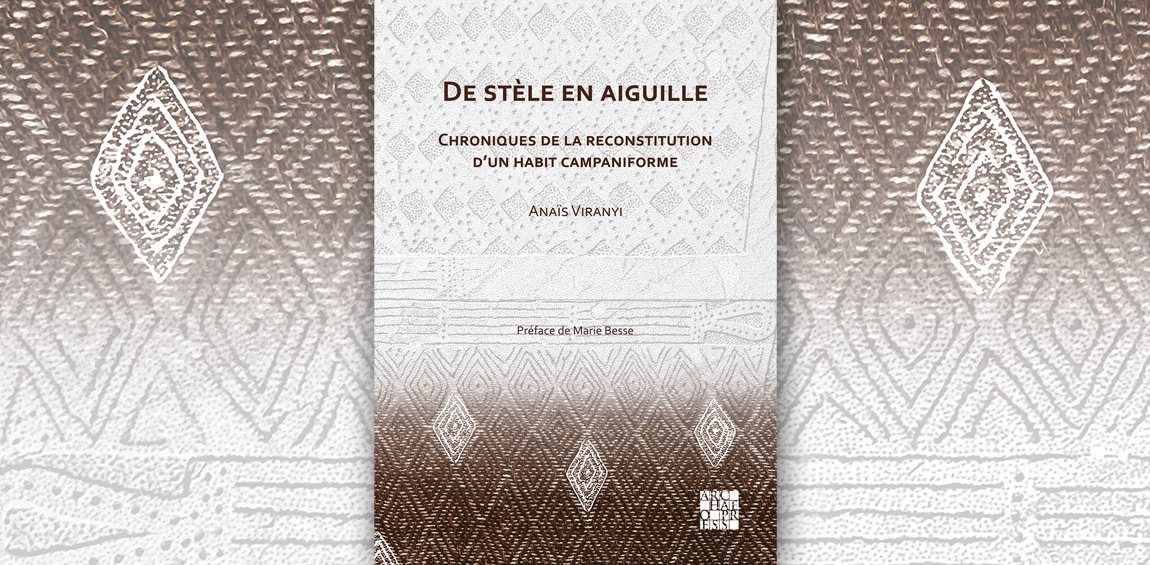
Stele èn Aiguille by Anaïs Vinary is the result of her Master Thesis in Prehistoric Archaeology, defended in 2025 at the University of Geneve. But this book is much more than simply the review of a Master’s Thesis. It is the product of combining scientific analysis and creative curiosity. I found it a fascinating book; visually attractive and very inspiring.
Arranged in three main chapters covering three key aspects of textile archaeology: the exploration of the diversity of textile-related activities in the campaniform areas around the Alps; a reflection on the position of textile artisans in prehistoric societies and; the creation of a tangible representation of the way past people dressed.
Through a very detailed reconstruction of a complete outfit (collar, capelet, tunic, belt, dress and several accessories) based on the analysis of a specific stele excavated from within the site of Petit-Chasseur à Sion (Valais, Swtzerland), Anaïs takes us on a journey that allows us to understand how the inhabitants of this campaniform site experienced what is an integral part of the human experience.
Chapter one focusses on the description of the archaeological site of Petit-Chasseur à Sion and the anthropometric stelae, their chronology, secondary uses, typology and the specific elements that are represented on each type of stelae.
In chapter two , Anaïs places in context the importance and limitations of the study of textiles from prehistoric societies, underlining how textile activities had a central place in the lives of people from the past.
Starting by defining what is considered a textile, Anaïs arranges this chapter in three main questions:
- The different sources that allow us to study textiles in a prehistoric context (textile fragments, textile related tools, iconography, associated raw materials, impressions on clay and ethnographic and experimental studies;
- A summary of the main premises that will be used during the development of the project; and
- A classification of the different techniques linked to textile production.
The chapter ends with a comprehensive review of different raw materials and techniques traditionally used for the creation of textiles.
Chapter three , full of colour images, illustrations, and includes a review of previous interpretations of the anthropomorphic stelae of Petit-Chasseur à Sion , stressing the traditional overrepresentation of the male figure.
For the first time we see an image of the garment that Anaïs reconstructs, and can compare it to the interpretation of the stele that inspired the project (stele 20).
The chapter continues with a detailed description of stele 20, a complex stele that is covered with diverse motifs, allowing for the exploration of several textile techniques.
Something that I found fascinating, is that stele 20 is included in the subgroup of stelae considered to represent a “female figure”.
The selection of this stele allows Anaïs to explore the underrepresented role of the non-warrior.
The chapter ends with a description of the limitations that an experimental project like this one can present, from the difficulty of sourcing original materials, to confine the production of the garment, to techniques and tools as similar as possible to those documented on Neolithic contexts.
Chapter four is the heart of the project. In this chapter, Anaïs describes the process she follows in the reconstruction of the different components that are part of the neolithic garment represented in stele 20.
For each component of the garment Anaïs describes how it is represented on the stele, the archaeological evidence of similar objects, some practical notes regarding her choice of materials and techniques, the process she followed in its creation – explaining each step in the process – the time it took to complete it, its dimensions, and which archaeological artefacts she used as reference.
Full of photographs, this chapter is a detailed “how to”, that will allow anyone that is interested to reproduce similar textile artifacts.
Chapters five and six are short but interesting: in both chapters, Anaïs reviews the personal impressions and sensory information obtained during the creation of each item that forms part of the garment, as well as a summary of the time that it took to create them.
Both chapters emphasize how experimental archaeology is an essential tool to reconstruction the lives of past societies, especially in terms of textile studies.
In the final chapter, chapter seven , Anaïs explains how the data gathered during the completion of her project can answer questions related to the textile sphere in Neolithic societies.
Documenting the manufacturing time of the complete garment allows reflection on how woven textiles as functional garments could have contributed to changes in social structure during the Neolithic.
Book Information:
Anaïs Vinary. 2026. De stèle en aiguille: Chroniques de la reconstitution d’un habit campaniforme. Archaeopress Archaeology, 246 pages, 190 figures
ISBN Paperback: 9781805832874, Digital: 9781805832881
Keywords
Country
- Switzerland