
The content is published under Creative Commons Attribution 4.0 International license (CC BY 4.0).
Reviewed Article:
Tracing Vessel Use-Lives through Experimental Cleaning, Baking and Burial of Reconstructed Funnel Beaker Pottery
Interpreting Neolithic vessel use requires attention to the long and often complex use-lives through which vessels entered the archaeological record. This article presents an experimental reference collection based on reconstructed South Scandinavian Funnel Beaker pottery, documenting how selected use-trace combinations formed, changed and partly disappeared through repeated use, maintenance and post-depositional processes. Abrasive cleaning removed visible food crusts while producing surface wear, whereas softer organic implements fragmented residues with limited attrition. Clay-disc baking and movement created differentiated surfaces with residues, soot, heat exposure and contact wear. After eight months in two contrasting burial environments, soot, carbonisation and cleaning-related attrition remained visible, although surface colour, thin deposits and the appearance of some corrosion-like alterations changed. Compared with 330 Middle Neolithic vessels from western Zealand, Denmark, the experimental results help identify the practices and processes that shaped visible traces. The study situates individual use-traces within longer vessel biographies and offers a comparative basis for interpreting cumulative use-alteration on low-fired prehistoric pottery.
Introduction
Pottery is one of the most abundant categories of archaeological material, but reconstructing its actual use remains challenging. Vessel form and fabric provide important indications of function but cannot alone establish how individual vessels were used in practice. Ceramic surfaces often preserve traces of activities such as heating, stirring, cleaning and handling. However, these traces are also affected by manufacture, firing, burial conditions and post-excavation treatment. Rather than providing a direct link to a single activity, use-traces may therefore reflect cumulative surface histories in which alterations from use, maintenance and deposition may overlap (Hally, 1983; Skibo, 1992; 2013; van Gijn, et al., 2020; Debels, 2021; Forte, 2022;).
This interpretive difficulty is important for Neolithic pottery, where vessels often entered the archaeological record after long or complex use-lives. A recent study of 330 Middle Neolithic Funnel Beaker vessels from settlements, wetland deposits and passage tombs in western Zealand (circa 3300–2800 BC) found that 86.7% of the vessels preserved use-related traces prior to deposition, although the frequency varied between depositional contexts: 90.9% in settlements, 94.7% in wetlands and 82.1% in passage tombs. Settlement vessels frequently exhibited soot, interior carbonisation, abrasion, and surface loss, wetland vessels were associated with heating and retained residues, and passage-tomb assemblages featured a combination of selected vessel types, often containing thin residues of contents within the vessel. (Claudi-Hansen, 2026). These patterns raise a methodological question: how do repeated culinary, maintenance, and depositional practices produce the trace combinations observed on the ceramic sherds?
Experimental reference collections are essential for addressing questions of vessel use. Controlled and single-action experiments are valuable because they clarify how specific traces may form under known conditions (Outram, 2008; Forte, Nunziante and Medeghini, 2018; van Gijn, et al., 2020; Debels, 2021). Less often foregrounded is how traces are transformed through repeated sequences, where one action may intensify, modify or remove the traces of an earlier one. The experiments presented here therefore examine the cumulative formation and alteration of traces during repeated cooking, cleaning, baking and mechanical wear, as well as the early post-depositional survival of selected experimentally produced traces.
The article has three objectives. First, it examines cleaning as an active trace-forming practice, with attention to scratches, abrasion, surface loss, cracks and exposed temper. Second, it tests whether Neolithic clay discs could function as baking plates or heated surface implements and whether the resulting traces correspond with archaeological clay discs from settlement assemblages. Third, it evaluates short-term burial experiments to assess how post-depositional processes may preserve, modify, or obscure experimentally produced surface alterations. To address these objectives, the article uses experimental reference sequences to examine how trace combinations form, change, and partly disappear through repeated use, maintenance and deposition.
Ceramic Use-Traces and Cumulative Vessel Histories
Ceramic use-traces can form, be modified, or be removed during vessel use, maintenance, and deposition. A broad distinction can be made between accretion and attrition (Skibo, 1992; 2013; Forte, 2022). Accretion refers to the deposition of material on the vessel surface and includes exterior soot, interior carbonisation, charred encrustations and other residues. Attrition refers to the removal or modification of surface material and includes scratches, striations, surface loss, exposed or pedestalled temper, pits and spalls (Skibo, 1992; 2013; Forte, 2022). Individual use-traces cannot always be linked to a specific activity. A scratch may derive from stirring, cleaning, excavation or post-excavation handling. Exterior blackening may result from use over fire, firing clouds or later burning. And surface loss may be caused by mechanical abrasion, thermal stress, reactive contents or post-depositional processes (Schiffer and Skibo, 1989; Beck, et al., 2002; Skibo, 2013; Forte, 2022).
Interpretation therefore depends on trace combinations, position on the vessel, intensity and comparison with reference material (Skibo, 2013; van Gijn, et al., 2020; Debels, 2021; Forte, 2022). This approach is related to biographical perspectives on pottery, in which vessels are understood as artefacts with use-lives shaped by manufacture, use, maintenance, reuse, fragmentation and deposition (van Gijn, 2020, p.11, pp.18–19; van Gijn, et al., 2020, pp.65–108). A vessel used repeatedly for cooking may preserve exterior soot and interior carbonisation, while cleaning may remove visible residues and add scratches or surface loss. Later burial conditions, soil chemistry, trampling, excavation and post-excavation washing may further preserve, obscure or transform these traces (Beck, et al., 2002; Debels, 2021).
Experimental and ethnoarchaeological reference collections provide an important basis for interpreting ceramic use-traces, but their relevance depends on the conditions under which traces were formed (Forte, Nunziante and Medeghini, 2018; van Gijn, et al., 2020; Debels, 2021; Forte, 2022). Existing studies have provided important comparative material for abrasion, soot formation, thermal response, residues, cooking traces, fermentation-related alteration and post-depositional modification (Skibo and Schiffer, 1987; Schiffer and Skibo, 1989; Skibo, Schiffer and Reid, 1989; Beck, et al., 2002; Forte, Nunziante and Medeghini, 2018; van Gijn, et al., 2020; Debels, 2021; Forte, 2022). No single reference collection can be applied universally, however. The reference collection presented here was therefore developed in relation to a study of 330 Middle Neolithic Funnel Beaker vessels from settlements, wetlands and passage tombs in western Zealand, Denmark, from circa 3300–2800 BC (See Figure 1; Supplementary Table S1) (Claudi-Hansen, 2026). Its purpose is to document how selected traces form on reconstructed Funnel Beaker pottery and to provide a small-scale comparative basis for interpreting cumulative surface histories within the archaeological assemblage.
Materials and Methods
Reconstructed Pottery
The experimental programme was carried out on reconstructed vessels and clay discs produced at Sagnlandet Lejre, Denmark, in 2024–2025. The full programme comprised 55 reconstructed vessels and clay discs modelled on South Scandinavian Funnel Beaker forms. These reconstructions were produced as part of a wider experimental programme on Neolithic beer brewing, vessel use and the identification of microstructural malting markers in charred archaeological cereal grains (Cordes, in preparation; Cordes, et al., 2026). This article examines a subset of the overall pottery assemblage and focuses on the vessels, clay discs, and sherds most relevant to ceramic use-traces: repeated cleaning, baking and mechanical wear on clay discs, and early burial survival. It includes three vessels used for repeated porridge cooking and cleaning, three clay discs, selected vessels from cleaning and mashing episodes and 12 sherds from porridge cooking, mashing and the storage and fermentation of substances reused in the burial experiment (See Figure 2). Supplementary Table S2 lists the reconstructed vessels and clay discs used in the experiments, including their forms, dimensions, clay and temper recipes, firing methods and post-firing colours.
Professional ceramist Inger Heebøll of Sagnlandet coil-built the vessels using a clay mixture of two-thirds red clay and one-third blue clay from Sorring Lervarefabrik, a long-established Danish clay supplier. The archaeological vessels from western Zealand are macroscopically dominated by granite- or crushed-stone-tempered fabrics with sandy matrices, although variation occurs between vessels and sites (Hulthén, 1977; Koch, 1998). The experimental clay recipe therefore included heated, crushed granite and fine sand, with 125 g of each added per kilogram of clay; granite grains were generally 3–4 mm.
Within the wider experimental programme, the vessels were fired to approximately 650 °C under varying conditions, including open fires and reconstructed clay ovens, and both oxidising and reducing atmospheres. The archaeological assemblage examined includes both oxidised and reduced vessels: of the 330 analysed vessels, 209 (63.3%) were classified as oxidised, 110 (33.3%) as reduced and 11 (3.3%) as mixed or not securely classifiable.
Recording
All vessels and clay discs were photographed and documented before and after firing, and again before experimental use. This made it possible to distinguish manufacturing and firing-related features, such as forming marks, firing clouds, small cracks and surface irregularities, from subsequent use-related traces (See Figures 2 g–h).
After each experimental series, traces were recorded at macro- and microscopic scales through naked-eye inspection, digital photography, written descriptions, sketches of trace location and low-power stereomicroscopy at 10×–40× magnification. This scale is appropriate for broad use-alteration features on low-fired pottery and follows previous traceological approaches that combine macroscopic recording with low-power microscopy with attention to trace type, location and surface topography (van Gijn, et al., 2020; Forte, 2021; 2022;).
Traces were recorded by type, location, extent, and relationship to other surface features. The recording distinguished between interior and exterior surfaces and between rim, neck, shoulder, belly and base. For clay discs, the two flat surfaces were recorded separately. For the burial experiment, sherds were photographed before burial and re-photographed after recovery, allowing comparison of the visibility and preservation of experimentally produced traces before and after short-term deposition.
Experimental Programme
The experimental programme examined how use-traces form, accumulate and survive through repeated practical actions. Detailed vessel-level information is provided in Supplementary Tables S2–S5. The experimental sequences and main trace outcomes are summarised in Table 1.
| Experimental sequence | Vessels | Treatment and repetition | Main trace outcomes |
| Wet-mode porridge cooking, stirring and cleaning | 31, 12, 30 | Ten, 20 and 30 cooking-and-cleaning episodes, water, sand and wooden spatula | Exterior soot, fine horizontal and oblique interior scratches, localised surface loss, exposed temper, beginning interior cracks |
| Baking on clay discs with cleaning | 22, 23 | Eight baking episodes per disc, five cleaning episodes with animal-hair brush or bundle of reeds | Differentiated upper and lower surfaces, carbonised food residues on the baking surface, soot and heat exposure on the underside |
| Mechanical contact wear on clay disc | 18 | Two episodes of dragging across a dry, hard surface, totalling approximately one hour | Scratches, striations, general surface wear, exposed temper and flattened inclusions on the contact surface |
| Cleaning-only treatment | 56 | One hour of cleaning with water and a bundle of hay | Little or no visible alteration of the ceramic surface |
| Cleaning of pre-existing heating and residue traces | 6, 7, 33, 49 | One to three cleaning episodes after earlier grain-and-water cooking, moss and sand, wooden spatula or bundles of reeds | Several vessels retained strong soot, carbonisation and residue traces, vessel 49 developed slight lower-interior wear and beginning pedestalled temper |
| Short-term burial | Sherds from 7, 30, A, C, D and F | Two burial environments: clayey gravel soil and humus-rich wetland soil, eight-month burial sequence | Soot, carbonisation, cleaning-related scratches, surface loss and exposed temper survived in both burial environments, burial mainly altered colour, surface appearance and some thin deposits, pre-existing milk- and whey-related alteration persisted, with whey-related alteration appearing more clearly corrosion-like after burial. |
Table 1. Experimental sequences and main trace outcomes.
Repeated Porridge Cooking and Cleaning
The repeated cleaning experiment involved cooking porridge in three reconstructed bowls: vessels 12, 30 and 31 (See Figure 3). Open bowls were selected because they are suitable for observing the distribution of interior traces, and because bowls constitute an important vessel category in the western Zealand assemblage, representing 102 of the 330 analysed vessels (30.9%). Many archaeological bowls also preserve traces of heating and food residues (Claudi-Hansen, 2026). Each vessel was filled with a porridge mixture of emmer, barley, crushed hazelnuts and water. The mixture was deliberately starchy and prone to thickening during heating in order to produce residues that required removal.
The vessels were placed on three stones above a wood fire and hot coals. The porridge was brought to the boil, stirred regularly with a wooden spoon and cooked for approximately 10–15 minutes. Vessel 31 was used ten times, vessel 12 was used 20 times and vessel 30 was used 30 times. After each episode, the vessels were allowed to cool and were then thoroughly cleaned with water, sand and a wooden spatula, until all visible food crusts had been removed. The use of sand as an abrasive cleaning medium was included because sand is historically documented in nineteenth-century rural Denmark for cleaning vessels (Højrup, 1972, p.71).
This series was designed primarily as a cumulative cooking-and-cleaning experiment. It combined residue formation, stirring, scraping and abrasive cleaning in repeated sequences. The graded number of repetitions makes it possible to compare how traces developed after 10, 20 and 30 cycles of use and maintenance.
Baking and Contact Wear on Clay Discs
The clay-disc experiments were designed to test possible explanations for trace patterns observed on archaeological clay discs from settlement assemblages. In the examined western Zealand material, clay discs are represented only in settlement contexts, where 90.3% preserve use-traces and all examples fall within the moderate- to heavy-wear range. Soot occurs on 80.6%, visible residues on 12.9%, and 51.6% have distinguishable upper and lower surfaces, with heavier abrasion, exposed temper and striations concentrated on one side (See Figure 4) (Claudi-Hansen, 2026). Dark, localised carbonised marks are also known from other Funnel Beaker settlement material, including a clay-disc fragment from Fannerup I with a regular semicircular carbon coating of uncertain formation, possibly related to burnt food (Eriksen, 1984, p.33).
The experiments examined three related processes: baking on heated clay discs, mechanical contact wear and cleaning. Baking cereal-based products was selected as one plausible activity through which differentiated surfaces, food-contact residues and soot could form. Broader uses as griddles, heated plates, heat-transfer devices, lids or supports for other food-processing activities remain possible. Mechanical movement was tested separately on disc 18, which was dragged across hard, compacted soil containing small stones near a hearth for two episodes of 30 minutes. This was included as a reference for the formation of abrasion and exposed temper through contact movement against a hard surface.
The main baking series included clay discs 22 and 23. Both discs were fired in an oxidising atmosphere before use, resulting in a light orange-brown surface with a few light grey fire-clouds. During each baking episode, a flat piece of dough was placed on one surface, while the opposite surface was exposed to embers, hot ash and occasional flame contact. The plates were equally effective whether placed directly on the embers or on three stones raised a few centimetres above them (See Figure 5). The dough consisted of naked barley flour and grains, emmer flour and grains, water and sourdough starter (See Figure 6). Each disc was used for eight baking episodes and cleaned five times. Disc 22 was cleaned with an animal-hair brush, while disc 23 was cleaned with a bundle of reeds to compare two possible cleaning methods. Further details are provided in Supplementary Tables S3–S5.
Cleaning and Maintenance Practices
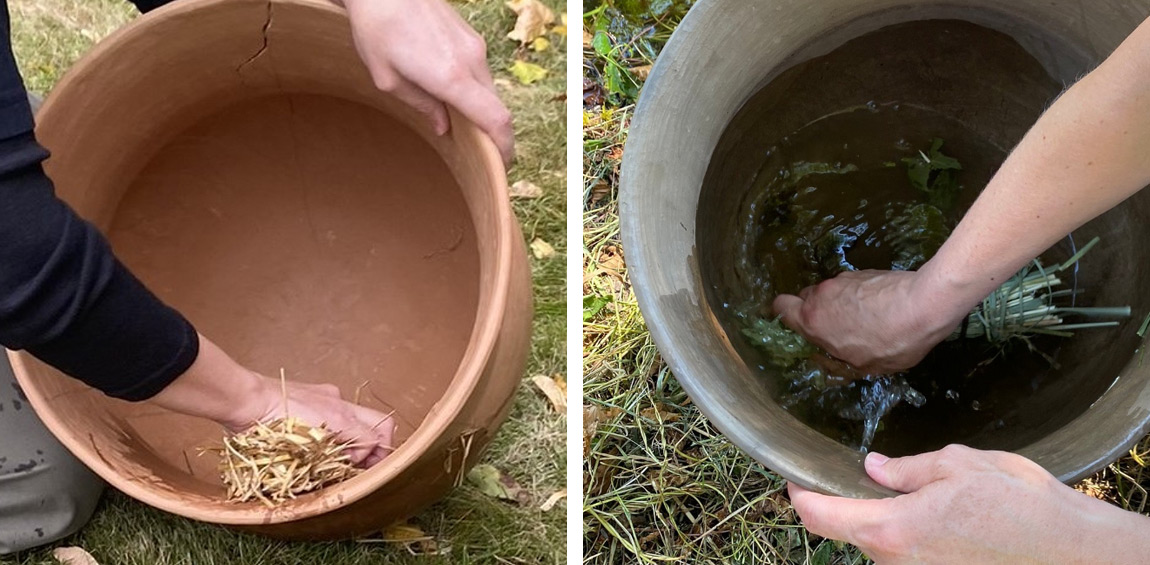
Cleaning was examined both as part of the cooking and baking sequences and through additional observations on vessels with different patterns of use and treated as a routine and trace-forming part of vessel use. The cleaning media and implements included sand, wooden spatulas, moss, bundles of reeds, an animal-hair brush and hay, with water used in all tests (See Figure 7). These materials were selected to represent a range of possible cleaning practices, drawing on historically documented rural cleaning methods in nineteenth-century Denmark (Højrup, 1972, p.71, pp.255–257). Historical cleaning practices also included clay, marl, and wood ash (Højrup, 1972), although these materials were not tested in the present experiments.
The porridge series provided the main repeated abrasive-cleaning sequence, while the baking discs and vessel 56 tested softer organic implements. Additional observations on vessels 6, 7, 33 and 49 examined how cleaning affected pre-existing soot, carbonisation and residue traces from wet-mode cooking. Details are provided in Supplementary Tables S3–S5.
Short-Term Burial
A final experimental series examined early post-depositional survival. Twelve sherds derived from six previously used vessels were buried, with two sherds selected from each vessel (See Supplementary Figure S1). The selected vessels represented different trace categories and uses. These included vessel A, with milk-related corrosion-like alteration, vessel C, used for beer fermentation but without corrosion-like alteration, vessel D, with whey-related exterior surface alteration, vessel F, used as a water-storage control and showing no use-alteration, vessel seven, used for wet-mode cooking in the mashing-heating series and showing soot, burnt residues, interior carbonisation and lime deposits, and vessel 30, from the repeated porridge-cooking and cleaning series, with soot and surface loss related to repeated cleaning (Supplementary Tables S2–S6).
The reactive-liquid and fermentation vessels provided experimentally produced surface alterations suitable for testing post-depositional survival. Their formation is discussed elsewhere (Claudi-Hansen and Cordes, in press). In the present article, these sherds are treated as part of a broader burial test designed to compare the survival of different experimentally produced traces.
The burial experiment began on 10 October 2025. Two parallel sets of six sherds, selected from the same vessels, were buried in two contrasting sediment types: clayey gravel soil and humus-rich wetland soil. The sherds were buried approximately 30 cm below the surface. In the clayey gravel soil, this corresponded to the base of the topsoil, just above the underlying subsoil. In the humus-rich wetland soil, the topsoil extended to a depth of at least 1 m. The sherds were placed in a hole made with a soil auger and buried 30 cm below the surface within this layer. The aim was to compare trace survival under different depositional conditions and to assess which experimentally formed alterations remained visible after eight months of burial. The two burial settings represent contrasting soil environments relevant to prehistoric and Middle Neolithic Denmark. Before extensive modern drainage, wetlands were more widespread, while settlements were often situated on slightly elevated sandy or clayey ground, with pottery also deposited in surrounding lower-lying cultural layers. The clayey gravel and humus-rich wetland soils were therefore chosen to approximate these different depositional settings. The experiment spanned the winter months and allowed for potential freeze–thaw cycles. The results should be regarded as observations of short-term trace survival under the conditions tested. The sherds were recovered on 10 June 2026, rinsed in water, and documented using the same photographic and low-magnification recording methods used before burial (Supplementary Table S7).
Results: Formation and Modification of Traces
The results are presented by experimental sequence, emphasising how traces were formed, modified, or partly removed through repeated actions.
Cleaning After Repeated Porridge Cooking
The porridge experiments produced a consistent combination of exterior soot, interior surface loss and other cleaning-related attrition (See Figure 8). All three vessels developed exterior soot on areas exposed to fire, with black to partly shiny soot concentrated on the middle to lower exterior walls and duller soot or oxidised patches near the base. The exact distribution varied between vessels as they were repositioned on the support stones during repeated cooking.
In this experiment, residue visibility did not directly reflect cooking intensity. Porridge residues formed during use, but thorough cleaning after each episode deliberately removed all visible food crusts before the next cooking event. The dominant final traces were therefore a combined pattern of exterior soot, interior scratches and localised surface loss with exposed temper. Cleaning with water, sand and a wooden spatula produced fine horizontal and oblique scratches, especially on the lower interior walls, belly and base. In vessels 12 and 30, many fine horizontal and oblique scratches were visible on the lower wall and belly, while the bottom and lower 3–4 cm of the wall were so heavily worn that the original surface had been removed and the temper was exposed (See Figure 9). Vessel 31 showed the same process at a less developed stage after 10 episodes, with parallel horizontal and oblique scratches and worn areas with exposed temper on the bottom and lower sides.
All three vessels developed lower-interior cracks that did not extend through to the exterior. Vessel 12 had a Y-shaped basal crack and a horizontal crack 4–5 cm above the base. Vessel 30 had a larger horizontal interior crack at a similar height, and vessel 31 had two or three smaller cracks just above the most heavily worn lower interior zone. Their restriction to the interior and their association with the most intensively cleaned and abraded zones suggest they are likely related to repeated mechanical stress from scraping and washing, possibly combined with repeated heating and cooling.
The graded sequence illustrates how repeated cooking and cleaning can transform the visible trace assemblage. After ten episodes, use was already clearly visible in the form of scratches, worn lower interior surfaces and cracks. After 20 and 30 episodes, cleaning-related attrition was more pronounced, with stronger surface loss, exposed temper and interior cracking. However, the difference between the vessels used and cleaned 20 and 30 times was not clearly gradational. Both showed broadly similar trace combinations, whereas the vessel used ten times displayed the same features to a lesser extent.
Baking and Contact Wear on Clay Discs
The clay-disc experiments demonstrated that reconstructed clay discs could be used as heated surfaces for baking cereal-based dough. Dough was placed directly on the upper surface, while the underside was exposed to embers, hot ash and occasional flame contact. The perforations also provided a practical means of lifting and moving the heated discs with a stick during use (See Figure 10).
Both baking discs developed differentiated upper and lower surfaces (See Figure 11). The upper surfaces retained black to dark-brown carbonised food residues. These encrusted residues were partly removed during cleaning, leaving thin, patchy or isolated remnants of burnt bread on the baking surface. Disc 22 developed heavier black soot on the underside, including glossy soot spots, a few oxidised patches and soot extending into the perforations. It also developed a larger incipient crack, visible only on the lower surface, possibly related to thermal stress. Disc 23 showed lighter soot overall, probably due to continued oxidation, although soot remained on the side and burnt food residues survived on the upper surface. Because the undersides were repeatedly exposed to embers and flames during the eight baking episodes, the amount and distribution of soot and oxidation varied during the experiment. On both discs, cleaning reduced the visibility of carbonised bread crusts but did not remove them completely (See Figure 12).
The separate mechanical-wear experiment on disc 18 produced a different but complementary trace pattern (See Figure 13). After two episodes of dragging across a dry, hard surface near the hearth, totalling approximately one hour, the lower surface displayed scratches, striations, general surface wear and exposed temper. The temper inclusions were worn slightly flat against the surface rather than standing prominently above it. Together, the baking and mechanical-wear experiments show that differentiated clay-disc surfaces resembling the archaeological findings can form through a combination of food contact, heat exposure, cleaning and mechanical contact wear.
Cleaning Implements, Episodes and Maintenance Traces
The cleaning observations illustrate that the visibility of maintenance traces depended on both repetition and cleaning implement. The clearest maintenance traces developed in the porridge sequence, where repeated abrasive cleaning removed visible food crusts and produced the strongest interior attrition. The ten-use vessel developed the same categories of wear as the 20- and 30-use vessels, but less extensively while the two most intensively used vessels were not clearly distinguishable by trace intensity alone.
The clay discs provide a contrast to this pattern. On discs 22 and 23, five cleaning episodes with an animal-hair brush and a bundle of reeds reduced and fragmented the carbonised bread crusts but did not remove them completely. Residues survived as thin, patchy or island-like remnants on the baking surfaces, while the ceramic surface itself showed only light scratching. The cleaning-only test on vessel 56, using water and a bundle of hay for one hour, likewise produced little or no visible surface alteration apart from adhering hay. As such the softer organic cleaning materials may affect the extent and continuity of residues without necessarily producing strong attrition traces, at least under the conditions tested.
The large funnel beakers previously used for grain-and-water wet-mode cooking in the wider mashing during brewing programme provide a further comparison. These vessels were included to observe how one to three cleaning episodes with different cleaning materials affected soot, carbonisation and residue traces. Vessel six was cleaned twice with moss and sand, vessel seven was cleaned three times with a wooden scraper and vessels 33 and 49 were each cleaned once with a bundle of reeds. Several vessels retained strong heating and residue signatures after cleaning, with limited recorded abrasive modification. Vessel 49, however, developed slight lower-interior wear, beginning surface loss and exposed temper, while vessel 6 showed slight general interior wear. Together, the observations indicate that limited cleaning, including cleaning with softer organic implements, may reduce, fragment or modify residues without causing substantial surface attrition, whereas repeated abrasive cleaning can produce more pronounced surface wear (See Supplementary Tables S3 and S6).
The experimental results indicate that these traces are shaped by cleaning material, implement and repetition. In cumulative vessel histories, the archaeological visibility of cleaning may therefore increase over time, as the residues that prompted cleaning become less visible.
Short-Term Burial and Trace Survival
After eight months of burial, the main experimentally produced use-traces remained visible on most sherds (See Figure 14 and Supplementary Figure S2). The twelve sherds were rinsed in water and documented using the same photographic and low-magnification recording methods as before burial. Exterior soot, interior carbonisation and cleaning-related attrition survived in the two different burial environments. On vessel seven, exterior soot and interior grey-black carbonisation were still visible after burial in both clayey gravel soil and humus-rich wetland soil. The thin white interior deposit, perhaps from lime, was strongly reduced, but small traces remained. On vessel 30, exterior soot, interior scratches, lower-wall abrasion, surface loss and exposed temper remained visible after burial in both soil types. The burial sequence therefore did not remove or substantially alter the main heating- or cleaning-related traces within the eight-month period.
The most visible post-burial changes concerned surface colour, surface appearance, and some loss of thin deposits (See Figure 15). Several sherds buried in humus-rich wetland soil became lighter in colour than their paired sherds from clayey gravel soil, particularly vessels A and D. Vessel C also showed marked colour differences between two sherds from the same burial environment. One sherd retained a darker colour, while the other became lighter, even though they had been positioned close together in the wetland soil. This indicates that colour differences may result from small-scale localised environmental and depositional variations, including soil conditions, moisture, exposure or the shielding of one surface by another sherd.
The reactive-liquid sherds showed clear post-burial survival, and in some cases further development, of pre-existing surface alteration. Vessel A retained milk-related exterior pitting and spalling. The wetland-buried sherd from vessel A became lighter and appeared more generally weathered than the paired sherd buried in clayey gravel soil. Vessel D retained the whey-related exterior alteration recorded before burial, but after burial this alteration appeared more clearly corrosion-like, with coalesced areas of pitting and spalling in both soil environments. The post-burial surface morphology resembles corrosion-like traces observed in the archaeological assemblages (Claudi-Hansen and Cordes in press). On vessel C, used for beer fermentation, one sherd developed a light grey mould-like accretion on the exterior, although this was not present on the sherd before burial. The water-storage control, vessel F, retained thin lime deposits after eight months of deposition in both soil types, and the sherd buried in clayey gravel soil was recovered as three fragments.
Detailed vessel-level trace outcomes are provided in Supplementary Table S7, while the main experimental trace combinations are summarised in Table 1.
Discussion
Cumulative Trace Formation and Archaeological Visibility
The experiments show that use-traces do not simply accumulate through repeated use. Cooking and baking produced soot and carbonised residues, while subsequent cleaning could remove or fragment these deposits and produce scratches, surface loss and exposed temper. Mechanical movement of clay discs caused additional surface wear. The resulting trace combinations may therefore reflect successive activities and modifications rather than a single episode of vessel use.
These results have implications for archaeological interpretation. In the western Zealand archaeological assemblage, mixed trace combinations are common: 202 of the 330 vessels (61.2%) combine accretion and attrition, and 177 vessels (53.6%) combine heating traces, in the form of soot and/or interior carbonisation, with attrition. Residues also frequently occur together with wear, with 108 vessels (32.7%) combining visible residues and attrition. Conversely, 183 vessels (55.5%) show attrition without visible food crusts. The absence of visible food crusts therefore does not rule out cooking and repeated vessel use.
Such combinations correspond well with the experimental observation that repeated use may leave some traces while reducing or removing others. However, attrition-dominated surfaces should not be interpreted as evidence for cleaning alone, since similar traces may also reflect stirring, scraping, handling or post-depositional alteration. At the level of individual scratches or worn areas, it may be difficult to distinguish the exact formative action. Interpretation depends on the position, orientation and distribution of the traces, as well as their association with other use-alterations. For example, the regularly spaced vertical scratches on the interior of the Jordløse Mose vessel do not resemble the more diffuse cleaning-related wear produced experimentally and may instead reflect repeated contact from a spoon-like implement during stirring or scraping (See Figure 16).
Cleaning as an Active Maintenance Practice
The experiments demonstrate that repeated cleaning can alter ceramic surfaces, removing residues while causing abrasion and surface loss. In the porridge sequence, ten to 30 cooking-and-cleaning cycles with water, sand and a wooden spatula removed visible food residues effectively, while producing fine scratches, localised abrasion, surface loss and exposed temper on the lower interior walls and bases. These traces are broadly comparable in character to abrasion-related traces recorded in the western Zealand assemblage, where striations or scratches occur on 245 of 330 vessels and pedestalled temper or surface loss on 95 vessels. Such archaeological traces cannot be attributed to cleaning alone (See Figure 16; Skibo, 2013; van Gijn, et al., 2020; Forte, 2022;). Nevertheless, the experiments show that repeated cleaning can contribute substantially to surface attrition over longer vessel biographies.
The experiments with softer cleaning implements, such as an animal-hair brush, reeds and hay, did not markedly alter the ceramic surface under the conditions tested, but they did affect the visibility and morphology of residues. On the baking discs, carbonised bread crusts were reduced and fragmented, surviving as thin, patchy or island-like remnants. Similar residue morphologies are present in the archaeological material, where 78 vessels with recorded food crusts are described as preserving small islands or patches of organic material (See Figure 17). By contrast, abrasive cleaning with sand and a wooden implement removed residues completely and produced substantial surface wear after only ten episodes. Together, the experiments show that cleaning low-fired, granite-tempered pottery can produce both attritional traces, such as oblique scratches, abrasion, and surface removal, and fragmented residues that resemble the patchy or island-like food crusts recorded archaeologically.
Cleaning is not only a technical response to dirt or residues, but also a socially embedded practice. What counts as clean, dirty or properly maintained varies between social settings, and cleaning practices are often embedded in wider expectations of order, care and appropriate household practice (Douglas, 1966; Shove, 2003). From a practice-theory perspective, cleaning also brings together materials, skills and meanings: water, abrasive media, brushes or plant bundles, practical knowledge of how to use them, and social expectations about when a vessel or household object is considered properly maintained (Shove, Pantzar and Watson, 2012). Cleaning may both extend or shorten the use-life of archaeological vessels and alter the traces by which that use-life is later recognised.
Ethnographic descriptions from 19th-century rural Denmark illustrate this social dimension of cleaning. The care of milk vessels and household equipment could be a matter of reputation and proper domestic practice, with washing and scouring carried out using a bundle of hay or crowberry twigs together with abrasive materials such as sand, clay or ash (Højrup, 1972, p.71). As a later historical parallel, early modern Dutch dairy production has also been linked to practical demands for clean working environments and to broader standards of domestic cleanliness (van Bavel and Gelderblom, 2009). In accounts of milkmaids delivering milk as payment to village specialists, the whiteness and scoured appearance of the milk vessels were socially noticed and compared (Højrup, 1972, p.76). Cleaning is therefore not only a practical act of maintenance but could also form part of the social presentation of household order, skill and care.
Seen in this light, the experimental results have broader interpretive relevance. Cleaning affects archaeological visibility in two ways: it may remove or fragment the residues that prompted cleaning, while also producing or accentuating scratches, abrasion, surface loss and exposed temper. Although the specific trace combinations documented here are tied to reconstructed Funnel Beaker pottery, the broader problem of separating cooking-related accretion, cleaning-related attrition and later alteration is relevant to low-fired prehistoric ceramics in general.
Clay Discs as Heated Surfaces and Contact Wear
The clay-disc experiments provide an experimental reference for interpreting Neolithic clay discs in the examined archaeological sample from western Zealand, Denmark. In the archaeological assemblage, clay discs occur in settlement contexts and almost all preserve use-traces. Many show soot, traces of heat exposure and differentiated upper and lower surfaces, with pronounced wear concentrated on one face (Claudi-Hansen, 2026). These traces have previously been considered difficult to reconcile with a primary function as lids (Davidsen, 1973).
The experimental discs reproduced several of these features. Baking produced a two-sided pattern, with carbonised food residues and partly removed crusts on the food-contact surface, and soot, heat exposure and contact traces on the underside. The discs were practical for baking bread products, and the perforations provided a simple way of lifting and moving the hot disc with a stick (See Figure 12). Comparable interpretations have been proposed for other Neolithic flat ceramic implements, including Late Neolithic husking trays from Upper Mesopotamia, circa 6400–5900 BC, which have been linked to cereal-based baking through integrated use-alteration, phytolith and residue approaches (Taranto, et al., 2023; Taranto, et al., 2024). The separate dragging experiment showed that pronounced underside wear, exposed temper and flattened inclusions could form relatively quickly through contact with a hard surface. Archaeological underside wear on clay discs may therefore reflect brief movement, rotation or adjustment in the hearth area, rather than necessarily prolonged use over many years. Together, the experiments support a baking or griddle-like use as a plausible explanation for at least some archaeological clay discs, while leaving other functions open.
Short-Term Burial and Taphonomic Filtering
The short-term burial experiment shows that vessel biographies continued after deposition, but not in ways that affected all traces equally. After eight months in both clayey gravel soil and humus-rich wetland soil, the main experimentally produced traces remained visible. Exterior soot, interior carbonisation and cleaning-related attrition, including scratches, surface loss and exposed temper, survived in both environments. This suggests that such traces may be relatively robust during early burial and may remain archaeologically identifiable after deposition.
At the same time, the burial experiment also shows that post-depositional conditions are not neutral. Although the main trace categories survived, burial affected surface colour, the visibility of thin deposits, and the appearance of already altered surfaces. Several sherds buried in the humus-rich wetland soil became lighter than their paired equivalents from clayey gravel soil, while vessel C demonstrated that even sherds from the same vessel, buried close together in the same deposit, may develop different colours. This indicates that sherd colour cannot always be treated as a straightforward reflection of manufacture, firing or use alone, but may also be shaped by small-scale depositional variation, such as differences in moisture, exposure to air, sediment contact, or the shielding of one sherd by another. A comparable pattern can be observed in the material from the passage tomb Olstrupgård, where two joining sherds from the same context differ markedly in colour (See Figure 15d). Such examples underline that colour variation may arise during deposition and burial, even within a single depositional context, and should therefore be interpreted cautiously in relation to vessel use or deposition.
The burial results are also relevant for understanding reactive or transformation-related traces. The sherds from the milk and whey experiments retained their pre-burial pitting, spalling and raised or altered surfaces, and in the whey vessel these appeared even more clearly corrosion-like after burial. This suggests that chemical or corrosive surface alteration produced during use may persist into the archaeological record and may even be visually accentuated by time or burial.
Overall, the experiment shows that early post-depositional processes did not erase the principal traces of heating and cleaning, but they did modify colour, surface appearance and some alteration traces. Deposition should therefore be treated as an active stage in vessel biographies. Archaeological ceramics reach the archaeologist as surfaces filtered through burial conditions as well as through prior histories of cooking, cleaning and contact with reactive substances.
Conclusion
This experimental reference collection shows how use-traces on reconstructed Funnel Beaker pottery were formed, modified and partly removed through successive episodes of use, maintenance and burial. Abrasive cleaning removed visible food crusts while producing scratches, surface loss and exposed temper, whereas softer organic implements fragmented residues with limited surface wear. Baking on clay discs produced contrasting food-contact and heat-exposed surfaces, while mechanical movement created additional contact wear. After eight months of burial, the principal heating- and cleaning-related traces remained visible, although surface colour, thin deposits and some pre-existing alterations changed.
More broadly, the experiments indicate that cumulative trace formation is not simply a matter of traces becoming thicker, clearer or more numerous over time. Repeated use may intensify some traces, while cleaning, handling, mechanical contact and deposition may reduce or transform others. The relatively low frequency of visible food crusts on settlement pottery from western Zealand may partly reflect their removal through cleaning or modification during subsequent use, although other factors, including preservation, may also have contributed. While the trace combinations documented here are specific to the reconstructed Funnel Beaker fabrics and experimental conditions tested, the broader issues are relevant to low-fired ceramic use-wear studies in general. The experiments provide a practical framework for interpreting vessels as artefacts with cumulative use-lives, shaped by food preparation, maintenance, handling and deposition.
Acknowledgments
We are grateful to Lejre Land of Legends for facilitating the experiments and providing an excellent setting in which to carry them out. We especially thank Charlotte Frantzdatter and Eline Avlund Nepper-Christensen for welcoming us and helping the experiments run smoothly. We also thank Kim Hebelstrup and Peter Steen Henriksen for sharing their knowledge, skills and good company during the experimental work. Søren Feldborg Pedersen is thanked for his collaboration and company, and Sofie Nielsen for her engagement and careful recording of firing methods and firing effects.
Funding statement
This research forms part of the PhD project: Rituals of Culinary Practices. Identifying Social and Ritual Dimensions of Foodways in the Funnel Beaker Culture of Denmark (Lone Claudi-Hansen), funded by the Ministry of Culture’s Research Fund, administered by the Danish Agency for Culture and Palaces, the Brand of 1848 Foundation and the Beckett-Foundation. The production of the reconstructed Neolithic ceramic vessels was undertaken within the PhD project: Malt and beer brewing in South Scandinavian Prehistory (Adam Cordes) and was supported by funding for experimental reconstruction and brewing experiments from the Farumgaard Foundation, the Elisabeth Munksgaard Foundation, and Queen Margrethe II’s Archaeological Foundation.
Country
- Denmark
Bibliography
Beck, M.E., Skibo, J.M., Hally, D.J. and Yang, P., 2002. Sample Selection for Ceramic Use-Alteration Analysis: The Effects of Abrasion on Soot. Journal of Archaeological Science 29, pp.1–15. Available at: < doi: 10.1006/jasc.2000.0631 >
Claudi-Hansen, L., 2026. Domestic use and ritualised deposition: culinary practices and vessel biographies in the Middle Neolithic Funnel Beaker Culture of western Zealand, Denmark. Praehistorische Zeitschrift . Available at: < https://doi.org/10.1515/pz-2026-3043 >
Claudi-Hansen, L. and Cordes, A, 2026. Food transformation and ritualised deposition in Middle Neolithic passage tombs: ceramic use-wear evidence from Denmark. Antiquity . Available at < https://doi.org/10.15184/aqy.2026.10483 >
Cordes, A. in preparation. Malting and Beer Brewing in Prehistoric Southern Scandinavia . Institute of Agroecology, PhD thesis, Aarhus University Flakkebjerg.
Cordes Henriksen, P. S., Taube, M., Johansen, S. M., Hald, M. M., Sørensen, L. V. and Hebelstrup, K. H., 2026. Evaluating microstructural malting identification markers in charred archaeological cereal grains. Journal of Archaeological Science: Reports , Vol. 73 , 105847. Available at: < https://doi.org/10.1016/j.jasrep.2026.105847 >
Davidsen, K., 1973. Neolitiske lerskiver belyst af danske fund. Aarbøger for Nordisk Oldkyndighed og Historie 1973, pp.5–72.
Debels, P., 2021. What’s on the Menu? An Experimental Approach to the Functional Study of Neolithic Pottery. In: S. Beyries, C. Hamon and Y. Maigrot, ed. 2021. Beyond Use-Wear Traces: Going from Tools to People by Means of Archaeological Wear and Residue Analyses , pp.69–78. Leiden: Sidestone Press.
Douglas, M., 1966. Purity and Danger: An Analysis of Concepts of Pollution and Taboo. London: Routledge and Kegan Paul.
Eriksen, P., 1984. Det neolitiske bopladskompleks ved Fannerup. Kuml 1984, pp.9–76.
Forte, V., 2021. Craft Identities and Skill in Copper Age Communities: A Multidisciplinary Approach to the Pottery Production of Central Italy. In:S. Beyries, C. Hamon and Y. Maigrot, ed. 2021. Beyond Use-Wear Traces: Going from Tools to People by Means of Archaeological Wear and Residue Analyses , pp.381–392. Leiden: Sidestone Press.
Forte, V., 2022. Use Activities, Wear Mechanisms and Residues: The Use Alterations Variability on Pottery in Light of the Latest Research Advancements. In:J. Vuković and V. Bikić, ed. 2022. Pottery Function and Use: A Diachronic Perspective , pp.13–36. Belgrade: University of Belgrade, Faculty of Philosophy and Institute of Archaeology.
Forte, V., S., Nunziante, C.andMedeghini, L., 2018. Cooking Traces on Copper Age Pottery from Central Italy: An Integrated Approach Comprising Use-Wear Analysis, Spectroscopic Analysis and Experimental Archaeology. Journal of Archaeological Science: Reports 18, pp.121–138. Available at: < 10.1016/j.jasrep.2017.12.052 >
Hally, D.J., 1983. Use Alteration of Pottery Vessel Surfaces: An Important Source of Evidence for the Identification of Vessel Function. North American Archaeologist, Vol.4, pp.3–26. Available at: < 10.2190/AK54-RNE2-9NGY-AHQX > [Accessed 16. November 2026]
Højrup, O., 1972. Landbokvinden: Rok og Kærne, Grovbrød og Vadmel . Copenhagen: Nationalmuseet.
Hulthén, B., 1977. On Ceramic Technology during the Scanian Neolithic and Bronze Age . Theses and Papers in North-European Archaeology 6. Stockholm: Akademilitteratur.
Koch, E., 1998. Neolithic Bog Pots from Zealand, Møn, Lolland and Falster . Nordiske Fortidsminder, Series B 16. Copenhagen: National Museum of Denmark.
Outram, A.K., 2008. Introduction to Experimental Archaeology. World Archaeology Vol. 40, pp.1–6. Available at: < https://doi.org/10.1080/00438240801889456 >
Schiffer, M.B. and Skibo, J.M., 1989. A Provisional Theory of Ceramic Abrasion. American Anthropologist 91, pp.101–115. Available at: < 10.1525/aa.1989.91.1.02a00060 > [Accessed 16. November 2026]
Shove, E., 2003. Comfort, Cleanliness and Convenience: The Social Organization of Normality . Oxford: Berg.
Shove, E., Pantzar, M. and Watson, M., 2012. The Dynamics of Social Practice: Everyday Life and How It Changes . London: SAGE.
Skibo, J.M., 1992. Pottery Function: A Use-Alteration Perspective . New York: Springer.
Skibo, J.M., 2013. Understanding Pottery Function . New York: Springer.
Skibo, J.M. and. Schiffer, M.B, 1987. The Effects of Water on Processes of Ceramic Abrasion. Journal of Archaeological Science Vol. 14, pp.83–96.
Skibo, J.M., Schiffer, M.B. and Reid, K.C, 1989. Organic-Tempered Pottery: An Experimental Study. American Antiquity, Vol. 54(1), pp.122–146. Available at: < https://doi.org/10.2307/281335 >
Taranto, S., Portillo, M., Gómez Bach, A., Molist Montaña, M., Le Mière, M. and Lemorini, C., 2023. Investigating the Function of Late Neolithic “Husking Trays” from Syrian Jazira through Integrated Use-Alteration and Phytolith Analyses. Journal of Archaeological Science: Reports, Vol. 47, 103694. Available at: < 10.1016/j.jasrep.2022.103694 > [Accessed 16 November 2026]
Taranto, S., Breu Barcons, A., Portillo, M., Le Mière, M., Gómez Bach, A., Molist, M. and Lemorini, C., 2024. Unveiling the Culinary Tradition of “Focaccia” in Late Neolithic Mesopotamia by Way of the Integration of Use-Wear, Phytolith and Organic-Residue Analyses. Scientific Reports, Vol. 14, 26805. Available at: < https://doi.org/10.1038/s41598-024-78019-9 >
van Bavel, B.J.P. and Gelderblom, O., 2009. The Economic Origins of Cleanliness in the Dutch Golden Age. Past & Present, Vol. 205 (1), pp.41–69. Available at: < 10.1093/pastj/gtp041 > [Accessed 16 november 2026]
van Gijn, A., 2020. Introduction. In: A. van Gijn, J. Fries-Knoblach and P.W. Stockhammer, ed. 2020. Pots and Practices: An Experimental and Microwear Approach to Early Iron Age Vessel Biographies , pp.11–19. Leiden: Sidestone Press.
van Gijn, A., Verbaas, A., Dekker, J., Feisrami, T., de Koning, N., Spithoven, M., Timmer T. and Vernon, F., 2020. Studying the Life History of Vessels: Creating a Reference Collection for Microwear Studies of Pottery. In: A. van Gijn, J. Fries-Knoblach and P.W. Stockhammer, ed. 2020. Pots and Practices: An Experimental and Microwear Approach to Early Iron Age Vessel Biographies , pp.65–107. Leiden: Sidestone Press.