

The content is published under Creative Commons Attribution 4.0 International license (CC BY 4.0).
Unreviewed Mixed Matters Article:
Event Review: PaleoFest, the Prehistory Festival – Montevarchi (Arezzo, Italy), 4–5 October 2025
On Saturday 4th and Sunday 5th October 2025, Montevarchi (Tuscany, province of Arezzo) hosted PaleoFest, the Prehistory Festival. The event was organized by the Montevarchi Paleontological Museum and the Accademia Valdarnese del Poggio, the institution that owns the museum.
The Accademia is committed to preserving and making accessible the fossil heritage of the Valdarno area, long recognized by the scientific community as a fossil basin of extraordinary importance. Founded in 1805, the Accademia is housed in the former Franciscan convent of San Lodovico di Tolosa in the center of Montevarchi, where the museum has been located since 1829. The structure, built in the 14th century and expanded over the centuries, was restored and redesigned in 2014.
PaleoFest began in 2017 to highlight the museum’s rich paleontological and archaeological collections. It also reaches out to diverse audiences by bringing events into Montevarchi’s squares and offering excursions throughout the region. The variety of venues is matched by the variety of formats: exhibitions, scientific talks, installations, theatre and musical performances, educational activities, sensory experiences, animated readings, scientific book fairs, guided tours, focus groups, themed food experiences, and storytelling.
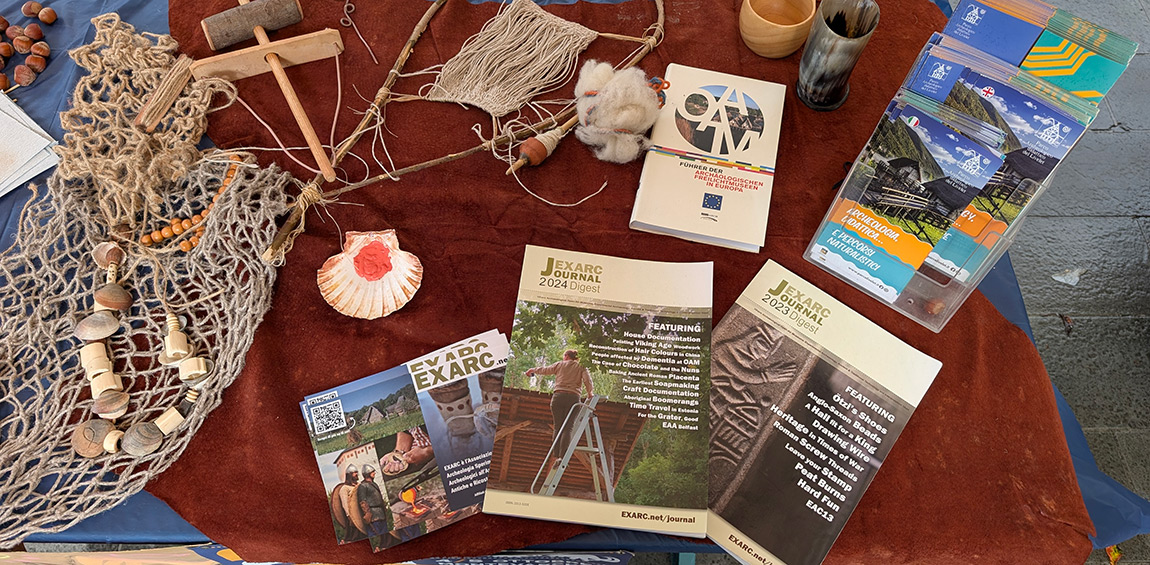
The initiative involves numerous partners and professionals, including universities, cultural institutions, cooperatives, museums, experimental archaeologists, paleontologists, and museum educators. EXARC participated in the event on Sunday 5th October, with a stand dedicated to two educational workshops on Prehistory.
The 2025 edition opened at 10:00 a.m. on Saturday 4th October, in the Accademia’s Sala Grande (Great Hall) with institutional greetings and the presentation of the work produced for the project Adotta un mammifero (Adopt a Mammal), carried out with local schools. At noon, the hall hosted the theatrical performance Dragogeno. Il pezzo di lignite che non si fece bruciare (Dragogeno: The Lignite Chunk That Wouldn’t Burn), aimed at families and children aged six and up, curated by Monia Baldini and Sergio Serges.
In the early afternoon, the conference Schiena, parto e giudizio: i compromessi dell’evoluzione umana (Backs, Birth, and Judgement: The Compromises of Human Evolution), presented by Simone Rizzuto, took place. Finally, at 5:00 p.m., a meeting was held with Raffaele Sardella from “La Sapienza” University of Rome, dedicated to Ecosistemi e cambiamenti climatici nel Quaternario italiano (Ecosystems and Climate Change in the Italian Quaternary).
In addition to the Great Hall, Saturday’s activities were also held in the museum, where at 4:00 p.m. restorer Antonella Aquiloni led a guided tour. The day concluded at 9:30 p.m. with the investigative game Un museo da morire (A Museum to Die For), curated by the association From Beyond APS.
The event also offered activities outside the museum spaces, such as Storie prima della storia: letture animate dentro la caverna e pitture rupestri per famiglie con bambini (4-11 anni) (Stories Before History: Animated Readings Inside the Cave and Rock Paintings for Families with Children (ages 4-11)), organized by the Children’s Library, I Seminalibri (The Bookspreaders), and the volunteers of the Universal Civil Service, hosted at the Municipal Children’s Library.
Completing the day's educational offerings was an excursion with a simulated paleontological dig for families and children, organized by CGT Engineering in collaboration with ENEL, in the former mining area of Castelnuovo dei Sabbioni (Cavriglia).
The 2025 edition of PaleoFest continued on Sunday 5th October, with a program spread across excursions, talks, and activities held in various locations throughout the area.
The day began at 9:00 a.m. with an excursion through the Balze di Castelfranco di Sopra, curated by Vagamondo Trekking and Legambiente. In the afternoon, a second excursion took place in Loro Ciuffenna, organized by CAI Valdarno Superiore.
At 10:00 a.m., at the Cassero Museum of Italian Sculpture of the 19th and 20th centuries, the results of the accessibility projects M.I.R.A. – Musei in Rete per l’Autismo (Museums in a Network for Autism) and SensiAbilità (SensAbility) were presented, along with the new initiatives planned for the next two years.
At 11:15 a.m., the Paleontological Museum hosted the opening of a temporary exhibition featuring the works produced within the two projects, followed at 11:45 a.m. by the creative theatre workshop Paesaggi di storie (Landscapes of Stories), curated by the company Diesis Teatrango. In the afternoon, at 3:00 p.m., a tour of the historical collections was offered by Fausto Barbagli, historian of science, and Samuele Frosali, researcher of the collection.
Meanwhile, starting at 10:30 a.m. in Piazza Vittorio Veneto, the Area ScienzAttiva (Active-Science Area) opened, featuring scientific museums and organizations engaged in experimental archaeology activities and workshops. The afternoon animated the streets of the historic center with the performances Loco-Motiv (3:30 p.m. and 5:00 p.m.), curated by Gambeinspalla Teatro under the artistic direction of Maschera Viva, and with a themed parade by the children of the homeschooling project Nuvole Bianche (White Clouds) at 4:00 p.m.
The day ended at 5:30 p.m. in the Accademia’s Great Hall with the science-theatre performance Scimmie, uomini e dei (Monkeys, Men, and Gods), performed by Stefano Ricci with music by Jacopo Crezzini.
EXARC’s contribution focused on the Area ScienzAttiva, where from 10:00 a.m. to 6:00 p.m. on Sunday 5th October, Federico Cappadona, EXARC Communications Manager, and Vittoria Faga, educator and museum guide, offered two educational workshops inspired by prehistory. Designed specifically at the museum’s request for children, the workshops also drew participation from parents and university students.
The first workshop, Suoni dalla Preistoria (Sounds from Prehistory), explored sound production in the past, with an introduction to the role of sound in hunter-gatherer societies and the materials and tools available to produce it. Participants made simple whistles from dried hazelnuts, with the base removed and the inside hollowed out. The workshop demonstrated how such a simple tool can produce very high-pitched sounds, illustrating the variety of functions materials can take on in different contexts, after simple modification processes carried out with tools of varying complexity.
Pitture per tuttə (Painting for All) focused on Palaeolithic art, inviting participants to trace on large sheets of packing paper the outlines of animals depicted in various Palaeolithic caves or typical megafauna of the Ice Age. Among the available silhouettes were mammoths, giant deer, cave bears, and penguins, the latter inspired by representations in the Cosquer Cave. During the activity, participants were introduced to the materials used at the time, such as ochres, plant pigments, and charcoal, along with their functions and uses. After colouring the silhouettes with non-toxic pigments (charcoal and chalk), the final step involved crumpling and reopening the sheets to create a corrugated effect reminiscent of cave walls. Younger participants were invited to take their drawings home and observe them in the dark, with a torch or candle, to see how light transformed and distorted the shapes of the animals on the paper’s irregular surface, just as firelight did on cave walls.
Both workshops ended with a body-painting session, where children were given 'prehistoric' face paint using non-toxic pigments.
EXARC’s participation in the event supports its goal of expanding the experimental archaeology community to younger generations and involving them in educational activities that allow them to learn through play, develop manual skills, and become familiar with different materials.
The festival, considered the most important outreach event of the Accademia Valdarnese del Poggio and the Montevarchi Paleontological Museum, aims explicitly to move beyond exhibition halls into the urban fabric, engaging local citizens, associations, and businesses.
Lorenzo Tanzini, President of the Accademia Valdarnese del Poggio, explained the vision behind the festival in an interview with EXARC during the event:
"There are two reasons behind PaleoFest. The first is to create a network with other museums or organizations involved in paleontology and archaeology, in Tuscany, Italy, and beyond.
The second is to bring the collections and experience of the paleontological museum outside its walls, into the square, into the city. To bring it physically and symbolically into the historic center of Montevarchi, seeking new languages and new forms of communicating scientific knowledge, including through play and direct experience. From this perspective, experimental archaeology is one of the most effective communication tools for us.
This initiative also reflects a concept of the museum and cultural heritage as a factor of inclusion and citizenship. Within the events of these two days, there are many moments designed for specific audiences requiring tailored forms of communication. Overall, we believe that all citizens should have access to heritage and rediscover, through its enjoyment, a sense of belonging to the community."
This vision, focused on diversifying cultural offerings and expanding communication formats, has ensured the success of the festival, now in its eighth edition, which saw a large turnout and positive impacts across the region.
The museum and the Accademia intend to continue this experience in the coming years, further expanding the cultural and educational offerings and making the initiative increasingly accessible and inclusive.
Keywords
Country
- Italy