

The content is published under Creative Commons Attribution 4.0 International license (CC BY 4.0).
Unreviewed Mixed Matters Article:
Event Review: Digital Storytelling Festival by Europeana 2026
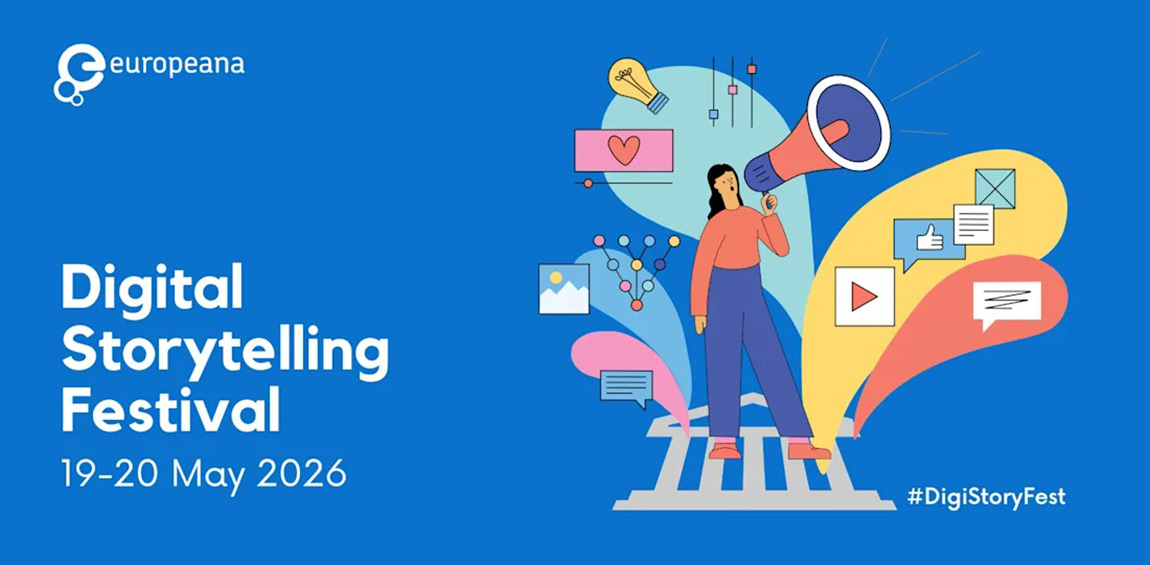
The Digital Storytelling Festival 2026, organized by Europeana and held online on May 19–20, took place between 9:00 a.m. and 2:00 p.m. (Lisbon time/GMT). It brought together professionals, researchers, and creators connected to digital cultural heritage, with the aim of exploring innovative storytelling practices and the impact of emerging technologies on cultural mediation.
The programme began with a welcome session, followed by a keynote by Pauline MacKay (University of Glasgow), focused on the relationship between literary heritage (e.g. the works of Robert Burns) and the metaverse. The talk discussed the potential of virtual reality as a narrative tool that allows audiences to “enter” literary worlds and interact with cultural content in an immersive way. Throughout the first day, several thematic panels stood out, among which Interactive Formats, featuring Rob van Haarlem (Tijdlab), Matevž Straus (Arctur), and Pauline MacKay. They explored the use of technologies such as virtual reality, 3D modelling, and interactive experiences to make heritage more accessible and engaging (this could also help eliminate the “do not touch” concept?). This was followed by the panel Silent Artefacts, with Samba Yonga (Women’s History Museum of Zambia) and Anastazija Petrović (Ethnographic Museum of Zagreb), which offered a critical reflection on the role of museums, the legacy of colonialism, and the need for ethical approaches to the interpretation of cultural objects, considering them not merely as artefacts but as living elements of memory and knowledge.
The programme also included a workshop entitled Hooked on Ekphrasis, led by Lorette C. Luzajic (Ekphrastic Review), focusing on the relationship between visual art and creative writing, demonstrating how digital collections can serve as inspiration for new narratives. I missed the final part of the workshop due to lunch break, as well as an interactive social moment in the form of a quiz that concluded the first day.
The second day followed a similar structure, beginning with a keynote by John Beauchamp (Jagiellonian University / KU Leuven), dedicated to the role of sound in enhancing heritage spaces, highlighting the importance of soundscapes and audio storytelling in creating more immersive and emotionally engaging experiences. This was followed by the panel Engaging Audiences with AI, with Martina Freitag (Kunsthalle Praha) and Julie L. Parisi (MUNCH), which addressed the use of artificial intelligence as a creative and educational tool, fostering new ways of interpreting and exploring museum collections. Another noteworthy session was the panel Play and Remix, with Wytze Koppelman (Netherlands Institute for Sound & Vision), Mart Alaru (Estonian National Museum), and Christine Koblitz (Wien Museum). This panel discussed practices for creative reuse of digital heritage (and its inclusion in cultural history), including video games (and how to create a game library for their preservation as a physical object as well as a virtual copy), simulators, augmented reality experiences and cultural remix projects.
The programme also included the workshop Slow Looking with Europeana, led by Christine Hveding (Europeana Foundation) and Daniela Bunea, which presented methodologies of careful observation and critical interpretation of digital collections, promoting pedagogical practices based on reflection, empathy, and emotional engagement.
I missed the final part of the festival again due to lunch break, which ended with a creative competition entitled “GIFted Moment”, based on GIF content from digital archives, reinforcing the playful and participatory dimension of contemporary storytelling.
Overall, the festival highlighted the growing importance of digital storytelling as a tool for cultural mediation, emphasizing themes such as technological immersion, the use of artificial intelligence, active audience participation, the creative reuse of heritage content, and the integration of different sensory dimensions in the construction of narratives. By fostering dialogue between technology and heritage, the event contributed to reflection on new ways of interpreting, communicating, and experiencing culture in the contemporary digital context.
Links (including suggested applications):
- Edify | Immersive Learning for Enterprise & Higher Education
- What is XR, and how is it radically transforming industries?
- Infinite Muse
- Historic Buildings and Cityscapes | 5Dculture
- Women’s History Museum of Zambia
- etnografski muzej – Web etnografskog muzeja
- Kunsthalle Praha
- Munchmuseet
- Free AI Voice Generator & Voice Agents Platform | ElevenLabs
- Runway | AI Image and Video Generator
- Nim · O melhor app para produção de vídeo com IA
- Homepage Sound & Vision
- Eesti Rahva Muuseum
- A Shared Secret - WIEN MUSEUM
- Relax and immerse yourself... the art of experiencing museums slowly - The Art Newspaper - International art news and events