
The content is published under Creative Commons Attribution 4.0 International license (CC BY 4.0).
Reviewed Article:
Experiments Using Mixtures of Earth and Straw to Hermetically Seal Underground Pits Intended for Grain Storage and Ensure Optimal Preservation
In regard to underground grain storage, archaeologists know only the shape and volume of storage pits and understand that air and watertightness is essential to protecting the reserves. It is therefore necessary to consider the plausible and effective methods for sealing such pits. The seals must be natural, readily available, and locally sourced. The grain reserves must be protected from external pests, such as insects and rodents. Given that grains are living organisms the internal environment of the pits must be capable of isolating the grain from external elements without hindering their natural development. The experiments on grain preservation in storage pits focussed primarily on using a mixture of soil and straw to seal them. The recipes and manufacturing processes have been gradually improved over ten years of experiments conducted by a multidisciplinary team.
Introduction
Archaeological findings show that underground storage pits, commonly known as ‘silos’, have been in use in the Near East since the Neolithic, some ten thousand years ago. They have been found in various geographical regions and from different periods in history (Sigaut, 1981). In Europe, they fell out of use around the 16th century but are still found today in certain traditional agricultural practices, particularly in Sudan (Abdalla et al., 2002) and the Maghreb (Sigaut, 1979a), where they sometimes incorporate modern innovations in terms of shape and volume, watertightness and closure, such as the use of buried metal or plastic containers (Fleurat-Lessard, 2025). The fact that many societies have adopted them, is testament to their effectiveness, whether simply to deter looting, prevent the risk of fire or avoid damage caused by pests. Archaeologists currently excavate pits of various sizes, shaped like an inverted electric bulb (with a rounded base) or a bell (with a flat base), which allows them to be sealed tightly. Examples of abandoned pits, sealed but empty, are exceptional, as are pits containing forgotten grain stores that have preserved in a charred state (Ruas, 2011; Yebdri, 2022). Generally abandoned for use as a storage pit as soon as the structure deteriorated, these were subsequently reused as domestic rubbish pits, thus making it impossible to understand the activities carried out during their original function, or at least, the clues remain elusive.
Ethnologists collect accounts of traditional practices specific to a particular geographical region, without being able to confirm that the storage process is similar elsewhere or in a different period. Historical sources are scarce and incomplete, because their use was so commonplace that it did not seem necessary to record the rules for their implementation or the appropriate methods for optimal grain preservation. Consequently, as European populations moved away from this method of storage in favour of granaries and above-ground warehouses, the expertise required to make this technique effective in local soil and climate conditions has been lost (Sigaut, 1979b).
The assumption regarding the good preservation of the grain, accepted by the Western archaeological community and as formulated in Reynolds’ work in the late 1970s, was that the grains began to deteriorate and, in doing so, consumed the oxygen in the pit until they reached a state of dormancy (Reynolds, 1979a; b). However, following on from experiments on grain storage in silo pits have resulted either in failures due to high levels of moisture or led to the conclusion that the germination and health qualities of the grain stock tended to decline over time (Firmin, 1984; Bartali et al., 1989; Reynolds, 1988; Bourrouilh and Saout, 2016; Whittaker et al., 2014). However, at a time when there is a growing enthusiasm for low-energy and resilient techniques, driven by fears of a looming energy crisis, it makes sense to revisit the technologies that have been tried, evaluated and used by the farming communities over thousands of years. In the south of France, where the climate is Mediterranean, a multidisciplinary team conducted a series of trials, using modern analytical tools, between 2016 and 2025 with the aim of rediscovering traditional knowledge and skills and analysing their effectiveness (Dominguez et al., 2022, 2024, 2026; Savoie et al., 2026). Among others, the question of how to seal the pits to make them watertight and airtight has been a concern throughout the years of experimentation. The soil excavated from the pit and straw harvested with the grains provided the materials for sealing silos of underground grain storage. By adding water, a plastic earth-straw material (ESM) can be produced. Accounts of traditional practices already employed in past experiments mention surface domes and sealing with earth or cob; however, technical information regarding the methods and recipes is scarce and not detailed.
As part of the experimental archaeology trials presented above, surveys and observations on the use of ESM were used at various stages: to line the walls and seal the opening neck; to construct and protect the dome at the top; and to coat the walls of the storage chamber with a thick layer of mortar. ESM lends itself well to experimentation because it comes in different forms depending on its fibre and water content. Furthermore, this material is easy to use and handle; it poses no danger to the grain or to those handling it; it can be reused indefinitely from one year to the next simply by mixing it with water. In this article we outline the development of the ESM’s formulations and implementation as a critical technic for the suitable preservation of grains in silo pits.
Methods
Pits were dug to the shape and dimensions most commonly found in the archaeological record, namely volumes of around 600 litres (See Figure 1), at two separate sites in South-West of France: Alénya (42.63968, 2.97021) and the Ruscino Archaeological Museum in Perpignan (44.42150, 0.38560), in order to have different soil context types (See Figure 2). In Alénya, at a depth of 1.4 meters, the subsoil consists of layers of Holocene sandy gravel alluvium interspersed with compact clay layers that become increasingly clayey as one goes deeper. In Perpignan, the subsoil is made up of very compact clays mixed with quartz pebbles, evidence of a high Pleistocene terrace. Following the current observations in archaeological excavations, the pits, which were 130 cm both in diameter and depth, featured a neck at the top measuring 50–60 cm in diameter and the same height, which facilitated airtight sealing of the silo. The bottoms of the pits were prepared by laying down a 10 cm thick layer of straw, which was then compacted before grains of either einkorn, or barley, or wheat heritage cereal varieties, from organic farming, were poured in up to the level of the pit’s entry shoulder. Before sealing, the tops of the grain piles were covered with a further 10 cm layer of straw. The pits were sealed, for storage periods of up to six and 12 months. Within the storage chambers, there were sensors recording temperature and relative humidity, and in some cases an intragranular air extraction device enabling spot measurements of oxygen and carbon dioxide levels. At the end of the storage period, grain samples were analysed to assess their sanitary quality, germination capacity and processing value, which was compared to control batches stored under the usual storage conditions of cereal producer farms. Current technical and biological knowledge, centred on the risks of pest infestation and the development of moulds leading to grains alteration and their contamination by mycotoxins, rendering them unsuitable for human consumption, were used to assess the grain preservation and understand what happened in the silo pits (Dominguez et al., 2022, 2024, 2026; Savoie et al., 2026).
The geographical area of the experimental sites located in the Mediterranean Basin has a Mediterranean climate according to the Köppen climate classification system. It is a warm temperate climate characterised by warm and sunny summers with low relative humidity, and mild and moist winters.
Over the course of ten years of experimentation on the underground storage of cereals, the closure protocols have been regularly adapted. Each modification focused on a single parameter, which was tested simultaneously on several pits in order to assess its effects on the preservation of the stock. The process of ESM’s making has gradually evolved to meet growing production demands, whilst improving the material’s consistency. Initially carried out by hand on a tarpaulin, the process involved mixing moistened earth and straw until a homogeneous paste was obtained (See Figure 3). The increase in the number of silos led to the mechanisation of certain production stages using various pieces of equipment: a vertical mixer (See Figure 4a), a planetary mixer (See Figure 4b) and then an electric concrete mixer (See Figure 4c). Experience has shown that the mechanical incorporation of long fibres tended to form clumps that compromised the homogeneity of the mixture. Regardless of the tool used, mixing was facilitated by the use of short fibres, less than 10 cm in length. The proportions of water used for the mixture were quite similar, whether a concrete mixer or a planetary mixer was used. Manual preparation was more laborious but required less water, as the mixture was less fluid. The most effective method was to prepare a fluid clay slurry in a concrete mixer and then manually incorporate the fibres by handfuls in a separate container.
Our main concern was the amount of water introduced into the sealing system. A plug and a dome made entirely of ESM required around 150 litres of soil, a third of a small bale (0.90 × 0.45 × 0.35 m) of wheat straw and nearly 36 litres of water. The soil from digging the pits was used on each of the sites after removing the largest stones. This reservoir of moisture, situated directly above the grain store, was likely to influence its biological development by promoting localised germination, the growth of mould or certain forms of deterioration. Research has therefore gradually focused on reducing the volume of ESM used in favour of dry earth, whilst retaining the airtightness and rodent-proofing properties that characterise this material. This line of thinking led to the gradual development of the so-called ‘inverted hat’ system (See Figure 5), the various stages of development of which are presented below.
Timeline of developments in the closure system: towards a gradual reduction in the amount of water
The modification of the closure protocol was the result of an ongoing empirical process that has been underway since 2016. Each annual campaign has involved testing a specific modification to the system in order to assess its impact on stock preservation, the integrity of the pit, and resistance to degrading agents.
2016: initial trials. The first trial at the Alénya site focused on two distinct sealing methods. Silo Si02.16 was sealed using layers of straw and dry earth, whilst silos Si03.16 and Si04.16 were sealed using ESM prepared by hand on a tarpaulin. Unfortunately, the stock deteriorated, likely due to excessive moisture. This initial trial on three silos highlights, in particular, the need to better control the amount of water introduced into the sealing system.
2017: reduction of the moisture content of the plug and management of surface runoff . In order to reduce the water content of the sealing material, alternating layers of dry earth and dry straw were inserted between ESM discs forming the neck plug. The diameter of the protective dome was also increased. This campaign with three silos at Alénya revealed the first tunnel dug by rodents, which penetrated the ESM before bypassing it without passing through, thus confirming the material’s deterrent effect. The ground around the silo had been levelled to limit the formation of gullies during heavy rainfall.
2018: improved waterproofing and protection against erosion. Inspection of the closures carried out in previous years revealed surface erosion of the dome measuring several centimetres. To remedy this, in this campaign involving three silos at Alénya, long strands of straw were pressed into the surface of the dome whilst it was still fresh. The neck was now sealed using successive layers of ESM, tightly compacted by hand or foot and carefully pressed against the walls to improve airtightness. The diameter of the dome was increased to match that of the storage chamber to prevent any rainwater running off the dome, from seeping into the storage chamber. An initial test of the application of render on the internal walls of silo Si03.16 was carried out but was inconclusive due to an exceptional storm that caused the chamber to flood. The preparation of the ESM also evolved: the slurry was mixed in a concrete mixer before the fibres were incorporated using the tarpaulin method.
2019: stabilisation of the dome . The long fibres applied to the surface were now arranged radially, like the spokes of a wheel of bicycle. This arrangement applied on four silos (Si02-16, Si04-15, Si05-17, Si07-19) at Alénya facilitated the rapid drainage of rainwater towards the edge of the dome and helped to halt the erosion observed in previous years.
2021: introduction of a dry earth core. Since this year, four silos have been filled and sealed on each of the two sites, Alénya and Perpignan. Following the repair of the tunnels dug by rodents observed on silo Si07.19, a further major change was introduced. The dome was no longer composed exclusively of ESM, but a dry earth core was formed on top of a layer of ESM, approximately 10 cm thick. This modification significantly reduced the amount of water entering the system whilst maintaining a solid outer shell.
2022: development of a lightweight earth-straw mix . Material preparation was mechanised using a planetary mixer. The trial of ‘lightweight earth-straw’ was conducted on silo Si08.22: the fibres were first impregnated with slurry, then left to drain overnight on wooden pallets to reduce their water content before the ESM was applied (See Figure 6). This campaign was also marked by the opening of the second experimental site in Perpignan, intended to compare the results obtained in a soil different to that of Alénya. As the soil used was more clayey, the preparation of the ESM required approximately 10% more water.
2023: refinement of the ‘inverted cap’ closure system . Only the vertical walls of the neck were covered with about 3 cm of ESM applied by hand to ensure watertightness and provide protection against rodent intrusion. A thick horizontal layer of ESM was then applied directly over the straw and tightly against the neck walls, creating a continuous seal at the base of the neck. The waterproofing mulch extended upward to approximately halfway along the neck, where it was capped with a horizontal ESM disc about 10 cm thick, serving as the primary waterproof seal. The remaining upper portion of the neck was backfilled exclusively with dry earth up to ground level. A wide peripheral ESM disc 4 cm to 6 cm thick, with a diameter equivalent to that of the storage chamber, supported a dome consisting mainly of dry earth. This was covered with a thin layer of about 3 cm of well-smoothed ESM by hand, reinforced with long strands of straw arranged radially to drain rainwater. This configuration, which we refer to as the ‘inverted cap’, represents the culmination of research aimed at minimising water infiltration whilst maintaining airtightness, protection against seepage and resistance to rodents. It has been used in following experiments of storage in silo pits in 2024 and 2025.
Assessing the efficiency of the ESM based closure
Relative humidity and air temperature sensors were placed at the base of the mulch system. Combined with visual and olfactory observations of the grains, as well as laboratory analyses, these enabled us to assess the putative impact of excess water contained in the ESM and the quality of the mulch on the grain located directly beneath the straw. By way of illustration, we present here the data from silo Si09 from the 2022–2023 trial, in which three data loggers recording air temperature and relative humidity (Model EL-USB-1, Lascar electronics, Wiltshire, GB) were placed on the surface of the grain beneath the layer of straw and two in the centre of the stock of einkorn wheat.
Visual assessments carried out on site when the silo was opened after seven months of storage, showed that the layer of straw had slowed the spread of moisture from the plug. It had turned black on the surface, but not deeper down. The grains on the surface looked normal, similar to those in the deeper layers, and ran easily through the fingers. The temperature and relative humidity readings from the centre of the silo were generally consistent with what was observed in the various experiments we conducted. Throughout the winter period, temperatures at the centre of the silo were higher than those at the surface of the stockpile, which were closer to the outside temperatures. The temperature curves at the surface of the stockpile, measured at the centre and on the west side, overlapped, whilst temperatures on the east side remained slightly lower (See Figure 7). The relative humidities measured by the latter probe, however, were significantly higher than those from the others, whilst those from the other surface probes were similar to those from the two probes at the centre of the silo (See Figure 8). Carbon dioxide levels varied between 3.0 % and 6.1 %, both in the centre of the silo and at the surface beneath the straw (See Figure 9). They were slightly lower at the top, but the difference did not exceed 0.2 %. There was therefore no particularly higher respiratory activity beneath the layer of straw, and the sealing system appeared to be relatively impermeable to gas diffusion.
Laboratory analyses of grain quality, carried out using methods previously used by Savoie et al. (2026), indicate that after seven months of storage, the moisture content of the grains was similar at the top, beneath the layer of straw, and at the core of the silo, whereas microorganisms were more abundant at the core than at the top (Table 1). However, higher levels of mycotoxin contamination (aflatoxins) were observed beneath the straw, although below the safety threshold set by European regulations for these toxins (European Commission, 2023). These mycotoxins were likely produced during the first 45 days of storage, whilst the upper part of the stock in contact with the covering straw had a relative humidity of over 65% and temperatures above 18 °C.
All data and observations confirm the overall effectiveness of the sealing system and the straw buffer layer, but also highlight the need for particular care to prevent the formation of areas that are less watertight and airtight or contain ESM that is too damp. The breathability of ESM does not appear to offer any significant benefits for regulating humidity in the grain silo. Evapotranspiration from the grain towards the surface appears to be slowed down, or even halted, by the compact layer of dry straw on the grain silo, at the base of the neck. It was also the case for any potential migration by gravity of water from the ESM placed in the neck. Modifications to the sealing protocol have made it possible to gradually reduce the amount of water used.
Development of a reliable protocol for the implementation of ESM, regarding the airtight closure process
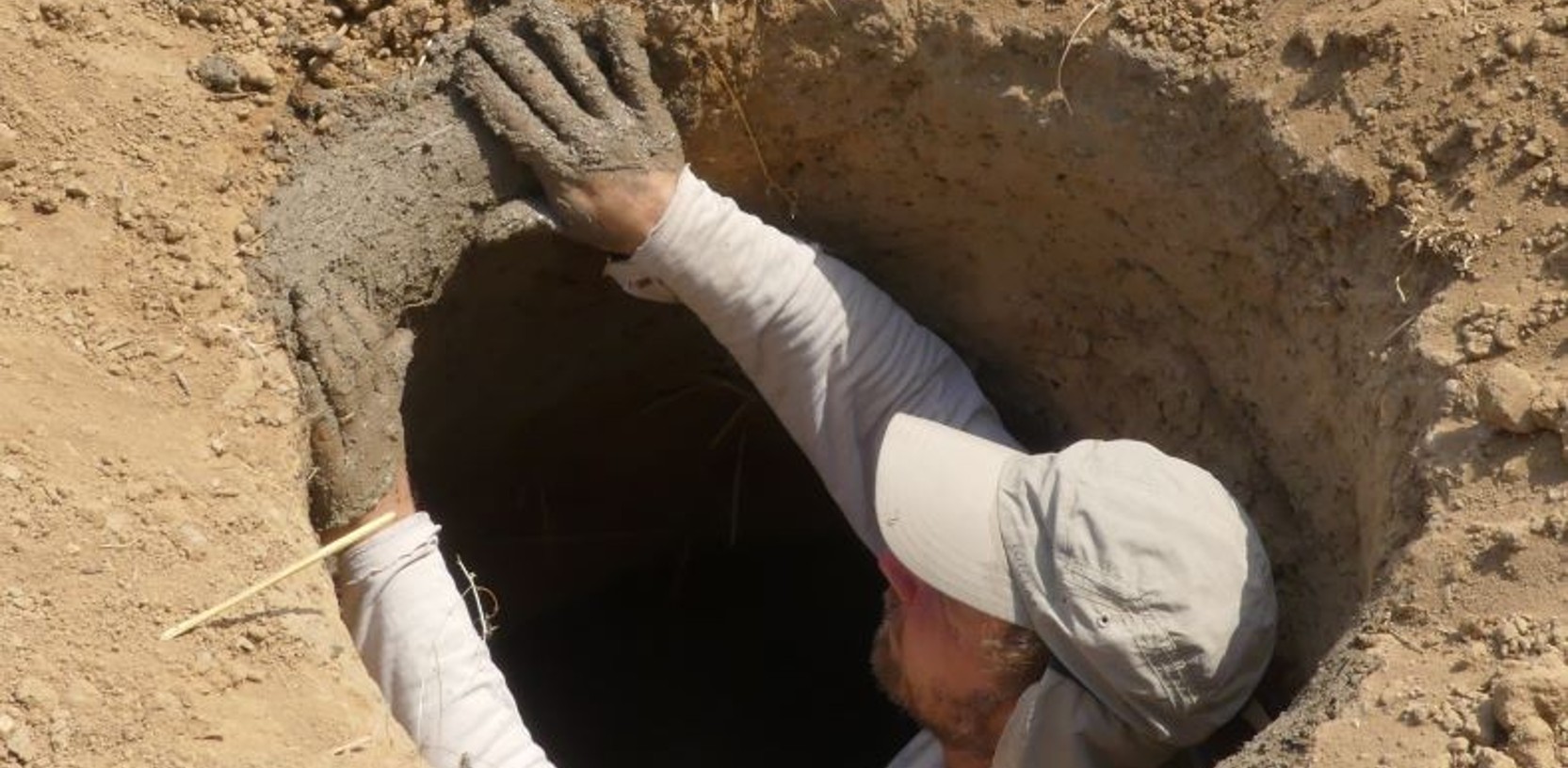
It is essential to remove dust from the substrate to facilitate the application of a slurry (liquid mortar) to the walls of the neck. Next, a plastic render containing few or no fibres needs to be firmly pressed on the cleaned substrate using a sideways motion of the hand to ensure good adhesion to the wall surface (See Figure 10). This first layer, less than a centimetre thick and applied over the full height of the neck, dries fairly quickly. It ensures the adhesion of the other layers and seals the joint between the surrounding ground and the plug. It has to be extended beyond the top of the walls down to ground level, closely following the angle between the neck and the ground (See Figure 11).
It is then important to seal and fill the central part of the neck using a series of ESM discs stacked one on top of the other. The first is firmly packed onto the layer of straw placed over the stockpile, whilst the last reaches ground level. It is widened to form a slab covering the ground around the neck, thus creating a disc several centimetres thick and 1.30 m in diameter, equivalent to the storage chamber, which will support the dome. Each disc layer is formed from rolls of material less than 10 cm thick, which are highly pliable and rich in long straw fibres. These are first applied around the perimeter, starting at the edge of the wall, and then pressed tightly together as they work their way towards the centre (See Figure 12a, 12b). Each disk is pressed down onto the previous one using the fist or trampled underfoot for the final layers. This creates a compact mass of ESM that bonds firmly to the wall. To reduce the amount of water, the middle discs of the filling can be replaced with well-compacted dry soil, provided it is sandwiched between two ESM discs.
This device, which fills the opening to the silo prevents rodents from entering if the surrounding environment is favourable. Indeed, from the very first test, we observed that a tunnel dug by a rodent did not pass through the ESM but tended to go round it on the outside, unable to penetrate inside. This material is certainly not impassable, but it acts as a sufficient deterrent, compared to natural soil, which, although compact lacks fibres. This is probably due to the silica content of wheat straw and exogenous grit and dust which, when mixed with the soil, wears down the rodents’ teeth (Malrain, 2002, p.92). Note that in 2020, a year marked by severe drought, a tunnel dug into the natural soil, running alongside the ESM to a depth of over 60 cm, likely dug by a rodent seeking cooler conditions, reached the level of the stock without, however, breaching the ESM barrier (See Figure 13a, 13b). However, it induced a watercourse causing the rotting and loss of half the grain stock.
Development of a reliable protocol for the implementation of ESM, regarding the surface protective dome
The construction of an earth dome on the upper disc (See Figure 14), above the pit opening, provided effective protection against the elements. During the initial campaigns, the dome covered the access opening with a slight overhang, giving it a diameter of approximately 80 cm. The risk of percolation from the surrounding soil after rainfall led to adjusting the dome's diameter to that of the storage chamber (130 cm). To maintain a 3 % slope suitable for surface water drainage, the dome's height was increased from 0.30 m to 0.50 m. Initially constructed entirely of ESM, it has been supplemented by a dry earth core on the disc at ground level, followed by the application of a layer of ESM. This layer must contain long fibers, manually embedded in the surface. The long fibers can be oriented like the spokes of a bicycle wheel to induce a rapid flow of water towards the periphery of the dome (See Figure 15). At the central part of the neck, the dry earth core reduces the moisture content of the protection system and makes installing and removing the plug easier and faster, while maintaining its effectiveness.
Development of a reliable protocol for the implementation of ESM, regarding the use of ESM inside the storage chamber
The application of a thick ESM coating to the chamber wall was tested. Only the practical aspects of implementation are described here. The consequences for storage quality will be presented in another article. The Alénya site where silos had been archaeologically excavated, has a silt substrate with two layers of sand, making mechanical adhesion difficult. The fiber-reinforced coating was held in place by a long-fiber reinforcement supported by reed tenons driven into the chamber wall (See Figure 16). At the Perpignan site, which has a soil composed of very compact clays mixed with quartz pebbles, the viscous coating was easily applied using clay extracted from the site, simply sieved and applied to the damp walls.
Conclusion
Over the course of ten years of experimentation, we have experienced both success and failures, which have led us to revise the formula used to reduce the amount of water in the preparation of the ESM. This mixture must not be too wet, as water accelerates grain deterioration and can lead to premature germination. Furthermore, the manufacturing process has evolved towards simplification and mechanisation. Various implementations have therefore been adapted empirically and pragmatically to better protect the stored grain, while reducing the amount of ESM used in favor of dry soil in the upper part of the neck and in the center of the protective dome on the surface. This dome is now ultimately protected by a 2 cm to 3 cm layer of ESM applied to its top, which is reinforced with long fibers placed radially, protecting the dome from rain erosion. The "upside-down hat" shape was adopted for the plug to guarantee an effective barrier against rodent intrusions and, more importantly, a true airtight seal, creating a confined atmosphere. It consists of a continuous 3 cm to 5 cm layer of ESM extending from the top of the straw layer at the top of the stockpile and against the vertical walls of the neck down to the large 1.60 m diameter disc at ground level at the base of the dome. ESM is well-suited to the various stages of grain stock protection as well as structural repairs after degradation. Degradation can include damage to the neck walls during opening, wear and tear cracks, or even rodent burrows. The main drawbacks are, of course, the time and effort required to prepare and handle it, compared to using dry earth, as well as the difficulty in determining the right amount of water needed for preparation.
Acknowledgements
This work was supported by the National Research Agency of France, ANR: Grant ANR-21-CE27-0013.
We thank Maïder Abadie (INRAE) for the laboratory analyses she performed.
Tanguy Wibaut warmly thanks Eric Yebdri and Cécile Dominguez (Inrap) for calling upon his expertise as an archaeologist specializing in earthen architecture to explore and work on optimizing the airtight sealing of the silo pits.
Country
- France